
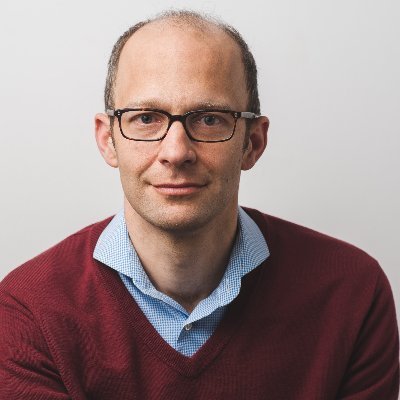
The RFBerlin Applied Economics Seminar series brings leading researchers to Berlin to share their latest work and engage with our community. We are pleased to welcome Fabian Lange (McGill University) for this session, where they will share their work.
Fabian Lange completed his Ph.D. in economics at the University of Chicago in 2004 and subsequently joined the Department of Economics at Yale University. In 2012, he joined the department of economics at McGill University. At McGill he is the director of the Industrial Relations program.
In labor economics, his research interests concern how careers are shaped by processes of information revelation. In particular, he focuses on the role of performance management systems in modern corporations and on employer learning.
Event Topic
Predicting Labor Force Types
A small group of people accounts for a large majority of flows between labor market states and of spells in un- and non-employment. In this paper, we ask whether it is possible to identify those weakly attached to the labor market during their prime working-age years using information available early in their lives. First, we use information on labor force transitions between ages 30 and 50 contained in the long panel provided by the NLSY 1979 to identify those weakly connected to the labor market during their prime age. To do so, we use k-means clustering on a set of moments on observed spells in employment, unemployment, and non-employment between 30 and 50. This yields a group of disproportionally female, less educated individuals in poor health whose weak attachment is already evident before age 30. In a second step we predict, using information collected at various points before age 30 – which we do not use in clustering – whether individuals will turn out to belong to the weakly attached type in their prime age. We find that information from ages 22 to 29 allows predicting membership of the low-attachment group with high precision. Particularly influential is information on early labor market experiences and health.
Event Details:
Date: 8 May 2026
Time: 14:00–15:15
Participation: the seminar is open to the public and targeted to an academic audience.
If you have any questions or need further information, feel free to contact us using the form or email us at [email protected]
