









We conduct independent research into significant challenges to the economy, society and the welfare state in a global world.
Become part of our research team
Research
The ROCKWOOL Foundation Berlin Institute for the Economy and the Future of Work (RFBerlin) engages in research designed to raise the standard of public debate and create the best possible basis for policy making.
Discussion papers
No. 54/26 - February 2026
Social Mobility in Western Countries: The Role of Families, Networks, and Institutions
Martin Nybom, Kjell G. Salvanes, JosΓ© V. RodrΓguez Mora
No. 53/26 - February 2026
Behavioral Responses to Estate Taxation: Evidence from Taiwan
Hsien-Ming Lien, Linda Wu, Tzu-Ting Yang
No. 52/26 - February 2026
Internal Pay Equity and the Quantity-Quality Trade-Off in Hiring
Michael Amior, Shmuel San
No. 51/26 - February 2026
Using distributional random forests for the analysis of the income distribution
Martin Biewen, Stefan Glaisner, Simon Zeller
Research Insights
Concise, research-based articles for scholars,
policymakers, and anyone curious about the world.

No. 3/26 - February 2026
Why Some Refugees Struggle to Work: The Role of Early Signs of PTSD
Refugees often have lower employment rates than natives and other migrants. One important reason may be exposure to severe trauma, which can affect how people function in daily life and make it harder to find and keep a job.
Learn more
No. 2/26 - February 2026
Too Old to Apply for a Job? How Age Limits in Job Ads Shape Who Applies
As populations age, keeping people in work later in life has become an economic necessity. Yet many older job seekers still face substantial barriers to reemployment.
Learn more
No. 1/26 - January 2026
From Steam Power to Artificial Intelligence: What the Past Can Teach Us About the Future of Work
Regional inequalities remain a central issue in public and policy debates. Where do such disparities originate? And what policies can reduce them? A new study traces these inequalities back to the introduction of a transformative technology: the steam engine.
Learn moreNews
RFBerlin research and researchers are regularly featured in the press.

18 Feb 2026
German Media Highlights RFBerlin Study: Trauma as Hidden Barrier to Refugee Employment
View article
17 Feb 2026
Trauma is a major barrier to refugeesβ employment, new study finds
View article

15 Jan 2026
The steam engine still drives the German economy – Lessons for the introduction of artificial intelligence
View articleTweets by @RF_Berlin
π§ New RFBerlin Research Insight!
Why do some refugees struggle to find work, even years after arrival? For many, the barrier isn’t language or skills, it’s trauma.
@MetteFoged_econ, Karen-Inge Karstoft & Edith Zink show that early signs of PTSD have a lasting impact on
If youβre a bachelor or master in economics, statistics, or data science, this is for you!
RFBerlin is looking for a Research Assistant to work on a research project that evaluates a collective bargaining reform using Danish data.
π
#EconJobs
Upcoming events
RFBerlin hosts a wide array of events aimed at fostering academic research and collaboration.
RFBerlin Applied Economics Seminar
27 February 2026
Philip Oreopoulos (cancelled)
cancelled
RFBerlin Masterclass
12 Mar β 13 Mar 2026
“Tasks At Work: Comparative Advantage, Technology and Labor Demand” by Fredric Kong
Handbook of Labor Economics β Chapter Previews
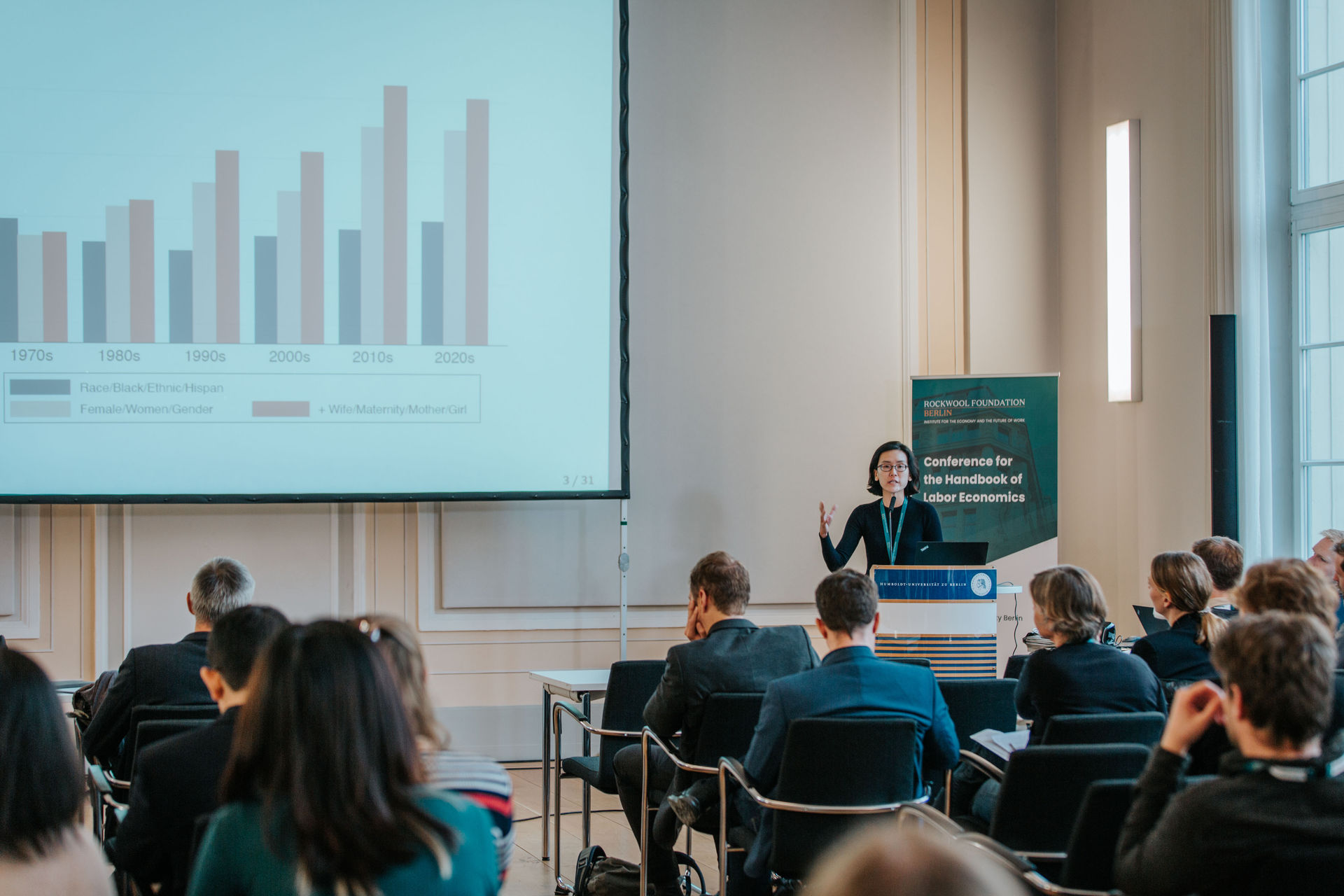
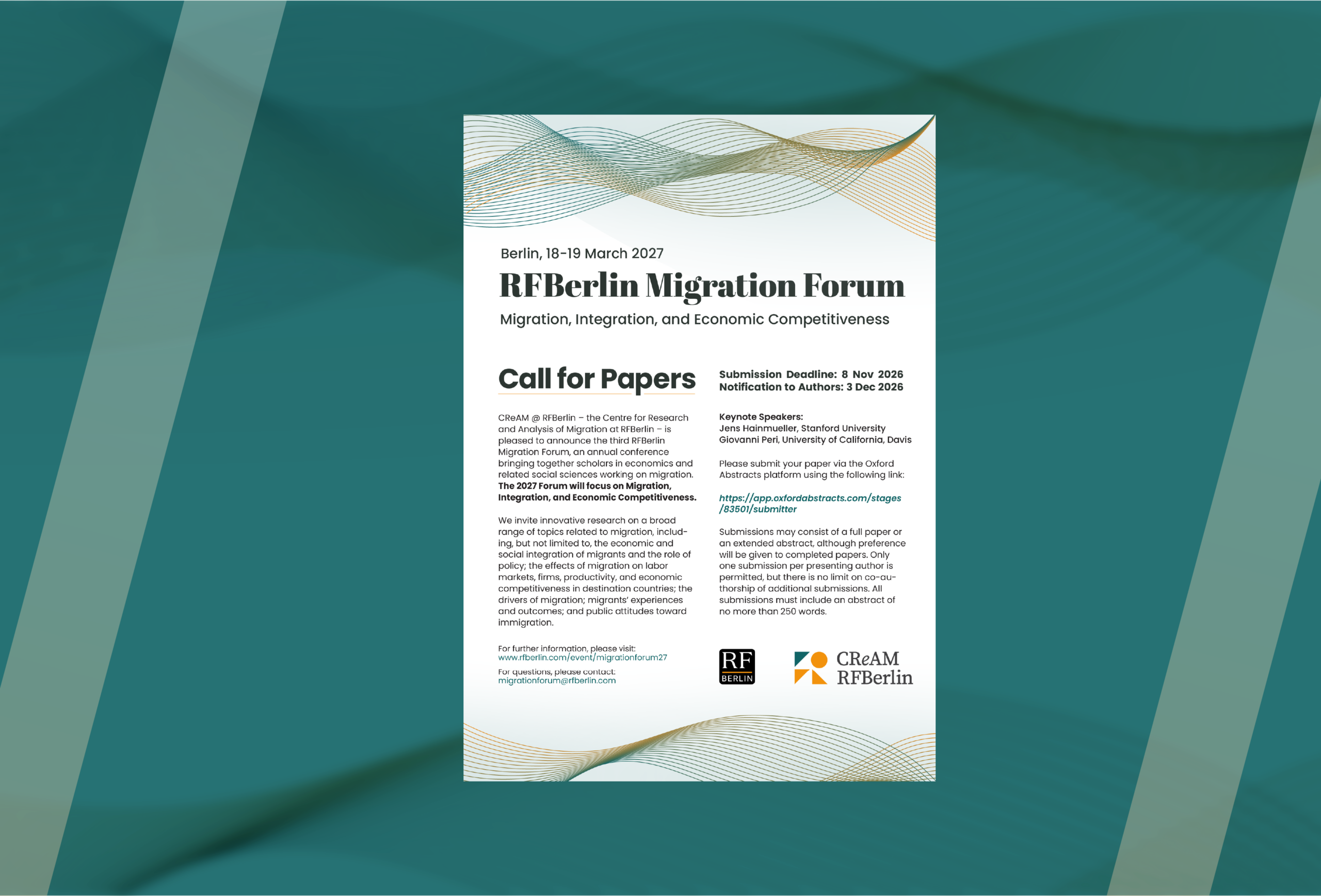
In anticipation of the upcoming Handbook of Labor Economics, we offer early access to select chapters through our Discussion Papers series. Following our 2023 conference on this new edition, first chapters are now available for preview, featuring insights from leading research in economics and labor.

Sign up to our newsletter
Keep up to date with upcoming RFBerlin events, our new research and other news from our research centre.