

Short summary
Does the state of the economy matter when immigrants arrive in a host country? Our study shows that it does – and the effects can last for years.
Using US Census data for the period 2010-2019, we find that immigrants who migrate during a recession earn significantly less than those arriving in better times. A one percentage point increase in the unemployment rate at the time of arrival (for example, an increase from 4 to 5 percent) reduces immigrants’ annual earnings by almost 4 percent in their first year. Twelve years later, earnings are still about 1.4 percent lower. These losses are not temporary, and for many workers, they shape their entire career path.
The main driver is that immigrants who arrive during a downturn are more likely to start in low-paying jobs. Many of them struggle to move out of these adverse working conditions. This initial sorting into worse occupations explains most of the long-term earnings gap. The effect is not uniform across immigrants: men without a college degree from low-income countries suffer the largest and most persistent losses. Women, college-educated migrants, and immigrants from high-income countries are largely unaffected. Overall, entering the labor market of a host country during recessions costs affected migrants between 1.6 and 2.4 percent of their lifetime earnings.
Key Findings
- A 1 percentage point higher unemployment rate at arrival reduces annual earnings by 4% in the first year.
- Earnings remain 1.4% lower even 12 years after arrival.
- A typical recession shock (4 percentage points) implies a 10% earnings loss on impact.
- Immigrants entering during downturns are 2–3% more likely to work in low-paying occupations.
- Lifetime earnings losses amount to 1.6–2.4% of total career income, largely driven by occupational sorting.
Relevance Today
Migration often coincides with economic uncertainty. In the aftermath of the COVID-19 recession and amid ongoing geopolitical instability and labor market volatility, understanding how timing of migration affects integration in the labor market is crucial. The absence of immigration policies that account for the business cycle conditions is likely to translate into persistent scarring effects on immigrants’ career trajectories and economic assimilation. Our findings suggest that facilitating immigrants’ occupational upgrading may be key to long-run economic outcomes.
Author Quote
“Our results shed light on the determinants of immigrants’ labor market careers and suggest that the earnings cost of the business cycle fluctuation is likely to be larger once the long-term effects of recessions on immigrants are factored in.”
Based on “Unlucky Migrants: Scarring Effect of Recessions on the Assimilation of the Foreign Born”, Labour Economics, (2025) 92: 102667, Gabriele Lucchetti and Alessandro Ruggieri.
Research summary
When Timing Shapes a Career
The United States attracts more immigrants than any other country in the world, and immigration remains a highly debated topic in domestic politics. Between 2023 and 2024 alone, approximately 2.8 million foreign-born individuals migrated to the country. For many, migration can offer a route to economic opportunity and upward mobility. But economic downturns at the time of arrival may put that promise at risk.
Our study shows that immigrants who enter the labor market of a hosting country during periods of high unemployment experience lasting earnings losses. A one percentage point increase in the unemployment rate at the time of entry reduces annual earnings by about 3.9 percent in the first year. These effects are not short-lived. Instead, they shape the earnings trajectories for more than a decade: after eight years, earnings are still 2.5 percent lower and even twelve years after arrival, the gap remains around 1.4 percent.
Figure 1: The evolution of the native–migrant earnings gap by years since migration
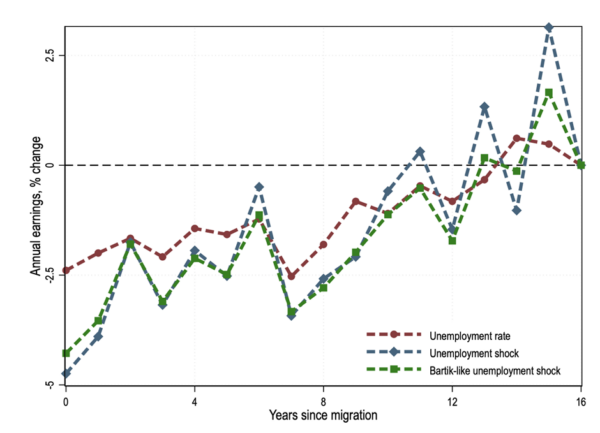
Note: The figure shows how the earnings gap between immigrants and the average US native evolves over the first 16 years after migration. The estimates are based on a regression of earnings gaps on the unemployment rate at the time of labor market entry, allowing the effect to vary by years since migration, and controlling for entry-cohort and years-since-migration fixed effects.
For comparison, a recession characterized by an increase in unemployment of about four percentage points translates into a roughly 10 percent earnings drop on impact and nearly 6.5 percent lower earnings after eight years.
Why This Matters
The labor market integration of immigrants is central to debates on migration policy, asylum systems, fiscal sustainability, and social cohesion. Although immigrants’ earnings typically converge toward those of natives over time, the speed and extent of this convergence may depend critically on conditions at entry. While prior research shows that graduating during a recession generates persistent career penalties, much less is known about whether similar scarring effects arise when immigrants enter the labor market during economic downturns.
Since 1990, the United States has experienced four major recessions. Over the same period, the immigrant population has doubled in size and it’s at the core of US internal political debate. Understanding the long-term consequences of labor market entry in periods of recession is therefore crucial to ensure successful economic integration and promote the efficient allocation of skills in the labor market.
Identifying the Effect of Recessions
Using data from the American Community Survey, we identify migrants who entered the US between 1990 and 2021, track them across different cohorts over time and compare their earnings paths to those of natives. A key challenge to measure the effects of recessions on immigrants’ labor market integration, is that migrants may time their arrival based on economic conditions. If people delay migration during bad times, we might underestimate the true effect of recessions. To address this, we relate their labor earnings to the unexpected changes in unemployment rates, that is, the deviations from what could have been predicted based on past economic information. These unexpected deviations are unlikely to influence migration decisions but directly affect realizations of labor market outcomes across cohorts.
What Drives the Earnings Loss?
One might expect higher unemployment or fewer hours worked to explain lower earnings. However, we find no systematic effects on employment probabilities or hours worked. Instead, the main mechanism is that immigrants start in lower-paying occupations.
Immigrants entering during downturns are significantly more likely to start in low-skill, low-paying occupations. A one percentage point increase in unemployment raises the probability of working in a routine, low-paying occupation by about 2–3 percent on impact and around 0.7 percent even twelve years later.
Figure 2: Probability of working in low-paying occupations by years since migration
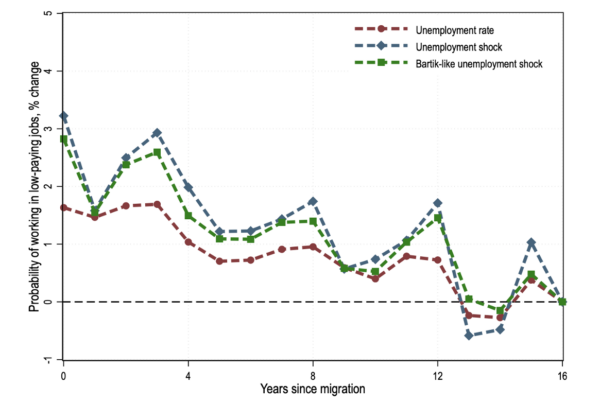
Note: The figure shows how the gap between immigrants and US natives in the probability of working in a low-paying job evolves over the first 16 years after migration. The estimates come from a regression of this gap on the unemployment rate at the time of labor market entry, allowing the effect to vary by years since migration, and controlling for entry-cohort and years–since-migration fixed effects.
Starting in a low-paying job can slow future mobility, because skills accumulate within occupations. Our counterfactual analysis shows that without this shift toward lower-paying occupations, the earnings loss at entry would be less than one-fourth as large and would fade much faster. In other words, most of the long-term earnings gap arises from initial occupational placement.
Who Is Most Affected?
The effects of entering the labor market during a recession are not uniform.
- Male migrants without a college degree from low-income countries experience large and persistent losses.
- Women show no statistically significant earnings losses from entering during a recession.
- College-educated migrants are largely unaffected.
This pattern suggests that vulnerability in the labor market interacts with business cycle conditions. Those who may be already disadvantaged face the largest scarring effects.
The Lifetime Cost
What do these persistent earnings gaps mean in practice? We estimate significant earnings losses over an entire immigrant’s career. We show that entering during a period of high unemployment reduces immigrants’ lifetime earnings between 1.6 and 2.4 percent. Around two-thirds of this loss can be traced back to occupational sorting into lower-paying jobs.
Policy Implications
Short-term employment statistics may underestimate the lasting impact of recessions on immigrant integration. Even when employment recovers quickly, early occupational downgrading can leave persistent scars on immigrants’ careers. Policies that help move immigrants into better jobs, such as the recognition of foreign qualifications, targeted job placement programs, or timely retraining, may help mitigate these long-term effects.
Our findings suggest that economic downturns leave lasting marks on immigrants’ career trajectories. Integration policies should therefore take economic conditions into account, and broader efforts to stabilize the economy can play an important role in shaping immigrants’ long-term outcomes.
Conclusion
Migrating during recessions leaves a lasting mark on immigrants’ careers. Earnings losses persist for more than a decade and translate into measurable lifetime income losses. The mechanism is not higher unemployment or fewer working hours, but early placement in low-paying occupations that slows upward mobility.
Future research could validate our analysis of the case of European countries. They should also aim at understanding in more detail which occupations are the most vulnerable to the business cycle and how this interacts with foreign-born workers’ career paths. Immigrant integration is not only about who arrives, but also when they arrive.
Disclaimer
The opinions and views expressed in this publication are those of the author(s) and do not necessarily reflect those of the ROCKWOOL Foundation Berlin (RFBerlin). While research disseminated through this series may address policy-relevant topics, RFBerlin, as an independent research institute, does not take institutional policy positions.
Publications in the RFBerlin Research Insights series may represent preliminary or ongoing work that has not been peer-reviewed. Readers are advised to consider the provisional nature of such research when citing or applying its findings.
These publications aim to make scientific work accessible to a broader audience and to encourage informed, research-based discussion. All materials are provided by the respective authors, who bear responsibility for appropriate attribution and rights clearance. While every effort has been made to ensure accuracy and proper acknowledgment, RFBerlin welcomes notifications of any concerns regarding authorship, citation, or intellectual property rights. Please contact RFBerlin to request corrections if needed.
Use of these materials for the development or training of artificial intelligence systems is strictly prohibited.
