



Short summary
How can foreign managers change local workplace culture? In our recent study (Minni et al., 2026), drawing on data from a large multinational firm, we show that international manager rotations can shift cultural norms inside organizations. We focus on the widely discussed issue of the gender pay gap and find that managers from countries with more gender-progressive attitudes significantly reduce pay disparities within their teams. After exposure to such managers, the gender pay gap falls by nearly 20 percent, and women are more likely to be promoted into higher-paying roles.
Importantly, these changes do not remain confined to a single team. The effects spread both vertically and horizontally within the firm. Local managers who work with or under gender-progressive foreign managers later adopt similar practices in their own teams. As a result, the effects persist even after the foreign manager has left the organization. This suggests that managerial practices can transmit cultural norms that shape workplace decisions about promotions, task allocation, and career progression.
These results highlight an often overlooked role of managers inside organizations. Managers do not only affect performance through supervision or incentives. They can also transmit cultural norms that shape workplace opportunities. Understanding this mechanism may help explain why some organizations adopt more gender-egalitarian practices faster than others.
Key Findings
- The gender pay gap on teams that are exposed to a gender-progressive foreign manager during an international rotation narrows by nearly 20%.
- The main driver behind the narrowing of the gender pay is promotions: women are 4.8 percentage points more likely to be promoted after exposure to a gender-progressive foreign manager.
- These effects persist after the rotations end: local managers who are exposed to a gender-progressive foreign manager continue to promote women and increase pay for female workers at a higher rate.
- This type of cultural transmission extends beyond the gender pay gap, shaping broader managerial practices and workplace norms within the firm.
Relevance Today
Despite decades of progress, gender gaps in the labor market persist. Our study exposes a way to narrow that gap. Worldwide, policymakers are intensifying efforts to reduce persistent pay, promotion, and leadership gaps between men and women workers. The EU Pay Transparency Directive renewed debates over board gender quotas and growing pressure for corporate diversity all reflect a common concern: despite decades of progress, gender disparities within firms remain substantial. Cultural transmission via manager rotations can play an important role in shifting these workplace norms.
Author Quote
“This suggests that expat managers influence the practices and culture of the destination office not only through the direct impact on their immediate subordinates, but also through a broader set of workplace contacts that allow norms and managerial styles to diffuse across peers and down the hierarchy.”
Reference: Based on RFBerlin Discussion Paper No. 40/26: Minni, V., Nguyen, K.-T., Sarsons, H., and Srebot, C. (2026). Managers and the Cultural Transmission of Gender Norms.
Research summary
We all know that the gender pay gap exists, but what can we do to narrow it? Policymakers across the world have wrestled with this persistent problem, and though some short-term solutions have had real effects, this disparity remains substantial. A persistent issue like this warrants a long-term solution. If this is a cultural issue, how can cultural norms be changed? The answer lies in cultural transmission, and our research gives insight onto how managers, specifically on international rotations, can wield this power to drive cultural change that radiates from their team into the rest of the firm.
International rotations are increasingly popular for multinational corporations. Managers from foreign cultures are brought in to temporarily manage a team based in a different country. The main reason for these types of rotations is to spread exposure to talented managers across the firm. We find that managers who are selected for international rotations tend to enjoy higher early career success than average. A large body of research has highlighted less obvious ways in which managers affect firm productivity, such as through their influence over internal job allocation. But how do these foreign managers’ cultural norms impact the lasting influence they have on their rotational team? We used years of personnel records from a large multinational firm to understand the answer to this question.
First, we had to understand and classify the inherited gender attitudes that managers bring with them on these international rotations. We determined this by using average gender attitudes of individuals from the same origin country and birth cohort in the World Values Survey. Using this data, we specifically studied cultural norms surrounding women in the workplace by country of origin and determined how progressive or conservative a manager’s attitudes were likely to be in the workplace.
Using records of manager rotations from the multinational firm, we first tried to establish the effects of these international rotations. A team with a rotating foreign manager generally enjoys improved outcomes along lines of pay, promotion, and career success when compared to a team with a manager from the local culture. As our case study focused specifically on the gender pay gap, we then compared gender pay gaps before and after teams were exposed to foreign managers who were either from cultures where norms were more gender-progressive or gender-conservative relative to the local culture.
Rotational managers from cultures with more gender-progressive norms significantly reduce the gender pay gap within their team. The gap narrowed by 4.9 percentage points: an 18% decline relative to the baseline gap. This change was purely from women’s pay rates increasing, male workers on this team did not have an adverse decrease or stagnation in pay. Additionally, having a foreign rotational manager with more gender-conservative norms did not increase the gender pay gap more than having a manager from the local culture would. This pay gap narrowing effect is particularly strong in offices with a local culture that is more conservative when it comes to gender workplace norms.
These foreign managers, as cultural outsiders, are able to operate with less baggage from persistent cultural mores and existing networks in the local firm office and thus can be much more direct in driving change and reshaping workplace practices. This shifting of cultural norms continues even after the international rotation has ended (Figure 1) But how do these long-term changes manifest themselves within the firm?
Figure 1. Evolution of impact of expat manager’s gender norms on the gender pay gap
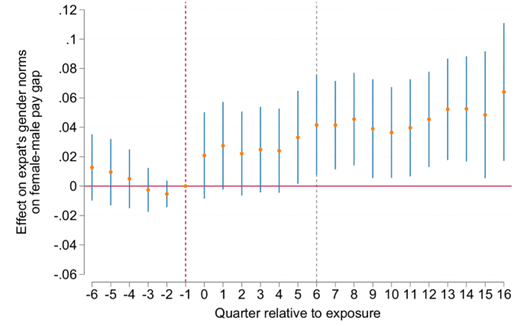
Notes: This figure shows event-study estimates of the impact of expat managers’ gender norms on the within-team gender pay gap over time. The coefficients capture how the female–male pay gap evolves before, during, and after exposure to the expat manager, relative to the period just before exposure. On average, exposure lasts about six quarters. The sample includes workers observed for at least three months both before and after exposure. Error bars represent 95% confidence intervals, with standard errors clustered by worker and by the expat manager’s home country × worker’s gender.
We find the main driver of this pay gap narrowing is female employees being promoted into better-paying roles under foreign gender-progressive managers. These might be formal promotions into higher roles, but also lateral reallocation across different tasks and functions to match female employees with jobs that are a better fit and come with increased pay. Another driver is that, after exposure to a gender-progressive manager on rotation, women are much less likely to leave the firm. Within the firm, these managers help improve workplace satisfaction and perception of managerial effectiveness. The gap isn’t just narrowed with hiring decisions, but by reshaping promotions, job allocations, and career trajectories of team members.
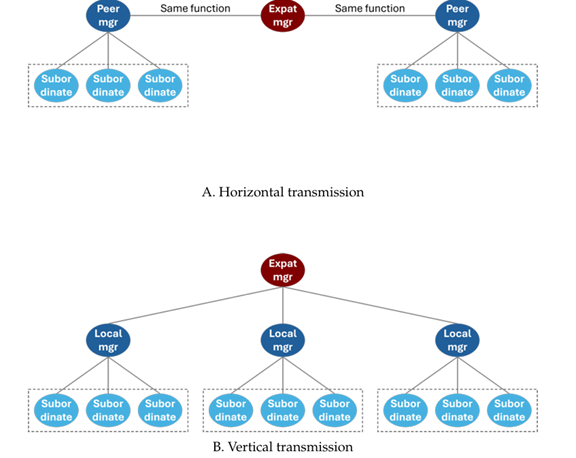
We also found norms shift in local managers who worked under or alongside these gender-progressive foreign managers during international rotations. Both peer managers (who worked laterally with foreign managers) and subordinate managers (who were managed by these foreign managers) from the local offices improved pay for women employees (Figure 2). The increased pay for women likely also reflects a more equal representation of women in higher positions within the firm: another long-term shifting of social norms. This is indicative of norms changing across the entire firm and not just within the scope of an individual team. Cultural transmission can spread through the roots of an entire firm, even long after the architect of change is gone.
Figure 2
Policy Implications
Formal policies such as pay transparency rules, quotas, anti-discrimination enforcement, and hiring targets are among the most widely discussed tools to reduce the gender pay gap. While these measures can be effective, they often focus on hiring and reporting requirements rather than the internal decisions that shape employees’ careers once they are already inside the firm. Our findings highlight a different channel: cultural transmission through managerial practices.
Foreign managers on international rotations may be uniquely positioned to influence workplace norms. As cultural outsiders, they can challenge existing expectations and reshape how managers evaluate employees, allocate tasks, and promote workers. This suggests that international rotations may have organizational benefits beyond knowledge transfer or leadership development. They can also help diffuse more gender-egalitarian workplace norms across teams and managerial layers.
Conclusion
This study shows that managers can influence organizations not only through supervision or incentives, but also through the transmission of cultural norms. Exposure to managers from more gender-progressive cultures significantly reduces the gender pay gap within teams and increases women’s promotion rates, with effects that persist over time and spread across the firm. While our analysis focuses on one multinational company, the results raise a broader question for future research: to what extent can managerial mobility help diffuse more inclusive workplace practices across firms and countries?
References
Alesina, A, P Giuliano and N Nunn (2013), “On the origins of gender roles: Women and the plough”, Quarterly Journal of Economics 128(2), 469–530.
Bertrand, M (2011), “New perspectives on gender”, in Handbook of Labor Economics, Vol. 4B, Elsevier, 1543–1590.
Bertrand, M and A Schoar (2003), “Managing with style: The effect of managers on firm policies”, Quarterly Journal of Economics 118(4), 1169–1208.
Bisin, A and T Verdier (2001), “The economics of cultural transmission and the dynamics of preferences”, Journal of Economic Theory 97(2), 298–319.
Bloom, N and J Van Reenen (2011), “Human resource management and productivity”, in Handbook of Labor Economics, Vol. 4B, Elsevier, 1697–1767.
Fernández, R and A Fogli (2009), “Culture: An empirical investigation of beliefs, work, and fertility”, American Economic Journal: Macroeconomics 1(1), 146–177.
Giuliano, P (2021), “Gender norms and economic outcomes”, Annual Review of Economics 13, 663–687.
Guiso, L, P Sapienza and L Zingales (2015), “The value of corporate culture”, Journal of Financial Economics 117(1), 60–76.
Levy Yeyati, E and M Gonzalez Rozada (2018), “The ‘ask gap’: New evidence on the supply side of the gender wage gap”, VoxEU.org, 7 September.
Minni, V, K-T Nguyen, H Sarsons and C Srebot (2026), “Managers and the Cultural Transmission of Gender Norms”, Working paper.
Minni, V (2025), “Good managers, better matches: Job allocation effects on worker productivity ”, VoxEU.org, 10 February.
Minni, V (2026), “Making the invisible hand visible: Managers and the allocation of workers to jobs.”, Quarterly Journal of Economics, Forthcoming
Olivetti, C, E Patacchini and Y Zenou (2020), “Mothers, peers, and gender-role identity”, Journal of the European Economic Association 18(1), 266–301.
Schivardi, F, M Macis, A Moro and L Flabbi (2015), “Female executives and gender wage gaps”, VoxEU.org, 24 April.
Disclaimer
The opinions and views expressed in this publication are those of the author(s) and do not necessarily reflect those of the ROCKWOOL Foundation Berlin (RFBerlin). While research disseminated through this series may address policy-relevant topics, RFBerlin, as an independent research institute, does not take institutional policy positions.
Publications in the RFBerlin Research Insights series may represent preliminary or ongoing work that has not been peer-reviewed. Readers are advised to consider the provisional nature of such research when citing or applying its findings.
These publications aim to make scientific work accessible to a broader audience and to encourage informed, research-based discussion. All materials are provided by the respective authors, who bear responsibility for appropriate attribution and rights clearance. While every effort has been made to ensure accuracy and proper acknowledgment, RFBerlin welcomes notifications of any concerns regarding authorship, citation, or intellectual property rights. Please contact RFBerlin to request corrections if needed.
Use of these materials for the development or training of artificial intelligence systems is strictly prohibited.
