
Short summary
What happens after a far-right protest ends? Our recent paper (Sardoschau and Casanueva-Artís, 2026) shows that the effects do not stop when the crowd goes home. Studying PEGIDA, the largest far-right protest movement since World War II, and its offshoots we find that protests held during pleasant weather drew larger crowds, received more attention in newspapers and on social media, and were followed by more hate crimes against refugees.
The key message of our study is that visibility of far-right protest matters for the onset of politically motivated violence. Because PEGIDA’s Monday protests were announced and scheduled in advance, short-run local weather conditions mainly changed how many people showed up and how much attention the protest received, not whether the protest happened at all. When a scheduled protest took place on a pleasant day, the probability of a hate crime in the same town or city later that week rose by 8.6 percentage points. The increase came mainly from lone actors and perpetrators already known for extremist behavior.
The effects also spread beyond the protest location. Newspaper coverage of PEGIDA protests and PEGIDA-linked social media networks increased hate crimes in places that did not host a protest. Newspaper coverage of counter-protests had the opposite effect and reduced hate crimes.
Key Findings
- Pleasant weather increased turnout at scheduled PEGIDA Monday protests by 47 percent.
- It raised newspaper coverage by 34 percent and PEGIDA-related tweets by 23 percent.
- The probability of a hate crime later that week rose by about 9 percentage points after a pleasant-day protest.
- The rise came mainly from lone actors and known extremists.
- Exposure to newspaper coverage of counter-protests reduced hate crimes elsewhere.
Relevance Today
Our study speaks directly to debates on how democracies should respond to far-right street mobilization while preserving freedom of assembly. Its message is that the policy question is not only whether a protest takes place, but also how strongly it is amplified afterward. That has implications for policing, newsroom decisions, and the moderation of extremist content online.
Author Quote
“The key risk is not only that a far-right protest happens. It is that a protest becomes highly visible. When that happens, anti-minority violence increases locally but it also spreads beyond protest locations.”
Reference: Based on RFBerlin discussion paper 73/26 Right-Wing Protest and Hate Crimes by Sulin Sardoschau and Annalí Casanueva-Artís, March 2026.
Research summary
Germany’s refugee crisis did not only reshape politics, it also changed what happened in the streets. In our recent paper we study the impact of far-right protest movements on politically motivated violence. When protests drew more attention, hate crimes against refugees rose soon afterward. The effects were local, but they also spread through newspapers and PEGIDA-linked online networks.
PEGIDA emerged in late 2014 and built its mobilization around regular Monday demonstrations. The movement spread from Dresden to other cities during the refugee crisis. We have tracked 475 protests, including PEGIDA Monday protests as well as protests organized by other far-right actors and more than 9,000 hate crimes against immigrants, minorities, refugees and refugee housing across Germany. This setting lets us study whether far-right mobilization encourages people to exert violence against minorities after the protest is over.
This question matters because earlier research has shown that political signals and extremist online content can change behavior offline. This paper adds another channel: the street protest itself. It asks whether protest visibility can embolden violence.
Figure 1: Right-wing protests and hate crimes in Germany over time.
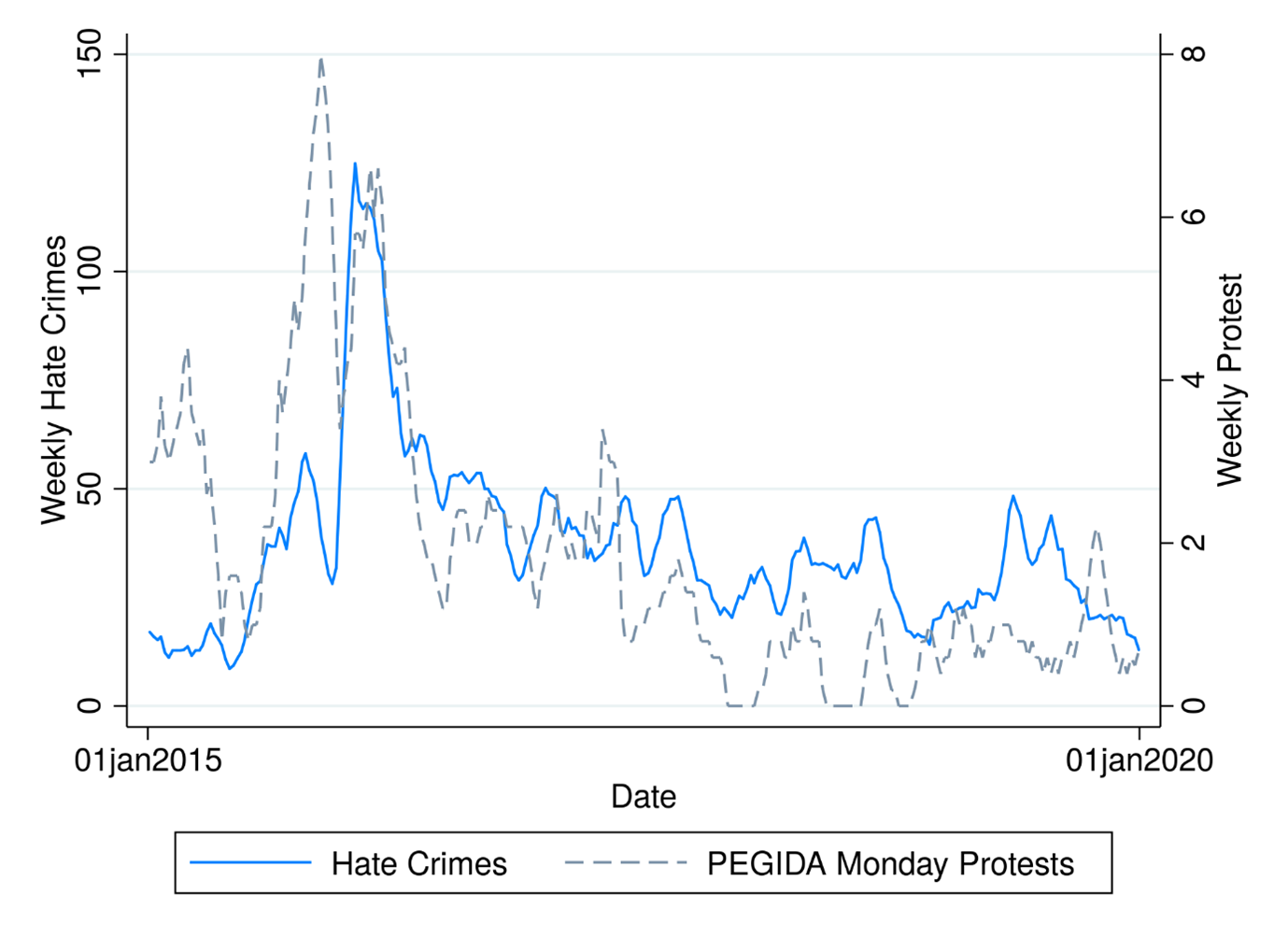
Notes: Figure shows the two-week moving average of the number of scheduled Monday PEGIDA protests (including offshoots and affiliated organizers) and the number of hate crimes across all municipalities.
The first result is that the scale of a protest changes sharply with weather. PEGIDA’s Monday protests were usually announced in advance, and German law required public assemblies to be registered beforehand. So, weather mainly changed how visible a protest became, not whether it took place. The authors compare scheduled protests that happened on pleasant days with those that happened on very hot, cold or rainy days, while comparing the same places over time.
Pleasant days made protests much more visible, as the turnout rose by 47 percent. Newspaper coverage rose by 34 percent. PEGIDA-related tweets from the local area rose by 23 percent. In the six days after those more visible protests, the probability of a hate crime in the same local area increased by 8.6 percentage points.
Our paper shows that this pattern is not explained by a direct effect of pleasant weather on crime. We also show that places with pleasant-day protests were not already on different hate-crime trends before the protest, and that the results do not seem to come from changes in reporting by police or the media. The evidence points to protest visibility as the main driver.
The next question is what kind of violence has increased. The answer is not simply clashes at the rally itself. The effect remains when we focus on the days after the protest. It is not driven mainly by incidents that explicitly happened during rallies or confrontations with counter-protesters. Using detailed descriptions of hate crimes, the paper shows that the increase is concentrated among lone actors and perpetrators already known to police or linked to right-wing extremism. The most plausible reading is that a large, visible protest can make extremist views look more acceptable and can embolden people who were already prone to violence.
Figure 2: Hate-crime characteristics after pleasant-day protests.
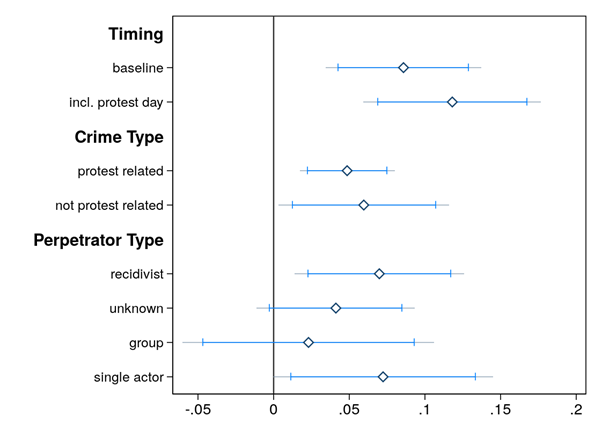
Notes: The increase in hate crimes after more visible protests is strongest for lone actors and known extremists, not only for violence that happened at the protest itself.
We also find spillover effects: areas more connected to protest locations through PEGIDA-specific social media networks experienced more hate crimes following a pleasant-weather protest elsewhere. General social media connectedness and simple geographic distance mattered much less once those PEGIDA-specific ties were taken into account. This suggests that the message spreads most strongly where there is already an audience for it.
Media exposure also mattered. Municipalities with more exposure to newspaper coverage of PEGIDA protests saw more hate crimes even when they did not host a protest themselves. By contrast, exposure to newspaper coverage of counter-protests reduced hate crimes. The same offsetting effect does not appear on social media: pro-refugee tweets did not measurably reduce hate crimes. A likely reason is that likely offenders do not see those messages.
Implications
The policy lesson is not simply to ban protests. In democracies, freedom of assembly is a fundamental right. The paper points to a different margin: amplification. When a far-right protest becomes larger and more visible, the risk of violence rises in the following days and can spread to other places.
Our findings have concrete implications. Police and local authorities may need extra protection for refugee housing and other likely targets after a large protest, not only during it. Newsrooms should be aware that coverage choices have consequences. Our paper suggests that coverage of counter-protests can blunt some spillovers, while coverage that amplifies the protest message can worsen them. Online platforms should also pay attention to movement-specific networks that can turn attention into offline harm.
References
Sardoschau, S. and Casanueva-Artís, A (March 2026), “Right-Wing Protest and Hate Crimes”, RFBerlin Discussion Paper 73/26
Disclaimer
The opinions and views expressed in this publication are those of the author(s) and do not necessarily reflect those of the ROCKWOOL Foundation Berlin (RFBerlin). While research disseminated through this series may address policy-relevant topics, RFBerlin, as an independent research institute, does not take institutional policy positions.
Publications in the RFBerlin Research Insights series may represent preliminary or ongoing work that has not been peer-reviewed. Readers are advised to consider the provisional nature of such research when citing or applying its findings.
These publications aim to make scientific work accessible to a broader audience and to encourage informed, research-based discussion. All materials are provided by the respective authors, who bear responsibility for appropriate attribution and rights clearance. While every effort has been made to ensure accuracy and proper acknowledgment, RFBerlin welcomes notifications of any concerns regarding authorship, citation, or intellectual property rights. Please contact RFBerlin to request corrections if needed.
Use of these materials for the development or training of artificial intelligence systems is strictly prohibited.
