




Short summary
How much do parents shape their children’s future? Many people believe that parenting plays a decisive role in children’s success later in life. But what type of parenting helps children succeed? Our research looks at how different parenting styles are related to children’s outcomes from school all the way into the labor market.
Using long-term data on nearly 3,000 children born in Stockholm in 1953, we examine how parenting style relates to education and life chances decades later. Children raised by more authoritarian parents—those who emphasize obedience and restrict choice—tend to have worse educational outcomes later in life. This does not imply that permissive parenting improves outcomes; rather, it points to risks associated with very strict and controlling parenting. Compared with children raised by the least strict parents, those raised by the strictest parents are about 35 percent less likely to complete a university degree and nearly 7 percent less likely to finish high school. Although we cannot establish causality, these patterns remain after accounting for family socioeconomic background and children’s cognitive test results.
Why might this happen? Parenting shapes how children make decisions and what they aspire to achieve. Parents who rely mainly on strict control may limit children’s opportunities to develop independence and motivation for long-term goals such as education. In line with this, our results also show that stricter parents place less value on their children’s education in the first place. However, this does not imply that a completely hands-off approach is beneficial. Instead, the results suggest that environments combining guidance with opportunities for independence may be important for children’s development.
Understanding how family environments shape children’s outcomes can help policymakers design better policies for families and children. Parenting practices are often discussed in public debates about inequality and social mobility, and our results suggest that the style of parenting itself may play an important role in shaping children’s future opportunities.
Key Findings
- Children exposed to more authoritarian parenting have a 6.6 percent lower chance to finish high school and a 35 percent lower chance to complete a university degree compared to less authoritarian parents.
- These relationships remain even after accounting for family background and children’s results on cognitive tests.
- Other parenting styles such as authoritative and permissive show weaker and less consistent links to long-term outcomes.
- Parenting styles appear to shape children’s educational ambitions and opportunities.
Relevance Today
Debates about inequality of opportunity often focus on schools, neighborhoods, and economic resources. But family environments also play an important role. Discussions about parenting programs, early childhood interventions, and family policy are increasingly central in many countries. Our findings suggest that how parents guide and interact with their children may have lasting consequences for education and social mobility
Author Quote
“The influence of parenting styles appears to extend well beyond schooling. Even in people’s late thirties and forties, we see differences in labor market outcomes and family formation.”
Reference: Based on RFBerlin Discussion Paper 023/26 “How Parenting Styles Shape Children’s Lifetime Outcomes” by Thomas Dohmen, Bart Golsteyn, Hans Grönqvist, Edvin Hertegård, and Gerard Pfann.
Research summary
Highly Controlling Parenting Linked to Worse Life Chances of Children
How does parenting influence a child’s future? Many parents worry that the way they raise their children—whether they emphasize discipline, independence, or freedom—may influence how their children fare later in life. Governments also take this question seriously. Large early childhood programs such as the Perry Preschool Project and the Carolina Abecedarian Project include parenting guidance because policymakers believe that parenting practices play an important role in children’s development.
Researchers in psychology and later also in economics have long argued that parenting styles influence children through two main channels (e.g. Baumrind, 1967; Doepke, Sorrenti and Zilibotti, 2019). Parents may shape children’s preferences, for example by encouraging patience, perseverance, or ambition. Alternatively, parents may influence outcomes more directly by controlling children’s choices, such as how much they study, which activities they pursue, or which peers they spend time with.
Despite the importance of these ideas, surprisingly little evidence exists on how parenting styles relate to outcomes across the entire life course. Most previous studies observe parenting during childhood but track outcomes only over a short period of time. Others measure only one specific parenting style or lack detailed information about family background and children’s abilities. Our study addresses these gaps by linking detailed measures of parenting styles collected during adolescence to outcomes observed over more than fifty years.
Key Findings
Our research examines how parenting styles are linked to children’s outcomes from school to middle age. Using unique long-term data on nearly 3,000 children born in Stockholm in 1953, we follow individuals for more than five decades to track their outcomes in both surveys and administrative registers. This allows us for the first time to quantify how parenting styles predict a wide range of children’s lifetime outcomes. The data host detailed measures of parenting styles based on survey questions collected at age 15. The parents were asked to rate how much they agreed (on a 5-point scale) with a series of statements measuring different parenting styles.
We focus on three widely studied parenting styles. “Authoritarian” parents emphasize strict control and obedience. Examples of survey questions that the parents were asked to rate on a 5-point (Likert) scale that capture these elements include: “Children must learn to obey” and “Children must revere their parents.” Authoritative parents try to persuade their children and shape their preferences through discussion and guidance. One example of a question include: “One must keep one´s promises.” Permissive parents prioritize children’s happiness and allow them to make their own choices. One example is: “The most important thing is that the child is happy and content.”
One finding stands out clearly: children raised in more authoritarian households—where parents emphasize obedience and restrict children’s choices—tend to have worse educational outcomes later in life. When we compare children raised by the least strict parents (the bottom third) with those raised by the strictest parents (the top third, corresponding to about 2.2 standard deviations in the index), we see clear differences in later outcomes with roughly a 35 percent lower chance of completing a university degree. Even the chance of finishing high school declines by almost 7 percent for children to the most authoritarian parents compared to the least authoritarian parents. Individuals raised by more authoritarian parents are more likely to receive unemployment benefits later in life. The findings for educational attainment are summarized below in the figure. There are also indications that they are less likely to become parents themselves. The pattern persists even after accounting for family background and children’s cognitive ability. Adjusting for family background in the analysis is crucial because it alleviates concerns that the survey responses parents have given might simply reflect differences in socioeconomic status or child academic proficiency.
For other parenting styles, including authoritative and permissive parenting, the relationships are weaker and less consistent. In general, authoritative or permissive parenting does not show the same strong negative association with education. In other words, we do not find clear evidence that permissive parenting improves outcomes; rather, the results mainly point to negative associations with highly authoritarian parenting.
Figure 1
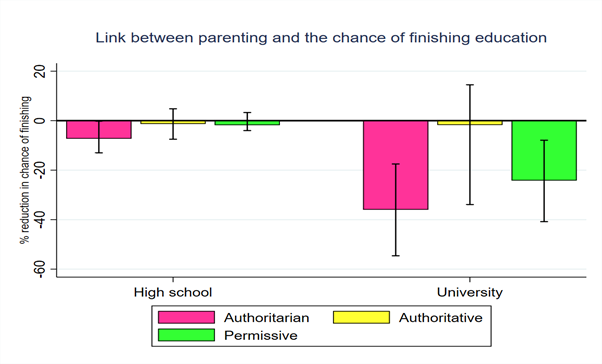
Notes: The figure shows the percentage change in the probability of completing high school or university education (relative to the sample mean) associated with hypothetically moving a child from the bottom third to the top third of each measure of parenting style. The figure is based on estimates from a regression that includes controls for individual background and family characteristics. The t-bars show the 95 percent confidence intervals.
The influence of parenting styles is not limited to education. When we follow individuals into their late thirties and forties, we also observe differences in labor market outcomes. Individuals raised by more authoritarian parents are more likely to receive unemployment benefits later in life. There are also indications that they are less likely to become parents themselves. These patterns suggest that parenting styles may influence life trajectories well beyond schooling.
Why might authoritarian parenting be linked to worse long-term outcomes? One possibility is that strict control limits children’s opportunities to develop independence and decision-making skills. When children have fewer chances to make choices, they may be less prepared to navigate complex decisions later in life. Our data also provide evidence that authoritarian parents tend to place less emphasis on education itself. For example, parents with stronger authoritarian tendencies are found to be more likely to agree with statements suggesting that it would be desirable for their child to leave school early and start working.
The data clearly show that parenting styles predict children’s long-term outcomes. However, our study does not claim that parenting styles alone cause these outcomes. Parenting decisions are closely intertwined with many other family characteristics that are difficult to separate completely. Instead, our results demonstrate strong and persistent associations between parenting styles and children’s life trajectories.
Policy Implications
These findings have implications for debates about equality of opportunity and social mobility. If parenting styles influence socioeconomic outcomes, family environments may play an important role in shaping economic inequality across generations. Programs that support parents—such as parenting education initiatives or early childhood programs that involve families—may therefore influence children’s outcomes not only by improving early learning but also by shaping how parents interact with their children.
Because our study is based on Sweden, a country with relatively low inequality and strong social institutions, the influence of parenting styles could be even stronger in countries with less social support.
Conclusion
Parenting styles are strongly linked to children’s long-term outcomes. In particular, authoritarian parenting – characterized by strict control and limited autonomy –is associated with lower educational attainment and less favorable outcomes later in life. These relationships persist even after accounting for family background and children’s abilities.
At the same time, our findings highlight an important open question: why do some parents adopt different parenting styles, and how might policies help families create environments that support children’s long-term success?
References
Baumrind, Diana, “Child care practices anteceding three patterns of preschool behavior,” Genetic Psychology Monographs, 1967..
Doepke, M., Sorrenti, G., & Zilibotti, F. (2019) The economics of parenting,” Annual Review of Economics, 2019, 11 (1), 55–84.
Disclaimer
The opinions and views expressed in this publication are those of the author(s) and do not necessarily reflect those of the ROCKWOOL Foundation Berlin (RFBerlin). While research disseminated through this series may address policy-relevant topics, RFBerlin, as an independent research institute, does not take institutional policy positions.
Publications in the RFBerlin Research Insights series may represent preliminary or ongoing work that has not been peer-reviewed. Readers are advised to consider the provisional nature of such research when citing or applying its findings.
These publications aim to make scientific work accessible to a broader audience and to encourage informed, research-based discussion. All materials are provided by the respective authors, who bear responsibility for appropriate attribution and rights clearance. While every effort has been made to ensure accuracy and proper acknowledgment, RFBerlin welcomes notifications of any concerns regarding authorship, citation, or intellectual property rights. Please contact RFBerlin to request corrections if needed.
Use of these materials for the development or training of artificial intelligence systems is strictly prohibited.
