


Short summary
Where a family lives often determines which school a child attends. In Switzerland, most children go to the public school assigned to them based on their place of residence. Unlike in countries with formal school choice systems, parents usually cannot freely choose a school. Families who want access to a different school often need to pay for private school or move to another neighborhood. As a result, housing decisions play an important role in shaping children’s school environments.
But what exactly do parents value when evaluating schools? Is academic quality the main factor, or do parents also care about the composition of students in a school?
Our recent study (Cattaneo et al., 2026) examines how parents in Switzerland evaluate different school characteristics and how much they are willing to pay to access preferred school environments. In a survey experiment with nearly 2,700 parents, participants were asked to choose between hypothetical schools that differed in several characteristics. These included academic performance, the share of students with special educational needs, the share of students who do not speak the local language at home, and housing costs.
The results show that academic quality has a strong causal effect on parental choices. Many parents place a very high value on strong academic performance. For a substantial share of parents, this preference is so strong that housing costs play only a limited role in their choices. Other parents are more sensitive to costs but still place considerable importance on school quality.
These preferences matter for education policy. When families move to access preferred schools, residential patterns can shape how students are distributed across schools and may contribute to differences in school composition.
Key Findings
- Academic quality has a strong causal effect on parental school preferences in Switzerland.
- Parents are willing to incur considerably higher monthly housing costs to access higher-ranked schools.
- Parents are willing to pay more to live near schools with fewer non-native speakers and special-needs students, with the latter effect being particularly strong in high-performing schools.
- Parents differ widely in their priorities, forming several groups with distinct preference patterns.
Author Quote
“The substantial WTP [willingness to pay] for higher school rankings and lower SN [special needs] shares indicates that parents are willing to incur significant housing costs to secure what they perceive as academically favorable peer environments, highlighting school composition as a key factor in residential decisions.”
Reference: “Paying for peers? Parental willingness to pay for school composition and quality in Switzerland”, RFBerlin Discussion Paper No. 018/26, by Maria Cattaneo, Stefan Wolter and Thea Zöllner.
Research summary
School choice can strongly influence how education systems function. When parents can choose schools, their decisions affect not only their own children but also how students are distributed across schools (Abdulkadiroğlu and Andersson, 2023). These choices can shape peer groups, competition between schools, and the overall distribution of educational opportunities.
Even in systems without formal school choice, parents may still influence school access through residential decisions (Black and Machin, 2011). Families often move to neighborhoods associated with schools they perceive as more desirable, linking housing markets closely to school quality. Information about school performance can further shape how parents evaluate schools and choose where to live (Ainsworth et al., 2023).
Switzerland offers an interesting case. Most children attend public schools, and students are typically assigned based on place of residence. Because parents cannot usually choose schools directly, moving to another neighborhood is often the main way to access a different school.
Understanding what parents value in schools is therefore important for both education policy and housing policy. Yet studying these preferences is difficult because school choices typically involve several factors at once, such as academic quality, student composition, and housing costs.
Data and Approach
To examine parental preferences for school attributes, we use data from a survey experiment with nearly 2,700 parents with school-aged children in Switzerland.
In the survey, parents were asked to choose between hypothetical schools that differed in several characteristics. These included academic quality, the share of students with special educational needs, the share of students who do not speak the local language at home, and the housing costs associated with living in the school’s catchment area.
By analyzing these choices, the study causally estimates how much parents value different school characteristics and how much they are willing to pay for access to certain types of schools.
This approach makes it possible to compare the importance of different school attributes and to see how parents trade-off school characteristics against housing costs.
Main Findings
Academic quality has the strongest causal effect on parental decisions. Many parents strongly prefer schools with higher academic performance. For a substantial minority, this preference is so strong that differences in housing costs have little influence on their choices.
Student composition also matters. Previous research shows that parents often consider both academic quality and peer composition when evaluating schools (Abdulkadiroğlu et al., 2020; Campos, 2024). In line with this, the study finds that parents prefer schools with a smaller share of students with special educational needs and fewer students who do not speak the local language at home.
Figure 1: Additional monthly amount parents are willing to pay (CHF)
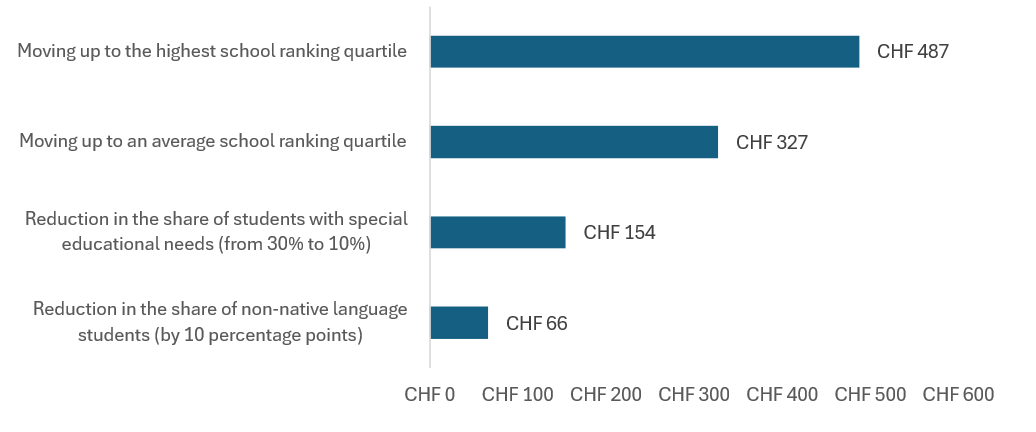
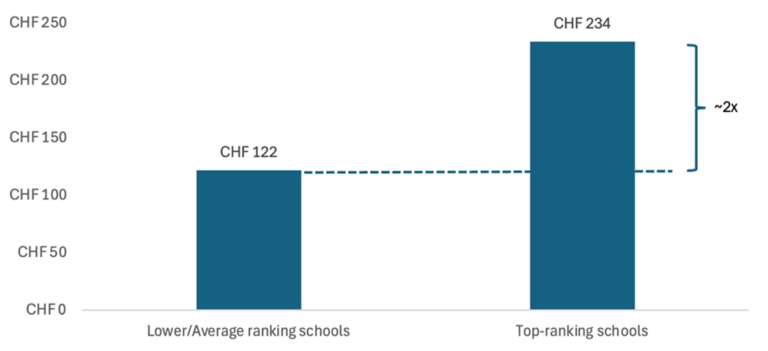
Importantly, the value parents place on peer composition depends on school quality. For example, willingness to pay for fewer students with special educational needs is highest when the school already performs well academically.
Figure 2: Additional monthly amount parents in top schools are willing to pay (CHF) for a reduction in the share of students with special educational needs
However, parents are far from uniform in their preferences. Some parents are more sensitive to housing costs and balance financial considerations with school characteristics.
We identify seven distinct types of parents, each with different priorities when evaluating schools. Some groups place overwhelming importance on academic quality, while others are more sensitive to housing costs. Additional groups attach particular weight to peer composition, such as the share of students with special educational needs or the share of non-native speakers. These differences highlight the considerable heterogeneity in parental preferences and suggest that families may respond differently to changes in school environments.
Policy Implications
Parental preferences can influence how students are distributed across schools, particularly in systems where school access depends on place of residence. If families move to access preferred schools, housing markets may reinforce differences between neighborhoods and schools.
The results suggest that both academic quality and student composition influence these decisions. Policies that affect school performance, student composition, or housing patterns may therefore shape how families choose where to live and where children attend school.
Conclusion
This study provides new evidence on how parents in Switzerland evaluate school quality and student composition. Academic performance plays a central role in parental decisions, but peer composition and housing costs also influence choices.
At the same time, parental preferences differ widely across families. Understanding these differences is key to anticipating how families respond to education policies and how these responses may shape patterns of school composition and residential sorting.
References
Abdulkadiroǧlu, A., Pathak, P.A., Schellenberg, J., Walters, C.R. (2020). Do Parents Value School Effectiveness? American Economic Review, 110(5). 1502–1539. https://doi.org/10.1257/aer.20172040
Abdulkadiroğlu, A., Andersson, T. (2023). School choice. In: Hanushek, E., Machin, S., Woessmann, L. (eds.), Handbook of the Economics of Education, Vol. 6. Elsevier, Amsterdam, pp. 135–185.
Ainsworth, R., Dehejia, R., Pop-Eleches, C., Urquiola, M. (2023). Why do households leave school value added on the table? The roles of information and preferences. American Economic Review, 113(4), 1049–1082.
Black, S., Machin, S. (2011). Housing valuations of school performance. In: Hanushek, E., Machin, S., Woessmann, L. (eds.), Handbook of the Economics of Education, Vol. 3. Elsevier, Amsterdam, pp. 485–519.
Campos, C. (2024). Social interactions, information, and preferences for schools: Experimental evidence from Los Angeles. No. w33010. National Bureau of Economic Research.
Disclaimer
The opinions and views expressed in this publication are those of the author(s) and do not necessarily reflect those of the ROCKWOOL Foundation Berlin (RFBerlin). While research disseminated through this series may address policy-relevant topics, RFBerlin, as an independent research institute, does not take institutional policy positions.
Publications in the RFBerlin Research Insights series may represent preliminary or ongoing work that has not been peer-reviewed. Readers are advised to consider the provisional nature of such research when citing or applying its findings.
These publications aim to make scientific work accessible to a broader audience and to encourage informed, research-based discussion. All materials are provided by the respective authors, who bear responsibility for appropriate attribution and rights clearance. While every effort has been made to ensure accuracy and proper acknowledgment, RFBerlin welcomes notifications of any concerns regarding authorship, citation, or intellectual property rights. Please contact RFBerlin to request corrections if needed.
Use of these materials for the development or training of artificial intelligence systems is strictly prohibited.
