


Short summary
Historians have long argued that the unequal and extractive tax system of the Ancien Régime was a key driver of the French Revolution (Norberg, 1994; Touzery, 2024). Until now, systematic evidence has been limited. Our paper (Giommoni, Loumeau, and Tabellini, 2026) fills that gap. Areas bearing heavier tax burdens experienced significantly more riots in the decades before 1789 and submitted more complaints against taxation in the cahiers de doléances. These patterns were driven by indirect taxes, which were regressive, highly visible, and collected intrusively. Comparing municipalities on opposite sides of tax borders, riots jump sharply on the high-tax side and the gap widens over time, peaking in the 1780s.
One interpretation of these findings is that taxation created the structural foundations for unrest, and material hardship and ideological forces acted as catalysts that activated long-standing grievances about fiscal inequality. Consistent with this view, we find that droughts led to significantly more riots in heavily taxed municipalities, and that the effects of taxation on unrest were stronger where Enlightenment ideas were more widespread. We then connect unrest to revolutionary politics in Paris, showing that deputies from heavily taxed constituencies were more likely to demand institutional change, support the abolition of the monarchy, and vote for the king’s execution. Together, these findings suggest that extractive and unequal taxation can erode the political legitimacy of the regimes that impose it.
Key Findings
- Moving from a low- to a high-tax region more than doubles the number of riots in the decades preceding the Revolution (1750–1789).
- In 1789, high-tax regions expressed around 72% more tax grievances in the cahiers de doléances.
- Taxation interacted with two catalysts—adverse weather and the spread of Enlightenment ideas—to produce the surge in unrest of the 1780s.
- High-tax areas were swept earlier and more extensively by the Great Fear of 1789—the wave of rural revolts that culminated in the abolition of feudal privileges on August 4.
- Representatives from high-tax areas were more likely to support the Revolution, condemn the unequal tax system, oppose the monarchy—and ultimately to vote for the king’s execution in January 1793.
Relevance Today
The findings carry lessons well beyond 18th-century France. Tax systems seen as unfair—whether because of inequality across groups or coercive enforcement—can erode trust and destabilize regimes. Today, debates about wealth taxes, VAT incidence, and digital levies raise similar questions about who bears the burden and whether the system is perceived as legitimate. This paper shows that fiscal inequality has historically been a source of political radicalization, especially when combined with economic hardship.
Author Quote
“Taxation created the structural foundations for unrest, while both material hardship and ideological forces acted as catalysts that transformed long-standing grievances about fiscal inequality into open revolt.”
Reference: Based on RFBerlin Discussion Paper 049/26: Tommaso Giommoni, Gabriel Loumeau, Marco Tabellini, Extractive Taxation and the French Revolution (February 2026).
Research summary
The French Revolution is one of the most studied events in world history. Its causes—from Enlightenment ideas to high wheat prices and rising government debt—have been debated for over two centuries. Yet one factor that looms large in historical narratives has, until now, lacked systematic empirical support: taxation. Our recent paper (Giommoni, Loumeau, and Tabellini, 2026) fills that gap, showing that fiscal disparities across regions shaped both popular unrest in the decades before 1789 and political behavior during the Revolution itself. These findings highlight how unequal taxation can undermine political legitimacy and contribute to large-scale political transformation.
Taxation in France on the Eve of the Revolution
On the eve of 1789, France had no unified tax system. Centuries of royal bargaining had left behind a patchwork of overlapping levies, each with its own geography and exemptions. The clergy and nobility—roughly 2% of the population—were mostly exempt. The Third Estate, everyone else, paid nearly everything. Figure 1 illustrates the spatial distribution of the total tax burden, measured in livres per capita, across French bailliages around 1780.
Figure 1: Overall tax burden
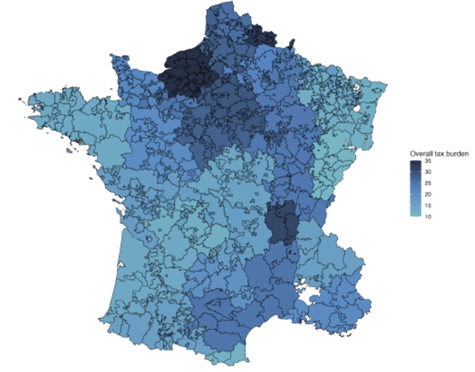
Notes: The figure plots the overall tax burden, expressed in livres per capita, around 1780 in each bailliage in contiguous France. Data come from Touzery (2024).
Two indirect taxes stood out for their weight and their resentment. The gabelle, or salt tax, was not just a levy on a commodity, it was effectively a forced purchase. Households in high-tax areas were required by law to buy a minimum annual amount of salt, regardless of need. In some regions, this obligation consumed up to 13% of a family’s annual income. Just across a provincial border, the same salt might cost only a fraction as much. The traites were a web of internal customs duties that sliced France into trade zones, adding costs and creating checkpoints at every boundary. Together, the two taxes were collected by the Ferme générale, a private tax-farming company, whose agents—the gabelous—were a visible and despised presence in rural life.
What made this system explosive was not just its cost, but its geography. The borders between high- and low-tax zones often followed centuries-old frontiers—wartime boundaries, feudal bargains, the distance a horse could travel from a salt marsh. They bore no relation to economic fundamentals. Two neighboring villages could face wildly different tax burdens for purely historical reasons. This arbitrary spatial inequality was visible to everyone, and it made the system feel not just burdensome but unjust.
Key Findings
1. Taxation, unrest, and grievances before 1789
We first correlate riots with per-capita tax burdens across France’s administrative districts around 1780. Districts in the top quartile of the tax distribution experienced more than twice as many riots between 1750 and 1789 as those in the bottom quartile. We then turn to the cahiers de doléances, the lists of grievances compiled across France in early 1789 ahead of the Estates General. Consistent with taxation driving discontent, we find that heavily taxed areas submitted significantly more complaints about taxation—and that these complaints emphasized not only the economic burden but also the unequal and arbitrary way taxes were imposed.
2. Causal evidence from tax borders
To identify the effect of taxation itself, we compare nearby areas located on opposite sides of historical tax borders for two major indirect taxes: the salt tax and internal customs duties. These borders were often drawn centuries earlier based on wartime frontiers, salt-marsh geography, and feudal bargains—not on local economic conditions—which means that otherwise similar communities ended up facing very different tax burdens for purely historical reasons. This allows us to compare locations on either side of these boundaries in a way that isolates the effect of taxation from other factors. We find that unrest was systematically higher on the high-tax side. Figure 2 illustrates this pattern graphically: crossing the tax border leads to a clear increase in riots, with no comparable changes in other local characteristics. Figure 3 shows that this effect grows over time, becoming particularly strong in the 1780s. The results are also concentrated in tax-related riots, rather than other forms of conflict such as food or labor unrest.
Figure 2: Riots around the tax borders (1750-1789)
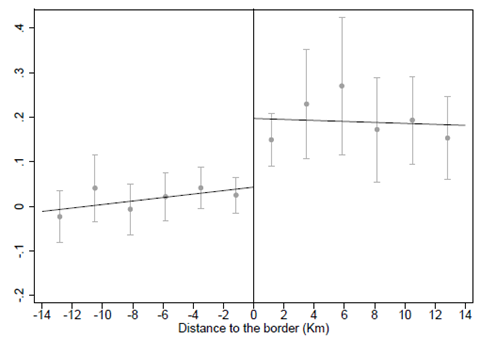
Notes: The plot shows nonparametric RD estimates, implemented following Calonico et al. (2014) with optimal bandwidth and polynomial order selection. The dependent variable is the number of economic and political riots between 1750 and 1789. The treatment equals one for municipalities on the high-tax side of the border. The sample consists of all municipalities in contiguous France within the optimal bandwidth.
Tax burdens had remained relatively stable for decades — so the spike in unrest in the 1780s calls for an explanation. We consider two catalysts discussed in the historical literature. The first is economic: a series of unusually hot and dry summers led to poor harvests and sharp increases in food prices (Lefebvre et al., 1947; Waldinger, 2024). We find that these shocks had stronger effects in high-tax areas, suggesting that subsistence crises amplified existing fiscal tensions. The second is ideological: exposure to Enlightenment ideas strengthened reactions to fiscal inequality, making grievances more likely to translate into open protest (Darnton, 1982). Together, these findings suggest that taxation created the underlying conditions for discontent, while economic hardship and changing beliefs acted as triggers — transforming long-standing grievances into unrest.
Figure 3: Riots around the border by decade
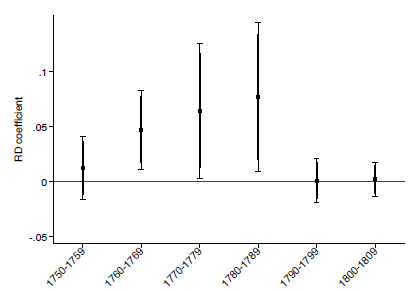
Notes: The plots show nonparametric RD estimates, with corresponding 90% and 95% confidence intervals, following Calonico et al. (2014) under optimal bandwidth and polynomial order selection. The dependent variable is the number of economic and political riots in each 10-year period. The treatment equals one for municipalities in the area with a higher rate. The sample consists of all municipalities in contiguous France within the optimal bandwidth.
3. From Local Unrest to Revolutionary Wave: the Great Fear
Local grievances, however intense, do not by themselves make a revolution. Revolutions require contagion. We study the Grande Peur—the “Great Fear”—of July and August 1789 (Lefebvre, 1973; Zapperi et al., 2025). Following the fall of the Bastille, rumors of aristocratic conspiracies swept rural France in a wave of panic. Peasants attacked manor houses and destroyed feudal records. The Assemblée Nationale, convened just weeks earlier, responded by abolishing feudal privileges on the night of August 4. Using digitized maps to trace how the panic spread across France, we find that high-tax districts were more likely to become early centers of unrest, were affected sooner and saw a larger share of their territory drawn into the Great Fear. By August 4, the night feudalism was abolished, roughly 80% of high-tax territory had already been reached, compared to about 60% of low-tax territory.
4. From local unrest to political change
These patterns suggest that fiscal grievances fueled the revolutionary crisis from below. But taxation also shaped the Revolution from above, through the behavior of its political representatives. We analyze more than 60,000 speeches from the Archives Parlementaires, delivered between May 1789—when the États Généraux convened—and January 1793, when Louis XVI was executed. Deputies from high-tax constituencies engaged with fiscal issues very differently from their counterparts in low-tax areas. They were more likely to speak about taxation, criticize the Ancien Régime, defend the Revolutionary project. They also framed taxation more often as unequal or oppressive, and more frequently called for fundamental fiscal reform.
We then move beyond fiscal debates to examine how taxation shaped political behavior at key turning points of the Revolution. In the weeks following the Great Fear, deputies from high-tax constituencies were more likely to demand institutional change, call for the abolition of feudal privileges, and openly criticize the monarchy. In the Assemblée Législative (October 1791–September 1792), legislators from heavily taxed areas were more likely to support the abolition of the monarchy. And in the Convention Nationale, using newly digitized roll-call votes, deputies from high-tax regions were more likely to vote for the king’s execution in January 1793.
Policy Implications
These findings speak to a broader debate about the relationship between taxation and political legitimacy. The ability to raise taxes is widely seen as a foundation of state capacity and long-run development (Besley and Persson, 2009 and 2010): states that can fund public goods, enforce contracts, and invest in infrastructure tend to grow faster and govern better. But tax capacity also requires popular acceptance. When taxation is perceived as fair and tied to representation, it can strengthen the social contract between citizens and the state. When it is not, it can corrode it.
The French Ancien Régime illustrates the risks of the alternative. A weak state, unable to reform its fiscal institutions, fell back on extraction: taxing heavily, unequally, and without consent. In the short run, this generated revenues. In the long run, it generated revolution. Our findings suggest that this was not inevitable — it was the combination of extractive taxation, the absence of political voice, and the perception of deep inequality that proved fatal. The broader lesson is that a fiscal system that excludes those it burdens will, over time, lose the legitimacy it needs to survive.
Conclusion
We provide evidence that taxation played a central role in shaping both unrest and political change during the French Revolution. These findings highlight how unequal and extractive taxation can undermine political legitimacy and contribute to major institutional change. Future work might ask whether similar dynamics were at work in other moments of regime crisis—Imperial Russia, late Qing China—where extractive fiscal systems coexisted with social inequality and political exclusion.
References
Besley, T. and Persson, T. (2009), ‘The origins of state capacity: Property rights, taxation, and politics’, American Economic Review, 99(4), 1218–1244.
Besley, T. and Persson, T. (2010), ‘State capacity, conflict, and development’, Econometrica, 78(1), 1–34.
Darnton, R. (1982), The Literary Underground of the Old Regime, Harvard University Press, Cambridge, MA.
Lefebvre, G. (1973), The Great Fear of 1789: Rural Panic in Revolutionary France, Princeton University Press.
Lefebvre, G., Palmer, R. R. and Tackett, T. (1947), ‘The coming of the French Revolution’, Princeton University Press Princeton.
Norberg, K. (1994), ‘The French fiscal crisis of 1788 and the financial origins of the revolution of 1789’, in ‘Fiscal crises, liberty, and representative government, 1450-1789’, pp. 253–298.
Touzery, M. (2024), ‘Payer pour le Roi. La fiscalité monarchique France, 1302-1792.’, Champ Vallon, Paris.
Waldinger, M. (2024), ‘”Let them eat cake”: drought, peasant uprisings, and demand for institutional change in the French Revolution’, Journal of Economic Growth 29(1), 41–77.
Zapperi, S., Varlet-Bertrand, C., Bastidon, C., La Porta, C. A. and Parent, A. (2025), ‘Epidemiology models explain rumour spreading during france’s great fear of 1789’, Nature pp. 1–7.
Disclaimer
The opinions and views expressed in this publication are those of the author(s) and do not necessarily reflect those of the ROCKWOOL Foundation Berlin (RFBerlin). While research disseminated through this series may address policy-relevant topics, RFBerlin, as an independent research institute, does not take institutional policy positions.
Publications in the RFBerlin Research Insights series may represent preliminary or ongoing work that has not been peer-reviewed. Readers are advised to consider the provisional nature of such research when citing or applying its findings.
These publications aim to make scientific work accessible to a broader audience and to encourage informed, research-based discussion. All materials are provided by the respective authors, who bear responsibility for appropriate attribution and rights clearance. While every effort has been made to ensure accuracy and proper acknowledgment, RFBerlin welcomes notifications of any concerns regarding authorship, citation, or intellectual property rights. Please contact RFBerlin to request corrections if needed.
Use of these materials for the development or training of artificial intelligence systems is strictly prohibited.
