

Danish data show that older siblings of children with disabilities are 13% more likely to need mental health care, and that public support for parents softens the blow.
Short Summary
About one in fourteen Danish families has a child with a physical disability such as a heart defect, epilepsy or cerebral palsy. Caring for that child takes time, money and emotional energy. What happens to the brothers and sisters who grow up alongside them?
Our study (Janet Currie, N. Meltem Daysal, Mette Gørtz and Jonas Cuzulan Hirani) follows more than 60,000 Danish families with three or more children over three decades. Second-born children whose third-born sibling has a disability are 13% more likely to use mental-health services between ages 9 and 20. The costs of childhood disability affect the entire family, and public support can reduce negative family spillovers.
Key Findings
- Second-born children are more affected than first-borns because they are younger at the time their disabled sibling is born.
- Second-born children whose youngest sibling has a disability are 13% (2.8 percentage points) more likely to use any mental health service between ages 9 and 20.
- Psychiatric visits rise by 23%, use of psychiatric prescription medicine by 18%, and counselling by 11%.
- These effects show up when siblings are around age 9 and grow through the teenage years.
- Effects are driven by families with mothers who have only basic education. In these families, mothers’ employment falls by 13% and parents are 6% less likely to stay together.
- Before Denmark’s 1998 expansion of benefits for parents of seriously ill children, there was a 21% increase in the use of mental health services for second-borns; afterwards it fell to 9%.
Relevance Today
Concern about youth mental health is growing; the World Health Organization estimates that 14% of 10- to 19-year-olds worldwide have a mental disorder. Policy debates usually focus on treatment capacity, such as the waiting times in child psychiatry flagged by the Danish Economic Council in 2025. Our study points to prevention: family stress in early childhood causes later mental health problems. Paid leave and wage replacement for caregiving parents can protect their other children.
Author Quote
“Disability may be an under-appreciated channel through which socioeconomic disadvantage is transmitted and amplified across generations. Since the Danish welfare system is among the world’s most generous when it comes to supporting the families of children with disabilities, the effects of such household stressors and their contribution to inequality could be much larger in countries without these supports.”
Reference: Based on RFBerlin Discussion Paper No. [186/26]: Currie, J., Daysal, N. M., Gørtz, M. and Hirani, J. C. (2026). “Child Disability and Effects on Sibling Mental Health.”
Research Summary
Imagine a family with three children. The youngest is born with a serious heart malformation. Parents must shuttle between doctors’ appointments. One parent cuts back on work and money gets tighter. The two older children still need to be cared for. This scenario is not rare: among Danish families with three or more children, one in fourteen families have a third child who has been diagnosed with a physical disability before age five. Our study asks what growing up in such a household does to older siblings’ mental health. We find that it leaves a mark. Older siblings are 13% more likely to need mental health care as adolescents or young adults, and the effect is largest in families with the fewest resources.
Why this finding matters
Child mental health problems are common and predict lower education, earnings and employment in adulthood (Currie, 2025). While people vary in terms of genetic predisposition to mental illness, the onset of some of these conditions can be traced to family stressors such as income shocks and exposure to violence. A younger sibling’s disability is common, yet little is known about its effects. Previous research had shown that Danish children whose younger sibling had a disability do slightly worse in school (Black et al., 2021). Ourstudy extends this previous work to examine the siblings’ mental health.
How the study isolates the effect
Families with a disabled child are not a random group. On average they have lower incomes and less education, which could by itself explain worse child outcomes. Our study handles this by comparing siblings within the same family. Using Danish registers from 1987 to 2019, we identify 60,405 families with three or more children. Of these, 3,854 had a third child diagnosed with a physical disability before age five. The key idea is timing. The second-born is younger than the first-born when the third child arrives, so they spend more of their early childhood in a household under strain. Hence, the second-born should be more affected than the first-born, and the gap between the two should be wider in families with a disabled third-born than in others. Anything that affects both older children in the same family equally, such as parents’ education or shared genes, drops out of this comparison.
We demonstrate that this comparison is valid in several ways. A separate method that matches each affected child to similar children in other families gives almost the same answers.
What the data show
In affected families, second-born children are 13% more likely than their older sibling to use any mental health service between ages 9 and 20, a 13% increase over the 22% rate among first-borns. Psychiatric visits rise by 23%, prescriptions for psychiatric medication by 18%, and counselling rises by 11%. Figure 1 shows that the two older siblings track each other closely until about age 8, after which the second-born pulls ahead and the gap widens through adolescence. The effect is not simply due to more contact with doctors: the same children show no increase in hospital or GP visits for physical health.
Why it happens
School performance is not the main route. While our study confirms Black et al.’s finding of a small drop in older siblings’ test scores, the mental health effect remains after accounting for educational impacts. Strain on parents may be more important. Six to ten years after the birth of a child with a disability, fathers are 7.7% more likely to use mental health care themselves, mothers’ employment is 6.4% lower, and fathers’ employment is 3.2% lower.
Figure 2 shows that these responses are largest when the disability is severe or unpredictable, such as with epilepsy. Mothers of children with episodic, unpredictable conditions reduce their employment by 11.8%, compared with only 4.9% when children have milder conditions. Among mothers with only basic schooling, employment falls by 13.4% and parents are 6% less likely to remain together but 13% more likely to have another child. College-educated mothers show none of these responses.
Figure 1) The mental health gap between siblings opens after age 8 and widens through adolescence
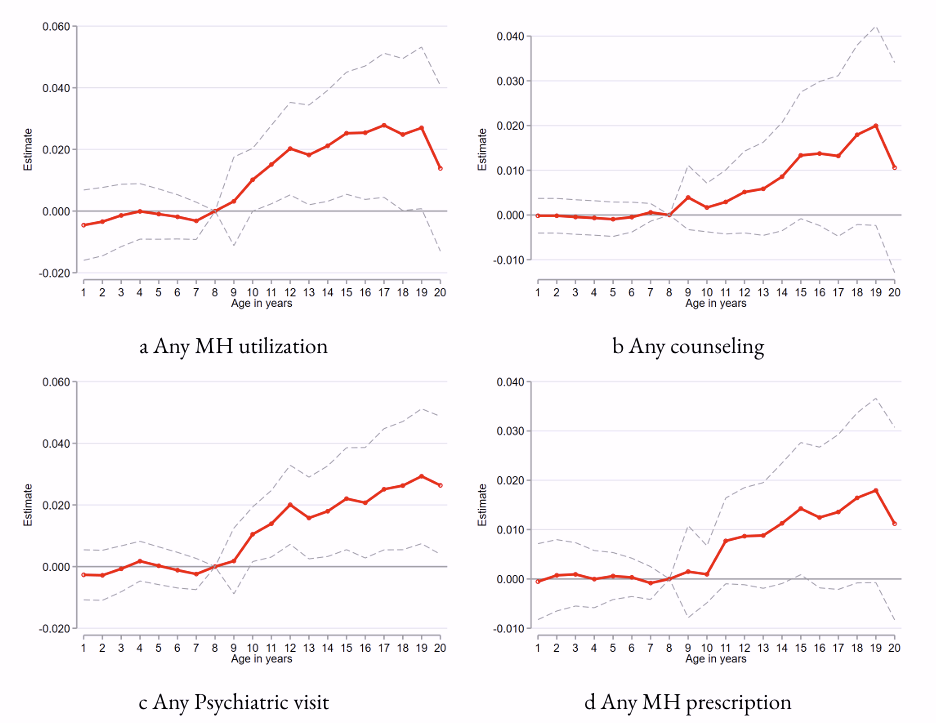
Figure 1: Each panel shows, at each age from 1 to 20, how much more likely the second-born child is than the first-born to have ever used the mental health service named in the panel, in families whose third child has a disability compared with families whose third child does not. Values are in percentage points (0.02 = 2 percentage points). Dashed lines are 95% confidence bands. Age 8 is the reference point. The sample is restricted to sibling pairs born in 1995 or later so that both can be followed from birth to age 20. MH = mental health. Source: Currie, Daysal, Gørtz and Hirani (2026), Figure 1.
Figure 2) Parents under the greatest strain respond most, especially mothers with basic schooling
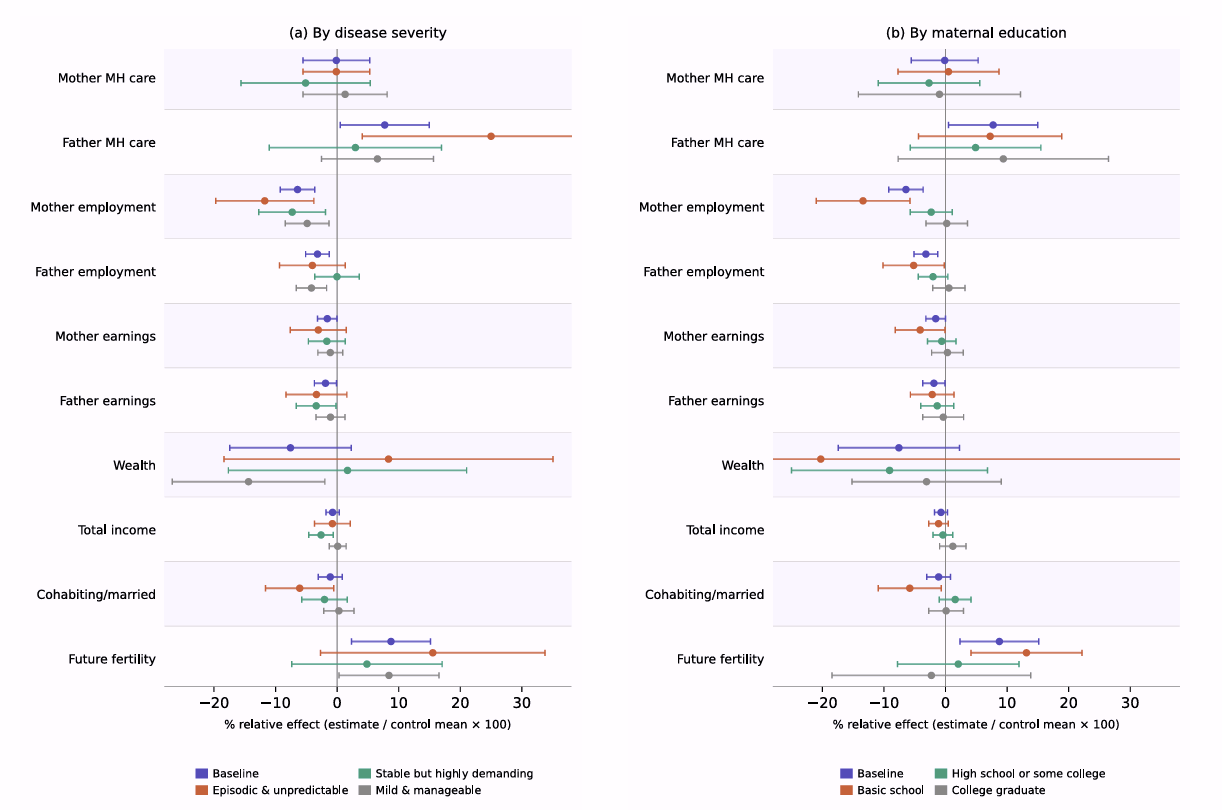
Figure 2: Each dot shows the estimated change in a parental outcome six to ten years after the birth of a child with a disability, relative to families whose third child has no disability, expressed as a percentage of the comparison group’s average. Horizontal lines are 95% confidence intervals. Panel (a) splits families by the type of disability; panel (b) by the mother’s education. “Baseline” is the average across all affected families. MH = mental health. Source: Currie, Daysal, Gørtz and Hirani (2026), Figure 2.
Policy Implications
Does policy soften these effects? Denmark offers a natural test. In 1998 it expanded sickness benefits for parents of seriously ill children, replacing capped payments with full wage replacement, extending eligibility for parents of children up to age 18 rather than age 14, and removing a 52-week limit on benefits. Families whose third child was born before the reform were hit harder than those with children born afterwards: mothers’ employment losses were twice as large (11% versus 5%), household wealth fell by nearly 14%, and couples were more likely to separate. The sibling effect was also twice as large: 21% before the reform versus 9% after. However, other things may have changed over time, so this evidence is suggestive rather than conclusive.
Still, it points to two conclusions. First, wage replacement and practical caregiving help protect siblings as well as the parents of children with disabilities. Countries with less generous support than Denmark should expect larger mental health effects. Second, targeting matters. The families most in need have the least education, are more likely to have a child with a disability and are the least able to absorb the costs.
The extra medical spending on treatment for childhood mental illness caused by the presence of a disabled sibling is small, roughly USD 118 per affected family per year, so the case for supporting the families of children with disabilities rests on the lasting harms of childhood mental illness rather than on immediate medical cost savings.
Conclusion
Growing up with a younger sibling who has a disability raises future use of mental health care by 13%, with the largest effects in families with the fewest resources. Strains on parents’ time, finances, and mental health appear to be an important channel. Because the study measures effects on mental health treatment, it may miss some children who struggle without seeking care. How support should be designed to reach the most affected families remains an open question.
References
Black, S. E., Breining, S., Figlio, D. N., Guryan, J., Karbownik, K., Nielsen, H. S., Roth, J. and Simonsen, M. (2021). Sibling Spillovers. The Economic Journal, 131(633), 101–128.
Currie, J. (2025). Investing in Children to Address the Youth Mental Health Crisis. American Economic Review, 115(5), 1369–1399.
Currie, J., Daysal, N. M., Gørtz, M. and Hirani, J. C. (2026). Child Disability and Effects on Sibling Mental Health. RFBerlin Discussion Paper No. [186/26].
Danish Economic Councils (2025). Danish Economy, Autumn 2025, Chapter 4.
World Health Organization (2021). Mental Health of Adolescents. Fact sheet, 1 October 2021.
