

Italy’s 2010 returnee scheme increased return migration among eligible expatriates by 30–40%, but its long-run payoff depends on how the incentives are designed and, crucially, on whether returnees remain after the tax break expires
Short Summary
Countries that lose young, high-skilled workers may try to attract them back by lowering taxes. Do these incentives change migration decisions, or mainly reward people who would have returned anyway? And are they fiscally sustainable in the short and long run?
Italy offers a useful setting to answer these questions. Its 2010 “Controesodo” scheme exempted 70–80% of eligible returnees’ labor income from income tax for several years. For a typical beneficiary, this raised take-home pay by about 43%. We compare return migration before and after the reform across Italians who differed in age and education, the two rules that determined eligibility. Eligible expatriates became 30–40% more likely to return than comparable ineligible Italians. German employment records also show that the additional returnees were concentrated in the upper half of the earnings distribution and included workers in healthcare and innovation-intensive sectors. A direct revenue calculation suggests that the scheme can eventually pay for itself, but only if many induced returnees remain after the benefit expires.
Key Findings
- The scheme raised return migration among eligible high-skilled Italians by 30–40%.
- Roughly 25% of eligible returnees would likely have stayed abroad without the incentive.
- Tax-induced returnees had relatively high earnings abroad and were concentrated in key sectors such as healthcare and innovation-intensive industries.
- The scheme may eventually recover its initial fiscal cost, but only if enough tax-induced returnees remain after the benefit expires.
Relevance Today
Preferential tax regimes for inbound workers have spread across Europe, prompting repeated debate over whether they should be tightened or abolished. Our findings suggest that their effectiveness for the receiving country depends not only on the generosity of the tax cut, but also on eligibility rules, duration, communication, and safeguards against tax avoidance. These schemes can form part of a short- to medium-term response to brain drain, but they cannot substitute for broader reforms that improve wages, career prospects, and support for families at home. Furthermore, they might induce inefficient tax competition between countries which can lead to a race-to-the-bottom.
Author Quote
“Our findings show that well-designed tax incentives are an effective tool to increase return migration, even in contexts of brain drain and large wage differentials. Future research should examine the broader effects of tax-induced immigration on the receiving economy, which can further inform the design of preferential tax schemes.”
Reference: Jacopo Bassetto, Giuseppe Ippedico (2026): Tax Incentives and Return Migration. RFBerlin Discussion Paper
No. 097/26
Research Summary
Across Europe, governments increasingly use temporary tax breaks to attract skilled workers and encourage expats to return. As Figure 1 shows, preferential regimes for internationally mobile workers have spread widely, initially to attract foreign talent and increasingly to bring nationals back home. These policies offer a relatively quick response to labor shortages and brain drain, but they are costly when they mainly subsidize people who would have moved anyway. Italy’s 2010 Controesodo scheme provides a clear test of whether such incentives affect migration decisions. We find that eligible expats were 30–40% more likely to return and that about one in four eligible returnees came back because of the policy.
Compared with previous research showing that top earners, inventors, and professional athletes respond strongly to international tax differences (Kleven et al., 2020), our findings demonstrate that these responses extend to a broader group of young, high-skilled workers. They also show that policy design matters for the fiscal sustainability of these types of tax incentives: careful targeting, clear and well-communicated rules, safeguards against strategic use, and incentives to remain after the benefit expires can all shape the scheme’s long-run success.
Figure 1: Preferential tax schemes for high-skilled inbound workers in Europe
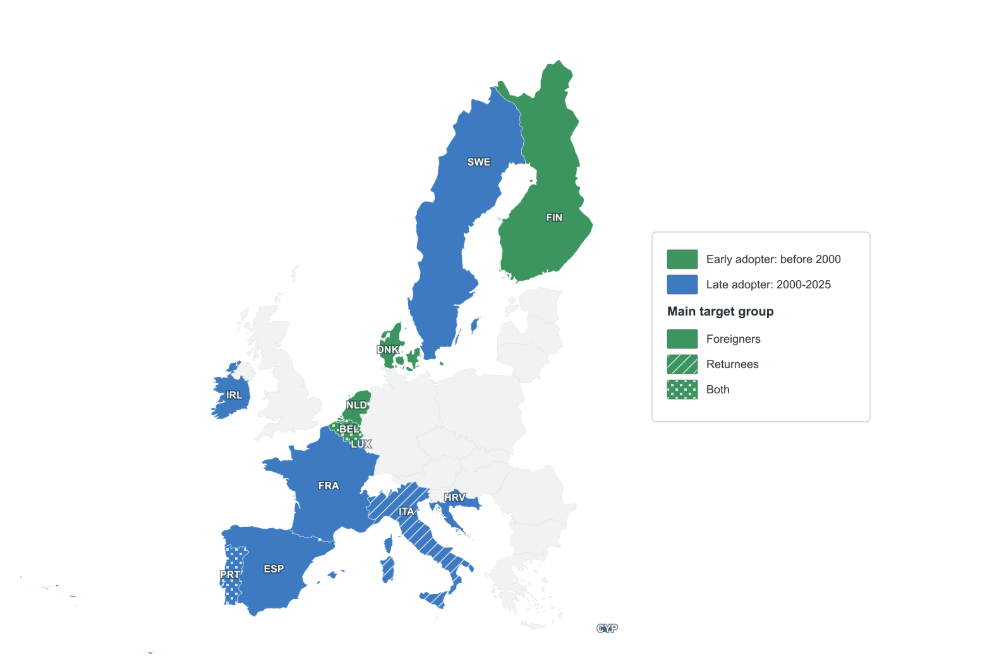
Notes: Green marks early adopters before 2000; blue marks later adopters through 2025. Patterns show whether schemes mainly target foreign workers, returning citizens, or both. Source: authors’ compilation.
Italy as a Case Study
Italy provides a useful case study. At the end of 2010, it introduced the Controesodo (“counter-exodus”) scheme to encourage young, high-skilled expats to return. The scheme exempted 70% of men’s and 80% of women’s labor income from income tax. The tax break was expected to last two to four years and was later extended to five. Eligibility required a university degree, birth in 1969 or later, and at least two years abroad. A further requirement of prior residence in Italy made the policy effectively limited to returning Italians until 2015.
Reforms in 2015 and 2019 broadened eligibility and, in some cases, extended the benefit to ten years. In 2023, Italy tightened the scheme again by restoring a high-skill requirement, limiting the benefit to five years, introducing a EUR 600,000 cap on eligible income, and requiring longer periods abroad, especially for transfers within multinational firms.
We study whether the original scheme brought high-skilled Italians back. The main challenge is to determine how many would have returned even without the tax break. We use the age and education rules to compare younger college graduates, who were eligible, with younger high-school graduates and older college graduates, who were not. Because return migration varies strongly with both age and education, this comparison helps isolate the policy effect and estimate how responsive expatriates were to the tax incentive.
Figure 2: Return migration flows of eligible and ineligible Italian expatriates, 2006–201
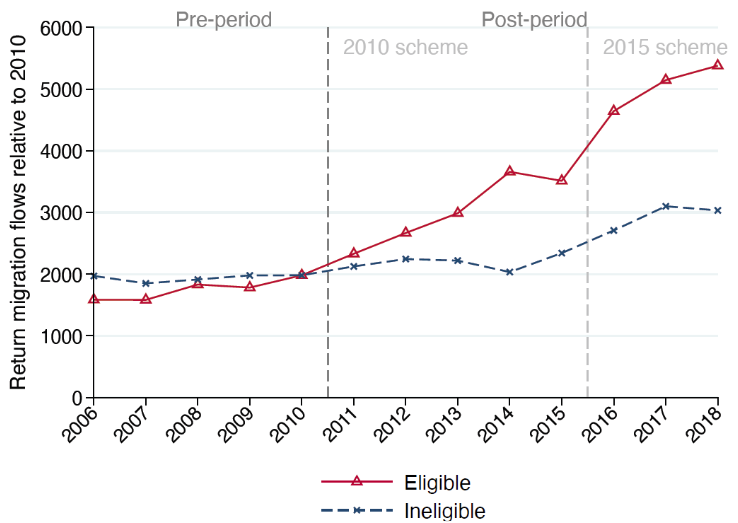
Notes: Eligible expatriates are college graduates born in 1969 or later. The ineligible series is scaled to match eligible flows in 2010. Vertical lines mark the 2010 scheme and the 2015 reform. Source: authors’ calculations using Istat data.
What Changed After the Tax Break?
The main result is a sizable but gradual increase in return migration. As Figure 2 shows, eligible and ineligible expats followed similar trends before the scheme was introduced, but their paths began to diverge after 2010 and the gap widened over the following years. We find that eligible expats were 30–40% more likely to return than comparable ineligible individuals. This implies that around one in four eligible returnees came back because of the scheme and would otherwise likely have remained abroad. The gradual response is also informative. Many expats may initially have been unaware of the policy or uncertain about its eligibility rules and duration, highlighting the importance of simple design and clear communication if such schemes are to influence migration decisions.
Who Returned?
To examine their characteristics, we looked at Italian expats in Germany and tracked those who left the German social-security records after the policy was introduced, again comparing eligible Italians with similar workers who were ineligible. The effect was concentrated in the upper half of the earnings distribution, rather than among top earners alone. Among those leaving Germany after the reform, eligible workers earned about 20% more than comparable ineligible leavers. They were also more likely to have worked in services and healthcare, as well as in industries with high patenting activity. The scheme, therefore, attracted workers with relatively strong labor market outcomes abroad and experience in key sectors, increasing the potential for knowledge and productivity spillovers.
Can the Scheme Pay for Itself?
Despite the sizable increase in return migration, the scheme is unlikely to pay for itself in the short run. The government also lowers taxes for people who would have returned anyway, and this initial revenue loss exceeds the taxes collected from additional returnees while the benefit is in place. Over the longer run, however, the scheme may recover its cost if enough policy-induced returnees remain after the tax break expires and begin paying full taxes. Its overall success therefore depends not only on attracting skilled workers, but also on retaining them and on whether they generate broader productivity and knowledge spillovers, which are potentially important but difficult to quantify in our setting.
Policy Implications
The Italian experience offers several lessons for how these schemes can be designed. Eligibility rules should be easy to understand, and the policy should be communicated broadly, since a tax incentive can affect migration decisions only if workers know about it while their plans are still open. The scheme may also be more effective when it focuses on younger or high-skilled workers, who have more years to contribute after returning and may bring skills that are in short supply. At the same time, safeguards are needed to limit purely strategic moves, for example through minimum periods of residence abroad or stricter conditions for transfers within multinational firms. A gradual phase-out could also reduce the sudden fall in take-home pay when the benefit expires and make beneficiaries more likely to remain. Taken together, these choices can increase the share of returnees whose decision is genuinely changed by the policy, while limiting the cost of subsidizing those who would have returned anyway.
Even a well-designed tax incentive, however, can only be part of the response to brain drain. Lower taxes can make returning financially more attractive, but they do not address the broader reasons why many high-skilled workers leave, including limited career prospects, lower wages, a high tax burden on labor, or insufficient support for families. A lasting strategy therefore requires reforms that make it more attractive to build both a career and a life in the country. There is also a broader European concern: when governments compete for the same mobile workers through preferential tax schemes, the gains for one country may come partly at the expense of others, potentially strengthening the case for some degree of tax coordination.
References
Based on Bassetto, J. and G. Ippedico (2026), “Tax Incentives and Return Migration,” RFBerlin Discussion Paper 097/26; forthcoming in The Review of Economics and Statistics.
Kleven, H. J., Landais, C., Muñoz, M., and Stantcheva, S. (2020). “Taxation and Migration: Evidence and Policy Implications.” Journal of Economic Perspectives, 34(2), 119–142
