

Short summary
The full-scale Russian invasion of Ukraine in February 2022 has generated one of the largest shocks to a labor market in recent history. One fourth of the labor force has exited the labor market: millions of workers were displaced abroad or mobilized into the armed forces, while many firms suspended or downsized activity. In spite of that, nearly four years later, the labor market has proven resilient, adjusting through significant geographical and sectoral reallocation. Several elements help explain why aggregate outcomes were less catastrophic than the severity of the shock might have suggested, even though major challenges remain. The lessons that can be learned from Ukraine can be valuable also for other countries facing major labor shortages.
Key Findings
- Labor supply shock of historic size: out-migration alone implies about 3 million fewer workers, plus at least 500,000 labor force participants are mobilized into the army and 150,000 exits due to casualties. The overall contraction is about one fourth of the pre-war labor force in government-controlled areas.
- Unemployment spiked to more than 20% in 2022, then stabilized and is now around 11%, only a couple of percentage points higher than before the war.
- Real wages, after an initial drop, reached and surpassed pre-war levels by 2024.
- The rate at which online vacancies are filled – that is, job openings become actual hires – declined by 15% after the invasion. Sizeable, but less than reduction in matching efficiency during the Great Financial Crisis in the US.
- Activity shifted towards the West, away from the frontline. Contested areas’ labor markets nearly collapsed. Employment moved towards defense manufacturing.
- Wage flexibility, adaptability of recruitment policies of firms, and remote working help explain the resiliency of labor outcomes.
Relevance Today
For the first time in a modern, large-scale war, we have detailed real-time economic data. This makes Ukraine’s wartime labor market dynamics unique and offers crucial lessons for both current challenges and post-war reconstruction.
Authors quote
“Long wars are often won in factories rather than on battlefields. In Ukraine, the 2022 full-scale invasion triggered one of the largest combined labor supply and reallocation shocks in recent history.”
 Based on RFBerlin Discussion Paper 10/26: Giacomo Anastasia, Tito Boeri and Oleksandr Zholud (2026), “A Wartime Labor Market: The Case of Ukraine”. Forthcoming in Economic Policy: Papers on European and Global Issues, Volume 41, Issue 125.
Research summary
How does a labor market perform under the strain of a long war? Ukraine offers a rare answer. Despite Russia’s 2022 invasion, detailed labor market data remained available, making this the first modern large-scale war where we can track how workers, jobs, and wages adapt under extreme stress. Wars disrupt labor markets, but systematic evidence on how markets for labor services operate during conflicts is almost entirely absent. Ukraine is a rare exception: despite the full-scale Russian invasion, timely data on workers and vacancies remain available. We use these data to document one of the largest labor supply and reallocation shocks in recent history and to estimate the impact on job matching, showing how labor markets adapt under extreme stress. The labor force shrank by about a quarter, yet firms’ ability to fill open positions, and the overall efficiency of the hiring process, declined only modestly. Only along the frontline and in occupied regions there is evidence of labor market shutdowns. Several mechanisms partly compensated for wartime frictions: the mobilization of underrepresented groups, remote work, wage flexibility, and a narrowing gap between wages firms were willing to offer and those workers were willing to accept. Analyzing such dynamics is essential for designing effective post-war reconstruction policies and offers valuable insights for economies facing mounting labor supply shortages and major reallocation.
Understanding how labor markets work during wars requires going beyond aggregate outcomes. While the economics of war is a growing area of research, the literature has primarily focused on the macroeconomic consequences of conflict, documenting large and persistent negative effects of wars on output and growth (Benmelech and Monteiro (2025); Chupilkin and Koczan (2022); Federle et al. (2024)) Research on labor markets has focused on post-conflict reconstruction and reintegration (which we survey in Anastasia et al. 2022). We know much less about how economies function during active wars: How workers find jobs, how wages adjust, how businesses stay open, all due to the fog of war, as: data were unavailable or unreliable. In Ukraine, the war did not prevent the collection of labor market data, at least outside the territories occupied by Russian forces. This allowed us to conduct a much richer analysis of wartime labor markets than in earlier episodes, focusing on the formal civilian economy in government-controlled areas.
Key Findings
The full-scale Russian invasion of Ukraine in February 2022 has generated one of the largest combined labor supply and reallocation shocks in recent history. Out of an estimated population of 41 million people in 2021, close to 7 million are no longer in the country, of which 70% adults. Out-migration alone implied an estimated reduction of about 3 million workers. At least 700,000 citizens were mobilized into the army. By late 2025, around 70,000 Ukrainians had been killed in combat and 400,000 wounded, most of them working–age men. Civilian casualties amount to 50,000 people, between killed and injured. Millions of citizens remain under Russian occupation. Taken together, this amounts to a contraction of about one fourth of the initial labor force in areas still under government control – a negative labor supply shock of unprecedented scale. The negative labor demand shock was also severe, though having less persistent effects.
Shortages were amplified by the massive and multidimensional reallocation taking place as a result of the war. Economic activity has shifted towards the West, less exposed to air attacks. In some contested and partially occupied regions, local labor markets have almost ceased to exist, with virtually no vacancies or workers left. In contrast, areas further away from the front lines have seen smaller reductions in employment and, in some cases, an increase in productivity and dynamism.
The sectoral composition has also changed: before the war, services related to energy and mining, professional and scientific activities, and construction were growing; after 2021, however, industries related to defense (production of weapons, ammunition, military vehicles) and some specialized manufacturing sectors are advancing. Extraction, transport, and hospitality took the biggest hit as people likely stopped spending on non-essentials, furthermore these industries lost large numbers of workers to the military. In light of the ongoing disruption, it would have been reasonable to expect very negative economic indicators. Yet, aggregate outcomes suggest an ability to reallocate labor with surprising speed under conditions of extreme stress. The estimated unemployment (due to the war, the usual labor surveys were halted, so there were alternative estimates made by the central bank, ministry of economy and others) rate spiked in 2022 –peaking above 20% – but later declined; by 2025 it stood at 11.5%, not far from its pre-invasion level of about 9%. Real wages (adjusted for inflation, which was high during the conflict) had already returned to above pre-war levels by 2024. Despite the great difficulties, the Ukrainian labor market proved itself to be surprisingly resilient.
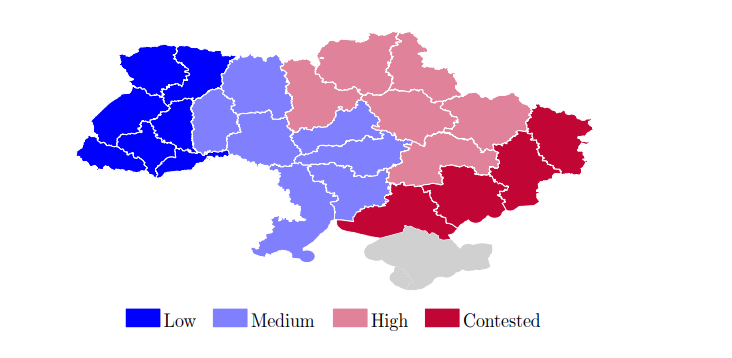
Figure 1 – Ukrainian oblasts by exposure to the conflict (based on terciles of hours of air raid alarms from February 2022 to October 2025, partially occupied oblasts hand-coded as contested)
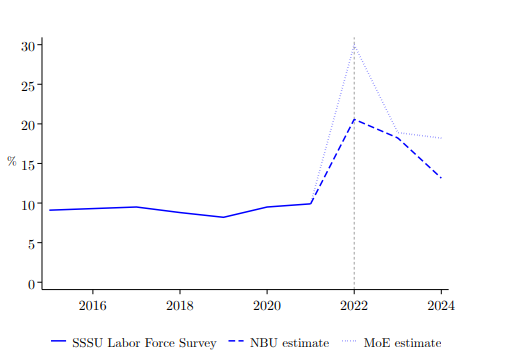
Figure 2 – Unemployment rate (sources: State Statistic Service of Ukraine, National Bank of Ukraine, Ukraine Ministry of the Economy)
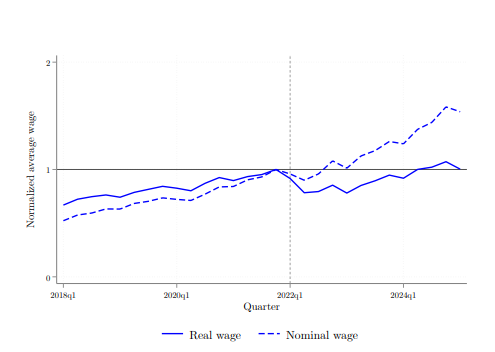
Figure 3 – Average wages of a full-time employee, nominal vs real (normalized to last quarter of 2021, source: NBU)
In a wartime economy, how well did job matching work? We analyzed data from Work.ua, Ukraine’s largest job platform, tracking how efficiently workers and vacancies matched before and after the invasion. We estimated the efficiency of matching between workers and firms: in other words, how often did supply and demand meet? A simple example: imagine there are 10 companies with one open position and 10 unemployed people. If efficiency is maximal, up to 10 hires can be generated; if it is minimal, none. The more friction there is in the market, the more this efficiency decreases. We traced how it evolved before and after the invasion across regions – experiencing different intensities of conflict exposure – and sectors. To our knowledge, no prior study evaluates the matching of job seekers and vacancies in a wartime context. Three findings emerge from the data. First, in the period since the full-scale invasion, matching efficiency declined by about 15%. It became more difficult for firms to find workers and for job seekers to find employers. The decline is significant, but not catastrophic: it is less than what was estimated during the 2008 financial crisis in the United States. Second: the situation is very heterogeneous. In the regions most exposed to the crisis, the reduction reaches about -20%, while in the western regions the picture is significantly better. Something similar applies to sectors: many blue-collar occupations are experiencing relatively modest declines (probably because these are the sectors that have lost the most workers and therefore companies have high demand), while non-essential personal services are suffering the most. Thirdly, direct exposure to conflict – measured using data on air raids alarms – makes it significantly more difficult to match labor supply and demand. It is not only major shocks that matter, but also daily disruptions that generate fear, uncertainty, damage to infrastructure, and blackouts.
What might have compensated, at least in part, wartime frictions? We identify at least four firm-level mechanisms. First, increased female participation: many women have taken on traditionally male roles (from mining to truck driving). To some extent, older people and people with disabilities are also playing a greater role. Second, the spread of remote working, which has allowed displaced persons and refugees to stay connected to their employers in Ukraine and continue to provide services despite the physical distance. Third, greater contractual flexibility: the minimum wage did not increase during the war and inflation eroded its real value, widening firms’ margins for adjustment. Martial law also removed some restrictions on the employment of women in heavy work. Fourth, the gap between wages offered by companies and wages demanded by workers seems to have narrowed, facilitating agreements. Alongside these factors, other explanations –more difficult to measure – are plausible: solidarity between workers and businesses, ability to adapt learned through previous crisis (Crimea invasion, pandemic), and social norms that change rapidly under pressure.
Policy Implications
So far Ukraine managed to face a major labor supply shock and to reallocate labor towards military related industries with relatively low costs in term of unemployment and matching efficiency. What are challenges ahead in case the war continues? Shortages of workers are emerging in many sectors of the economy, notably for skilled workers. Wages for these workers are increasing but not as much as to match their aspirations. A continuation of the war will necessarily require a higher mobilization in the labor market of people so far inactive and a greater contribution from those who left the country. Remote work can help as it allows refugees to participate in generating added value to support the economy and, possibly, to prepare for a return when conditions allow. Domestically, the army will unavoidably need more personnel if the war continues. The adoption of less labor-intensive military techniques should be encouraged as much as possible. Yet conscription will remain essential for national defense. While strategic considerations must obviously take precedence, incorporating labor market evidence into mobilization policy design may help reduce its economic impact.
How to prepare for the challenges of the reconstruction? We identify six priorities:
- Reintegrate veterans: Targeted hiring subsidies, job placement support, and psychological services for those returning from combat.
- Rebuild education: The pandemic and war damaged Ukraine’s human capital. Invest in schools, teachers, and remedial programs to help students catch up.
- Maintain high participation: Keep women, older workers, and people with disabilities engaged in the labor market through inclusion policies and support services.
- Help workers move: Strengthen job training and placement programs to help people shift between sectors and regions, with extra support for frontline areas, to prevent entire regions being left behind.
- Bring people back, or keep them connected: Encourage refugee return, maintain diaspora ties, simplify immigration for foreigners, and address emigration pressures.
- Manage pressures on public finances: Demographic decline plus an increase in disability and mental health needs will require resources and reforms to welfare programs.
Conclusion
Since February 2022, there has been a war raging on the front lines for four years, involving drones, soldiers, and missiles. And there has been a parallel war, perhaps just as decisive for Ukrainian resistance, being fought in the rest of the country: workers instead of soldiers, businesses instead of battalions. Holding the economic front, not just the military one. Factories that remain open, salaries that are paid, trade that continues, essential services that do not stop. Ukraine has held up well so far: the labor market has so far withstood shocks of unprecedented magnitude, but the challenges of reconstruction will be no less formidable than those of the war itself. Scars of war will be pervasive in the economy. Success will depend on investing in human capital, securing high employment among underrepresented groups, and strengthening the institutions that govern labor markets.
References
Anastasia, Giacomo, Tito Boeri, Marianna Kudlyak, and Oleksandr Zholud. 2022. “The Labour Market in Ukraine: Rebuild Better.” In Rebuilding Ukraine: Principles And Policies, pages 283–321. CEPR Press.
Anastasia, Giacomo, Tito Boeri, and Oleksandr Zholud. 2026. “A Wartime Labor Market: The Case of Ukraine.” RFBerlin Discussion Paper Series 10/26. Forthcoming in Economic Policy: Papers on European and Global Issues, Volume 41, Issue 125.
Benmelech, Efraim, and Joao Monteiro. 2025. “The Economic Consequences of War.” NBER Working Paper No. 34389. National Bureau of Economic Research.
Chupilkin, Maxim, and Zsóka Kóczán. 2022. “The Economic Consequences of War: Estimates Using Synthetic Controls.” EBRD Working Paper No. 271. European Bank for Reconstruction and Development.
Federle, Jonathan, André Meier, Gernot J. Müller, Willi Mutschler, and Moritz Schularick. 2025. “The Price of War.” Forthcoming in the American Economic Review.
Disclaimer
The opinions and views expressed in this publication are those of the author(s) and do not necessarily reflect those of the ROCKWOOL Foundation Berlin (RFBerlin). While research disseminated through this series may address policy-relevant topics, RFBerlin, as an independent research institute, does not take institutional policy positions.
Publications in the RFBerlin Research Insights series may represent preliminary or ongoing work that has not been peer-reviewed. Readers are advised to consider the provisional nature of such research when citing or applying its findings.
These publications aim to make scientific work accessible to a broader audience and to encourage informed, research-based discussion. All materials are provided by the respective authors, who bear responsibility for appropriate attribution and rights clearance. While every effort has been made to ensure accuracy and proper acknowledgment, RFBerlin welcomes notifications of any concerns regarding authorship, citation, or intellectual property rights. Please contact RFBerlin to request corrections if needed.
Use of these materials for the development or training of artificial intelligence systems is strictly prohibited.
