



Short Summary
Gender gaps in earnings widen sharply around childbirth. Women already earn less than men at age 25, and the gap grows steadily over the following fifteen years. Almost all of the resulting divergence occurs after women have children (Kleven et al., 2019; Landais et al., 2025). Whether such motherhood penalty reflects rigid workplace organization, or deeper forces such as gender norms, household specialisation, or employer discrimination, has remained an open question (Goldin, 2014).
We focus on the role of workplace organization and its interplay with other possible determinants by studying the spread of remote work in Italy after the COVID-19 pandemic. We link administrative records on registered remote-work agreements to matched employer–employee data, links between mothers and fathers, and fertility histories, covering the universe of births to private-sector employees between 2016 and 2023. Mothers employed where remote work was more feasible before the pandemic lost considerably less after childbirth once these agreements became widespread. Having a remote-work agreement offsets about three quarters of the earnings drop around childbirth. Rigid workplace arrangements therefore account for a large share of the earnings gap that opens after childbirth, at least in jobs that can be done from home.
Key Findings
- A remote-work arrangement offsets about 77% of the earnings drop mothers experience around childbirth.
- The gain comes from working more weeks and less part-time, not from higher wage rates. Employment probability and weekly earnings do not change.
- Fathers’ access to remote work leaves their own earnings unchanged, but raises mothers’ earnings by about as much as mothers’ own access does.
- Take-up responds far more strongly to feasibility where local gender norms are progressive, and where firms employ few women.
- Remote work as currently used raises the Italian birth rate slightly and closes about a tenth of the widening in the gender earnings gap over a career.
Relevance Today
Some employers have begun to scale back the remote-work arrangements introduced during the pandemic, and in Italy its diffusion has settled below the peak reached in 2021. Our estimates suggest that such decisions carry a cost for mothers in the years immediately after childbirth. They also bear on Italy’s fertility debate: how working time is organized is itself a determinant of family formation, alongside cash transfers such as the Universal Childcare Allowance (Assegno Unico Universale) on which family policy has mainly relied. Expanding access to flexible arrangements may prove more effective than paternity leave policies that may impose, in some contexts, earnings penalties on fathers (Andresen and Nix, 2025).
Author Quote
“Fathers’ earnings do not respond to remote-work exposure around childbirth, yet fathers’ remotability reduces mothers’ earnings losses by a magnitude comparable to mothers’ own exposure. This points to binding household-level time constraints rather than a purely mother-specific labour-market mechanism. Policies and firm practices that expand time flexibility, while preserving career progression, can play a central role in reducing gender inequality.”
Reference: RFBerlin Discussion Paper No. 140/26, “Workplace Flexibility and the Motherhood Penalty: Evidence from the Diffusion of Remote Work”, by Gaetano Basso (Banca d’Italia), Maria De Paola (University of Calabria, INPS and IZA), Salvatore Lattanzio (Banca d’Italia, RFBerlin and Dondena) and Matteo Paradisi (EIEF and CEPR).
Research Summary
Convergence in education and labour force participation has not closed the gender earnings gap, and much of the remaining gap emerges around childbirth (Angelov et al., 2016; Kleven et al., 2019; Casarico and Lattanzio, 2023). The reason is less well established. One influential explanation points to workplace organization itself: fixed schedules, commuting, and jobs where earnings rise steeply with long and inflexible hours (Goldin, 2014). Competing explanations emphasize gender norms, household specialization, or discrimination. Telling them apart requires variation in workplace flexibility that workers do not choose for themselves.
The spread of remote work after the pandemic offers exactly that. Work-from-home arrangements were seldom used before 2020 and became common within a year. They spread much faster in some industries and places than in others, reflecting pre-existing characteristics that made certain sector-locations more conducive to adopting remote work.
Research Design
Using Italy as a case study, we combine three administrative sources to our knowledge for the first time. The first is matched employer–employee records for Italian private-sector workers. The second is the full register of remote-work agreements, which firms are legally required to file, so we observe who actually held one and when, rather than relying on what workers report. The third is the Universal Childcare Allowance, which dates each birth and links mothers to fathers, allowing us to follow both parents.
We compare mothers giving birth in industries and places where remote work was more feasible with those where it was less, before and after the pandemic. Feasibility combines the share of jobs in an industry that can be done from home (Dingel and Neiman, 2020) with the quality of local broadband before the pandemic. Both were fixed in advance and outside firms’ control, which lets us use them to isolate the effect of actually holding a remote-work arrangement.
We perform several checks that support a causal interpretation of our findings. Mothers in more and less exposed jobs were on the same earnings path before 2020. Placebo exercises that assign childbirth two years earlier or three years later produce no effects, so the gains appear when time constraints bind rather than at any point in a mother’s career. We do not find evidence of sorting or selection on earnings growth before childbirth. Finally, exposure is unrelated to employer size, sales, or value added, as well as to coworkers’ earnings. This makes it unlikely that our estimates simply capture differential performance among more exposed firms.
Findings
Mothers with greater exposure to remote work earn considerably more in the years after childbirth, and the gain persists for at least three years (Figure 1, Panel A). The adjustment runs through how much they work, not what they are paid (Figure 1, Panel B). They work more weeks, take less parental leave, are more likely to be employed for the full year, and are less likely to move to a part-time contract (Figure 1, Panel C). Weekly earnings among those working do not change. Promotions to managerial positions rise from a very low base (Figure 1, Panel D). Employment rates are unaffected and mothers do not change employer, so the gains are realized inside the jobs they already held.
Holding a remote-work agreement offsets about 77% of the earnings drop around childbirth. That is a large share, but proportionate to the margin involved. Leaving employment altogether explains only a small part of the earnings loss working mothers suffer; the great majority comes from adjustments made while staying employed, which is exactly where flexibility operates. Restated as a share of the motherhood penalty itself, a remote-work agreement removes between two fifths and two thirds of it, depending on how the penalty is measured.
Figure 1 — Effect of exposure to remote work on mothers’ post-childbirth labor market outcomes.
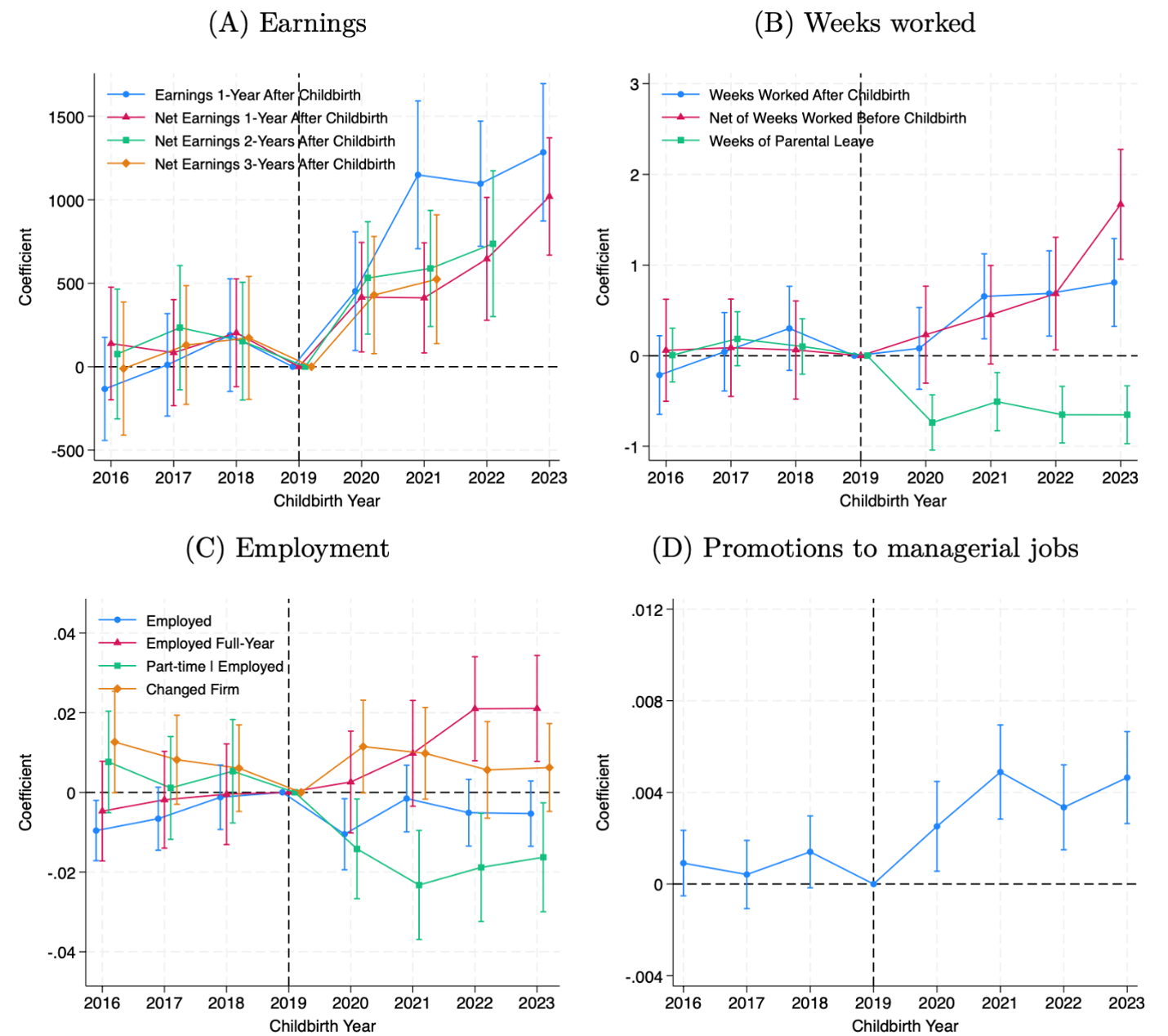
Notes: The figure shows how the outcomes of mothers changed after childbirth in sectors and local labor markets that were more exposed to the expansion of working from home, relative to those that were less exposed. The estimates come from a difference-in-differences analysis comparing different groups of mothers observed before and after the spread of remote work. The dots show the estimated effects and the lines their 95% confidence intervals. Panel A looks at earnings after childbirth and how they change relative to the years before childbirth. Panel B focuses on labor supply, including weeks worked and parental leave. Panel C considers employment outcomes, such as whether mothers remain employed, work part-time, or move to a different firm. Panel D looks at the probability of being promoted to a managerial position.
Household constraints and access to flexibility
The earnings gains are not the same for everyone. Gains are largest for younger, lower-earning, and non-college mothers, for those who commute, and for those in greedy occupations where earnings rise steeply with hours. Household composition matters sharply: the effect is roughly twice as large when the father was the main earner before childbirth than when the mother was.
We further analyze household-level outcomes, which provide additional insight into the mechanisms underlying the penalty. Consistent with the small penalty fathers face at childbirth, their own exposure barely moves their earnings. Yet it raises their partner’s earnings by about as much as her own exposure does. Explanations centered on mothers alone, such as career ladders or discrimination, would predict that the father’s working arrangements hardly matter. That they matter as much suggests a shared time constraint within the household running up against rigid arrangements at both partners’ workplaces.
Access to flexibility, however, is unequal. Take-up responds far more strongly to feasibility where local gender norms are progressive, and in firms where women are scarce and therefore costly to lose. Fathers’ take-up does not vary with how many women a firm employs. Once a mother holds a remote work arrangement, the benefit is statistically indistinguishable across these groups. Norms and the scarcity of women govern who gets access, not what flexibility is worth.
Fertility and the gender earnings gap
If rigid arrangements raise the cost of having children, flexibility should also affect fertility. We find that a remote-work agreement raises the number of children born to women who already have one, and, more modestly, to women who have none (Figure 2). Scaled up, the spread of remote work observed so far implies a 1.2% increase in the Italian fertility rate, and a 3.9% one if every job that could be done remotely offered the option. Whether this reflects women having children earlier or having more of them cannot be settled with only a few years of data.
Figure 2 — Effect of exposure to remote work on fertility.
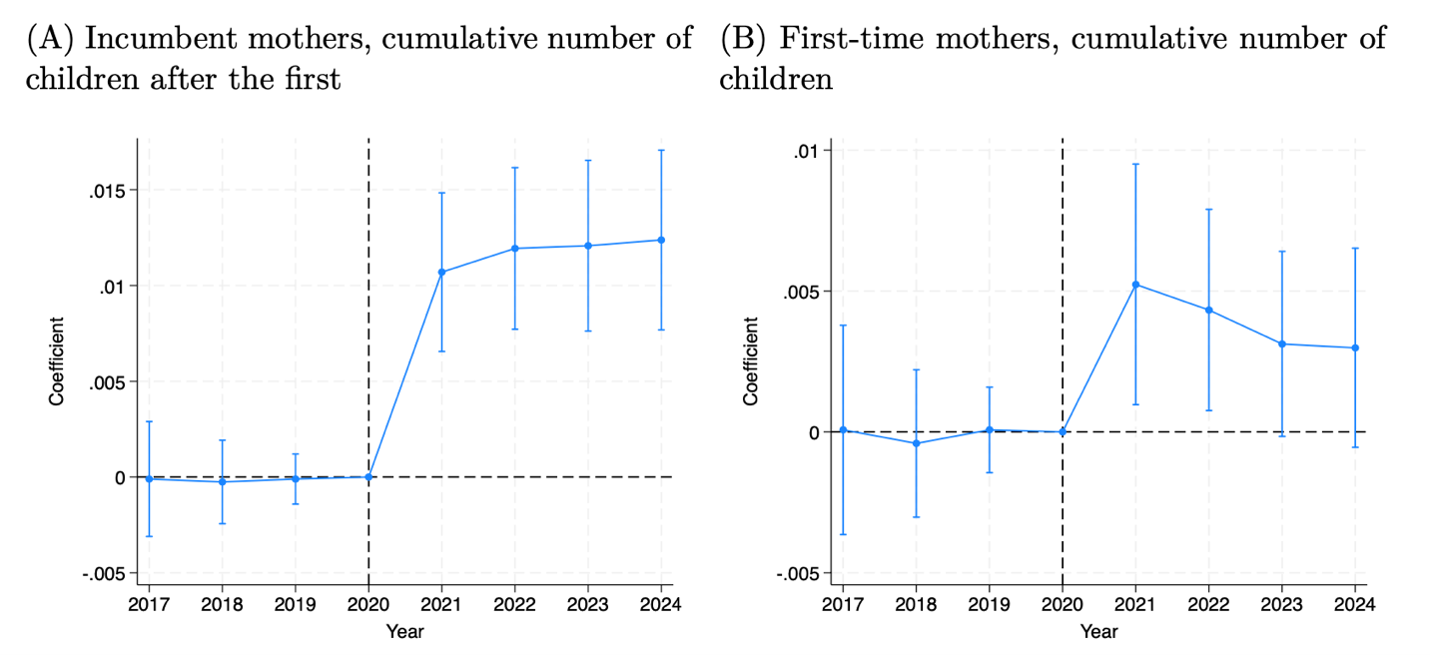
Notes: Panels A and B show how fertility evolved among women who were more or less exposed to the expansion of working from home. The analysis compares two similar cohorts of women: one observed before the pandemic and one observed after it. Within each cohort, women are grouped according to how suitable their pre-existing industry and location of employment were for remote work, allowing us to ask whether fertility changed more after the pandemic among women who were more exposed to the rise of working from home. Panel A considers women who already had at least one young child at the start of the period, while Panel B focuses on first-time mothers. In both cases, women are followed for four years after the baseline year, and the outcome is the cumulative number of children they have over that period. The dots show the estimated effects and the lines their 95% confidence intervals. The estimates account for differences in fertility trends that were already present before 2020.
Finally, following women born in the late 1970s from age 25 to 40, removing the motherhood penalty entirely would leave their earnings roughly flat relative to men’s, confirming that it accounts for virtually the whole widening of the gap over a career (Arellano-Bover et al., 2024; Landais et al., 2025). Remote work as currently used closes about a tenth of that widening. If every remotable job offered it, close to a third (Figure 3).
Figure 3 — The gender earnings gap over the life cycle under alternative scenarios.
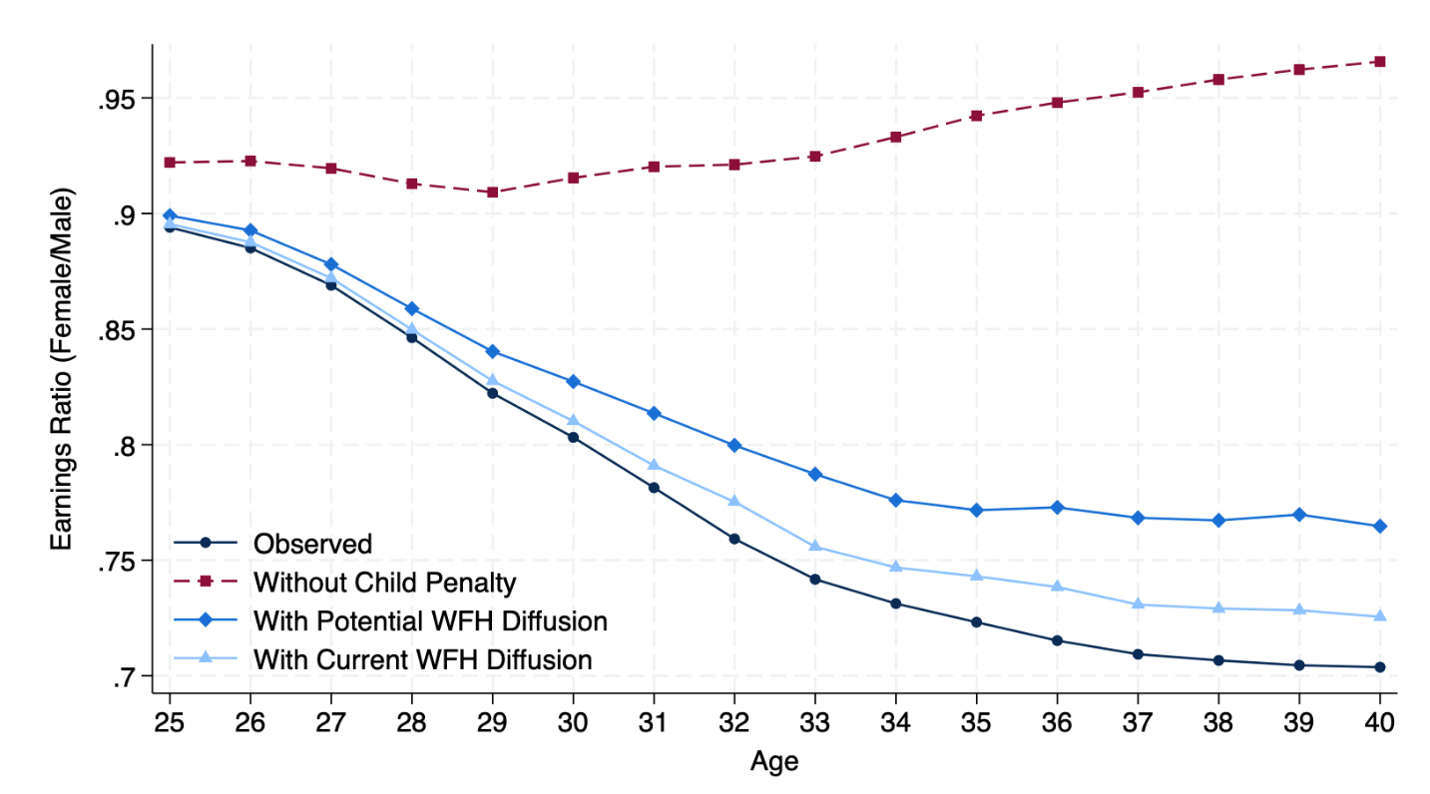
Notes: The figure shows how the gender earnings gap evolves between ages 25 and 40, and how it could change under different scenarios. “Observed” shows the actual ratio of women’s to men’s earnings. “With current WFH diffusion” estimates what this ratio looks like given the current spread of working from home. “With potential WFH diffusion” asks what would happen if all workers whose jobs can be done remotely actually worked from home. Finally, “Without motherhood penalty” shows how the gender earnings ratio would evolve if having children did not reduce mothers’ annual earnings.
Policy Implications
Our findings indicate that expanding access to remote work reduces the earnings losses associated with childbirth and, by lowering the labour-market cost of children, raises fertility among women already in employment. Both margins bear directly on the objectives of Italian family and employment policy. The evidence further suggests that flexibility relaxes a constraint operating at the level of the household rather than one specific to mothers, and may therefore promote paternal involvement in childcare without imposing the earnings penalties associated with reserved paternity leave (Andresen and Nix, 2025). Policies and firm practices that expand access to flexible arrangements, while preserving career progression, are therefore likely to remain relevant well beyond the circumstances that first produced them. While flexible work cannot eliminate the gender earnings gap, particularly where remote work is infeasible, our results show that reducing workplace rigidity can meaningfully limit the growth of the motherhood penalty over the life cycle.
References
Andresen, M. E. and Nix, E. (2025). You Cannot Force Me Into Caregiving: Paternity Leave and the Child Penalty. The Economic Journal, 136(674):780–797.
Angelov, N., Johansson, P., and Lindahl, E. (2016). Parenthood and the Female Labor Market. Journal of Labor Economics, 34(3):545–579.
Arellano-Bover, J., Bianchi, N., Lattanzio, S., and Paradisi, M. (2024). One Cohort at a Time: Young Workers’ Outcomes and the Declining Gender Pay Gap. Working paper.
Carrer, L. and De Masi, L. (2026). Municipal-level Gender Norms: Measurement and Effects on Women in Politics. Working Paper.
Casarico, A. and Lattanzio, S. (2023). Behind the child penalty: understanding what contributes to the labour market costs of motherhood. Journal of Population Economics, 36(3):1489–1511.
Dingel, J. I. and Neiman, B. (2020). How Many Jobs Can Be Done at Home? Journal of Public Economics, 189.
Goldin, C. (2014). A Grand Gender Convergence: Its Last Chapter. American Economic Review, 104(4):1091–1119.
Kleven, H., Landais, C., and Søgaard, J. E. (2019). Children and Gender Inequality: Evidence from Denmark. American Economic Journal: Applied Economics, 11(4):181–209.
Landais, C., Lundborg, P., Pazen, T., and Vikstrom, J. (2025). Gender Without Children. Working Paper.
