



Short summary
Many countries are currently increasing retirement ages due to aging populations. A key concern remains: will this have negative health consequences? We show that a higher early retirement age in Denmark successfully increased employment with limited health effects for the overall population. The health effects were limited possibly because Denmark’s welfare system offered other ways out — workers in poor health could still leave employment through disability benefits or other programmes, even after the retirement age went up.
Key Findings
- A six month increase in the early retirement age increased employment by 17 percentage points (27%) during the half-year period when early retirement eligibility was delayed.
- The six month increase in the early retirement age had no effect on general practitioner visits or the usage of painkillers, but it led to small increases in the usage of antidepressants and cardiovascular disease medicine, though the evidence is not conclusive.
- Not everyone responds the same way. Workers in routine jobs – such as assembly line workers – showed a larger increase in antidepressant use when induced to delay retirement.
- We show that individuals who were not employed – regardless of the increase in the retirement age – were in worse health in middle age compared to the rest of the population.
Relevance Today
Across developed countries, there are ongoing political debates on whether retirement ages should be increased. Our findings suggest that increasing retirement ages can extend employment with limited health effects. However, health effects may differ depending on the speed of the reform changes, availability of alternative exit routes out of employment, and the population affected.
Author Quote
“This suggests that well-anticipated reforms with a staggered rollout that increase the early retirement age (ERA) from a relatively low level (beginning of 60s) could possibly increase employment among older individuals with negligible health effects. While we find no apparent trade-off between increasing the employment of older workers and health or healthcare utilization for the overall population, our results indicate that some subgroups may experience adverse health effects.”
Based on RFBerlin Discussion Paper 046/26: Anne Katrine Borgbjerg, Hans Sigaard, Michael Svarer, Rune Vejlin (2026): “Delayed Retirement: Effects on Health and Healthcare Utilization”.
Research summary
Aging populations challenge the fiscal sustainability of public pension systems. Given declining fertility rates and increasing longevity, many countries have implemented retirement reforms with the goal of increasing employment among older individuals (OECD, 2023). However, public pension systems were historically created to allow individuals to withdraw from the labor market as health deteriorates with age (Blundell et al., 2016). This raises an important question: does working longer come at the cost of worse health? In Denmark, the Welfare Agreement from 2006 and the 2011 Retirement Reform progressively increased retirement ages based on birth dates. Using Danish administrative data, we find that a six month increase in the early retirement age increased employment with limited health and healthcare utilization effects for the overall population.
It is a key policy challenge to design pension systems that can balance adequate pensions with fiscal sustainability, while minimizing potential adverse health effects. As countries raise retirement ages, it is important to evaluate whether these reforms have negative spillovers on health. While this is clearly an important question, the economic literature has previously been inconclusive. Some studies find a negative effect of increasing retirement ages on health (e.g., Serrano-Alarcón et al. (2023)), while others find a positive effect (e.g., Ci (2022)).
Key findings
We evaluate the effects of a six month increase in the early retirement age in Denmark due to the 2011 Retirement Reform. We compare individuals born in a 50-day interval around July 1 in the years 1954 and 1955. The idea is that an individual born June 30, 1954, will be similar to an individual born July 1, 1954, except that the one born on June 30 can receive early retirement benefits at age 60.5 years, while the one born on July 1 can at 61 years – six months later. Likewise, for 1955, an individual born June 30, 1955, can receive retirement benefits at 61.5 years, while the one born on July 1, 1955, can receive benefits at 62 years.
We find that the six month increase in the early retirement age increased employment by 17 percentage points (27%) in the half-year affected by the increase in the early retirement age. Figure 1 shows the average share employed before and after the cutoff. Those born before July 1 could receive early retirement six months before those born on or after July 1. We also find that the increased early retirement age increased the uptake of public transfers by 4 percentage points (41%) and increased the share of individuals who are self-supporting (neither employed nor receiving public transfers) by 2 percentage points (26%). Thus, the increase in the retirement age keeps more people in the labor market, but also leads some individuals to rely on alternative income sources.
Figure 1: Effect of Increasing Rearly Retirement Age on Employment
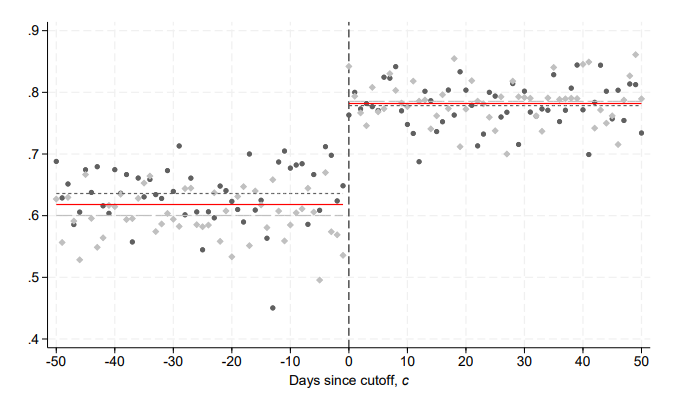
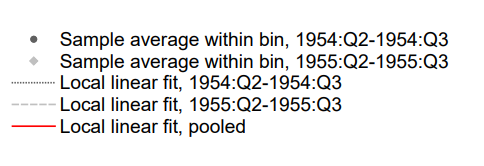
Notes: This figure plots the share of individuals employed in the first half-year following the increase in the early retirement age, by distance in days from the July 1 birthdate cutoff. The lines represent local linear fits estimated separately on each side of the cutoff, using a bandwidth of 50 days.
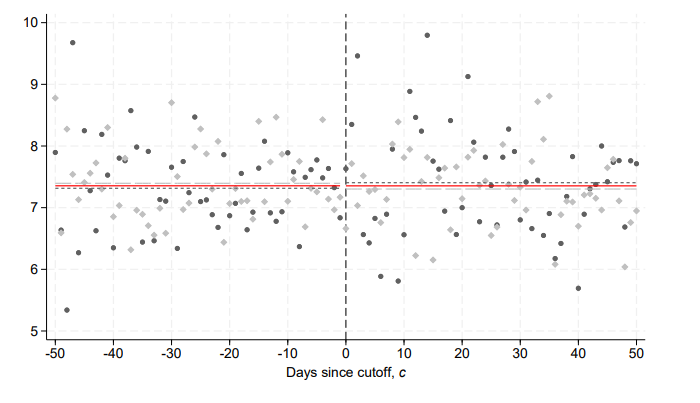
We then study the effects of an increased early retirement age on health and healthcare utilization outcomes. Figure 2 shows the number of general practitioner visits and the usage of antidepressants (measured in defined daily doses) for those born before and after July 1. Overall, we find no effect on general practitioner visits or the usage of painkillers. For the usage of antidepressants and cardiovascular disease medicine, we find small increases, though the evidence is not conclusive. We find that the effects of the higher retirement age vary across groups of individuals. Those working in occupations with a high degree of routine work or low degree of decision-making freedom (such as an assembly line workers) experience a higher increase in the use of antidepressants.
Figure 2: Effect of Increasing Early Retirement Age on Health and Healthcare Utilization
(A) General Practitioner Visits
(B) Antidepressants (Defined daily doses, DDD)
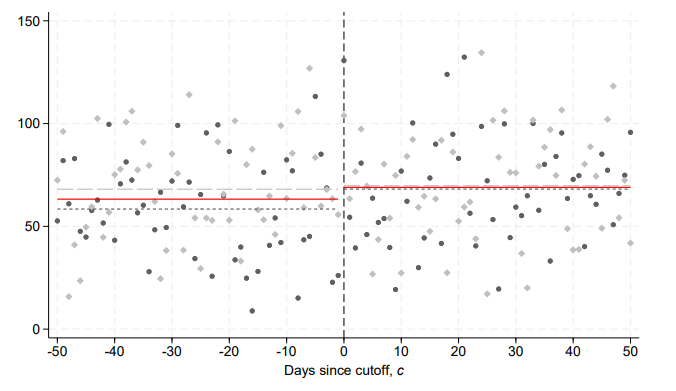
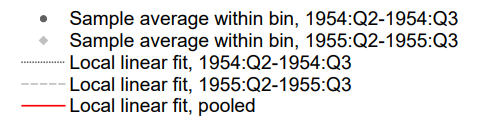
Notes: This figure shows the average number of general practitioner visits in panel (a) and usage of antidepressants in panel (b) by distance from birthdate to the cutoff, July 1. Outcomes are measured over a two-year period following the early retirement age increase. “Local linear fit” refers to the constants fitted on the data within a bandwidth of 50 days on each side of July 1.
We also highlight the importance of contextual factors. We group our sample into three groups following Marbach & Hangartner (2020): Those who work regardless of the reform (“always-takers”), those who do not work regardless of the reform (“never-takers”), and those who are employed because of the reform (“compliers”). We show that “never-takers” are in worse health prior to the reform announcement than the rest of the population. If people in poorer health are more negatively affected by higher retirement ages, then reforms that push more individuals to remain in work may have stronger impacts on health and healthcare use.
Policy Implications
Given that many countries are currently increasing retirement ages – or planning to do so in the near future – it is important for policymakers to know whether there are adverse health consequences of delaying retirement. Our findings show limited health effects for the overall population, although some subgroups may experience adverse effects.
Conclusion
Our results show that a six month increase in the early retirement age increased employment with limited overall health and healthcare utilization effects in Denmark. We highlight that contextual factors may play a role: The reform was announced well ahead of time with a staggered rollout, the Danish welfare system is generous – possibly allowing vulnerable individuals to sort themselves out of the labor market – and the early retirement age was at a relatively low level of 60 years. Whether these findings hold as retirement ages rise further remains an open question for the future.
References
Blundell, R., French, E., & Tetlow, G. (2016). Chapter 8 – Retirement Incentives and Labor Supply. In Handbook of the Economics of Population Aging (Vol. 1, pp. 457-566). North-Holland.
Ci, Z. (2022). Does raising retirement age lead to a healthier transition to retirement? Evidence from the US Social Security Amendments of 1983. Health Economics, 31(10), 2229-2243.
Marbach, M., & Hangartner, D. (2020). Profiling Compliers and Noncompliers for Instrumental-Variable Analysis. Political Analysis, 28(3), 435-444.
OECD (2023). Pensions at a Glance 2023: OECD and G20 Indicators. OECD Publishing, Paris.
Serrano-Alarcón, M., Ardito, C., Leombruni, R., Kentikelenis, A., d’Errico, A., Odone, A., Costa, G., Stuckler, D., & on behalf of the IWGRH (2023). Health and labor market effects of an unanticipated rise in retirement age. Evidence from the 2012 Italian pension reform. Health Economics, 32(12), 2745–2767.
Disclaimer
The opinions and views expressed in this publication are those of the author(s) and do not necessarily reflect those of the ROCKWOOL Foundation Berlin (RFBerlin). While research disseminated through this series may address policy-relevant topics, RFBerlin, as an independent research institute, does not take institutional policy positions.
Publications in the RFBerlin Research Insights series may represent preliminary or ongoing work that has not been peer-reviewed. Readers are advised to consider the provisional nature of such research when citing or applying its findings.
These publications aim to make scientific work accessible to a broader audience and to encourage informed, research-based discussion. All materials are provided by the respective authors, who bear responsibility for appropriate attribution and rights clearance. While every effort has been made to ensure accuracy and proper acknowledgment, RFBerlin welcomes notifications of any concerns regarding authorship, citation, or intellectual property rights. Please contact RFBerlin to request corrections if needed.
Use of these materials for the development or training of artificial intelligence systems is strictly prohibited.
