

Summary
- The desire to move permanently abroad fell from around one-third of adults pre-war (2017–2021 average ~30–35%) to about 9.5% in 2022.
- By 2023–2024, the share had recovered only modestly (to roughly 13–15%), remaining far below pre-war levels.
- The decline is broad-based: it is observed across regions, age groups, gender, and marital status.
- Germany has consolidated its position as the dominant desired destination, especially in central and northern regions; Poland gained prominence in the West.
- While current life evaluations declined after 2022, expectations for life five years ahead remained comparatively higher, resulting in a sharply widened expectation gap that peaked in 2022 and has stayed elevated since.
Introduction
Large-scale displacement following Russia’s full-scale invasion reshaped Europe’s migration landscape. UNHCR estimates that there are now close to six million refugees from Ukraine globally, 5.3 million of whom in a European country. However, the vast majority of the 41 million pre-war Ukrainian residents stayed in Ukraine. How has the ongoing conflict impacted their views about migration, and their hopes and expectations about the future? Nationally representative Gallup data from inside Ukraine allow telling a more nuanced story about migration preferences among those who remain.
A sharp decline in permanent emigration desire
Before 2022, roughly one in three adults in Ukraine reported that they would like to move permanently to another country if given the opportunity.
Figure 1
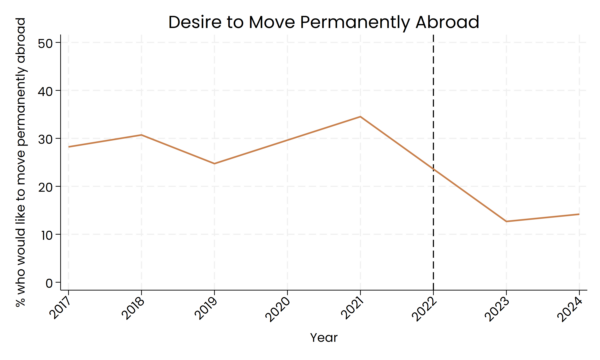
Source: Gallup World Poll, (downloaded on 6 June 2025). Notes: Desire to migrate permanently is measured as the share of respondents who report that they would ideally like to move permanently to another country, divided by all valid respondents in the given year (refused responses are excluded). Estimates are weighed using Gallup World Poll sampling weights.
This share fluctuated between about 25% and 35% from 2007 to 2021, with a noticeable rise after the 2014 Maidan Revolution, the wave of mass protests that led to the removal of President Viktor Yanukovych and shifted Ukraine toward closer ties with the West, and a peak in 2021, when the military tension with Russia was rising. In 2022, this share dropped abruptly to approximately 9.5%. By 2024, it had risen only modestly and remained below 15%, less than half the pre-war average.
The result that migration intentions declined sharply despite the substantial increase in hardship following the onset of the war may sound surprising. Notice, first, that we can rule out that the dramatic compositional change in the Ukrainian population after the Russian invasion explains the dramatic shift in migration aspirations observed in the data. In fact, before the war, Ukraine had about 41 million residents. The migration desire rate in 2021 was 35%, which corresponds to approximately 14.5 million individuals expressing their aspirations to migrate, if given the possibility. In the months following the start of the war, about six million Ukrainians left the country (Operational Data Portal – UNHCR). Even assuming that all the Ukrainian refugees were drawn entirely from this group of potential migrants, there would still be about 8.5 million individuals with migration intentions who did not migrate. Given that the post-war population of Ukraine declined to about 35 million, this would imply a post-war emigration desire rate of around 24%. However, the observed migration desire rate in 2022 is substantially lower – only 9.5% – corresponding to approximately 3.3 million individuals. Thus, compositional changes in the Ukrainian population are not enough to explain the decline in migration desires.
One interpretation of this result draws on social identity theory, which predicts that external threats heighten the salience of group membership and strengthen in-group identification. In the context of war, individuals may place greater weight on national belonging, solidarity, and perceived obligations toward the collective, which can reduce the appeal of exit even when material conditions deteriorate. Heightened identity salience may also shift behavior toward group-oriented norms—such as staying to contribute to defense, support local communities, or participate in post-war reconstruction—thereby lowering stated intentions to migrate. In this sense, migration decisions become not only a response to economic or safety considerations but also a function of identity-driven attachment and loyalty under external threat.[1]
A nationwide pattern – not just a regional shift
The decline in expressed desire to move permanently abroad is observable across regions and demographic characteristics, as shown in Figures 2 and 3. In all Ukrainian macro-regions, post-war averages are substantially lower than pre-war levels.
Figure 2
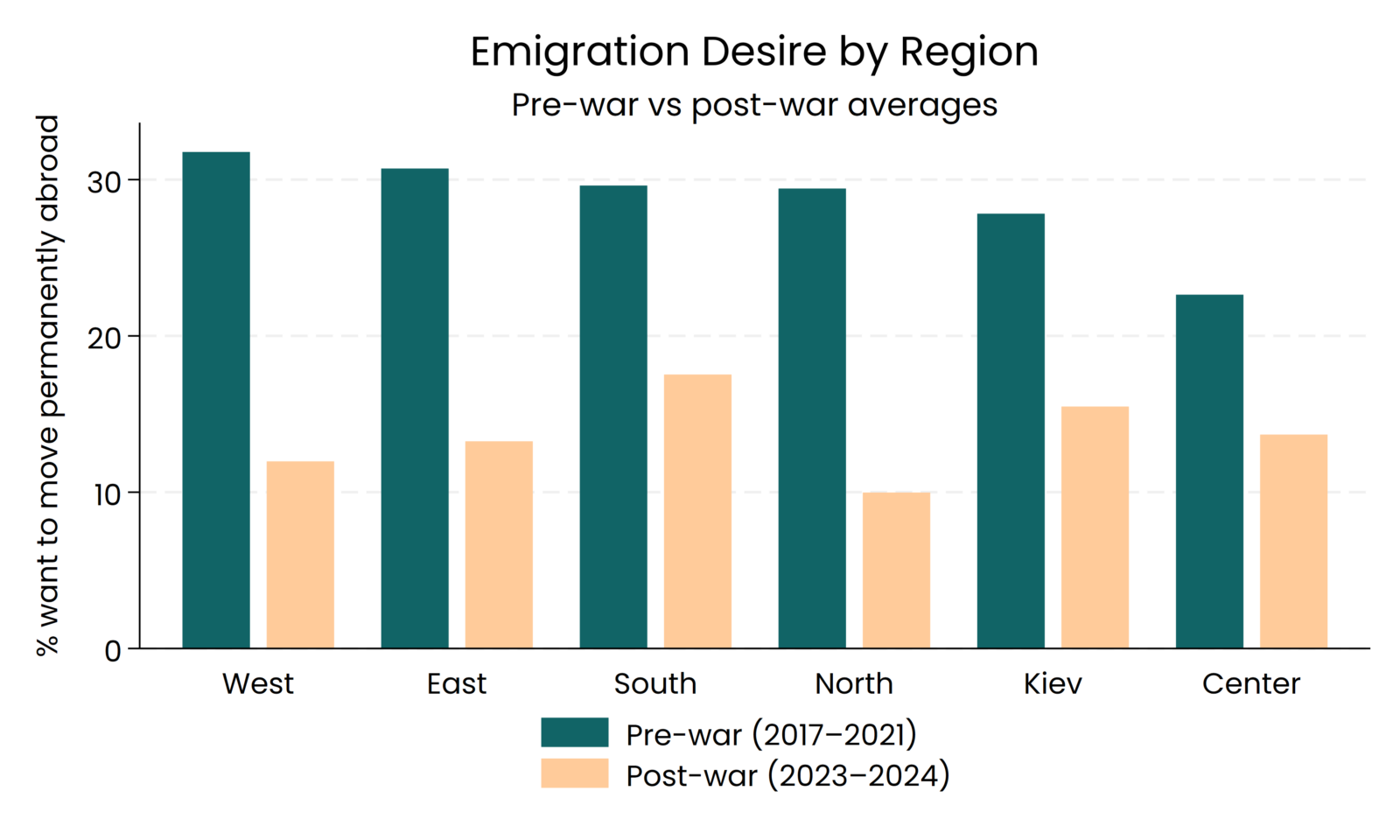
Source: Gallup World Poll, (downloaded on 6 June 2025). Notes: The figure reports the weighted share of respondents in each Ukrainian region who state that they would ideally like to move permanently to another country. Shares are calculated relative to all valid respondents in the respective region and period (refused responses are excluded). Pre-war averages refer to 2017–2021; post-war averages refer to 2023–2024. The year 2022 is excluded from averaged comparisons.
Pre-war averages (2017–2021) show emigration desire around 30–32% in most regions. Post-war averages (2023–2024) fall to roughly 10–18%, depending on the region. The East and South, regions heavily affected by fighting, do not show higher post-war levels than the West. If anything, the drop is broadly similar nationwide.
Figure 3
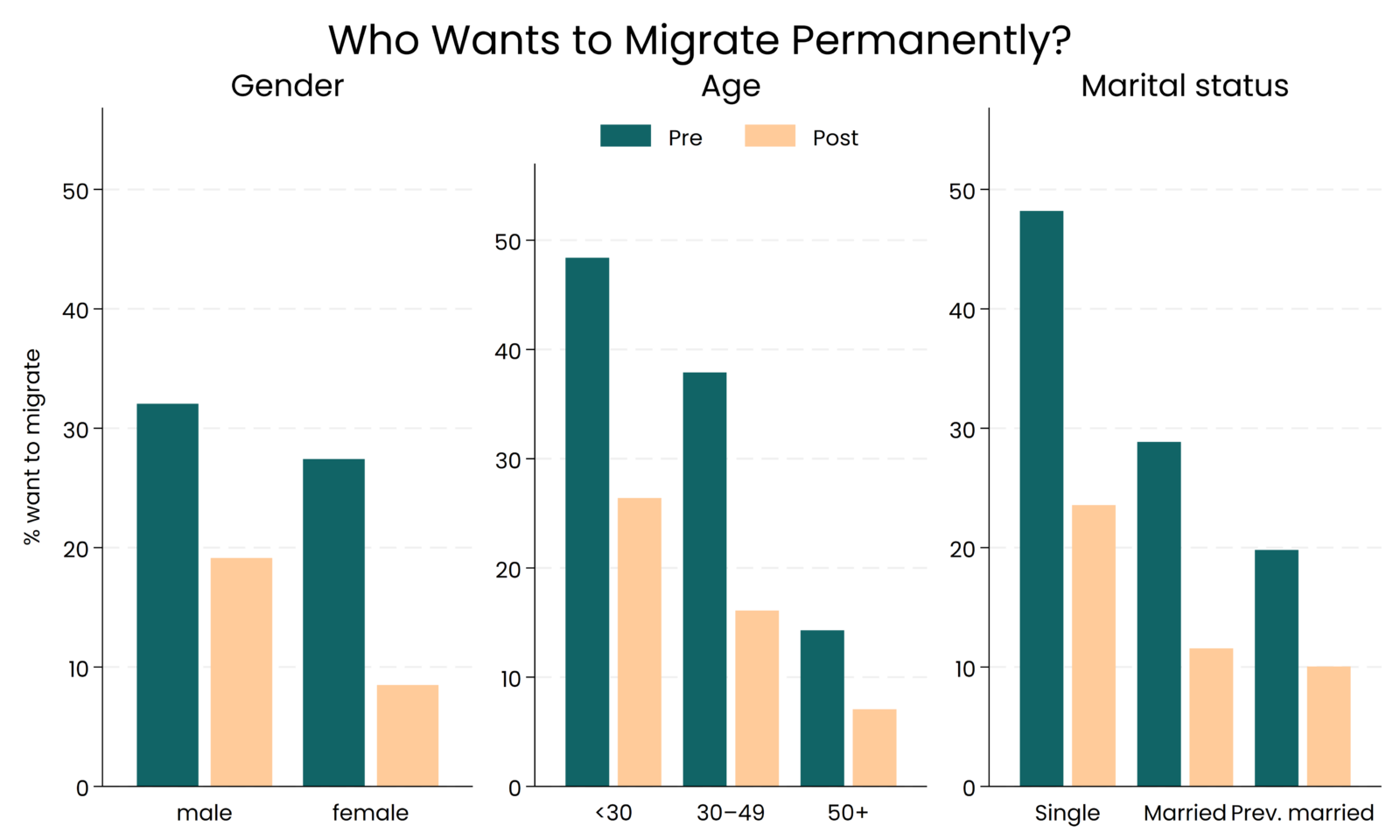
Source: Gallup World Poll, (downloaded on 6 June 2025). Notes: Bars show the weighted share of respondents who report that they would ideally like to move permanently to another country, by demographic group. Shares are calculated relative to all valid respondents within each group and period. Refused responses are excluded. Pre-war averages refer to 2017–2021; post-war averages refer to 2023–2024. The year 2022 is excluded from averaged comparisons.
The decline in expressed desire to move permanently abroad is visible across all age groups, as shown in Figure 3. Among young adults (under 30), the share expressing emigration desire fell from over 50% before the war to roughly 27% in the post-war period. For individuals aged 30–49, it declined from around 40% to approximately 16%. Even among those aged 50 and above, who already exhibited lower pre-war mobility preferences, the share fell from about 15% to below 10%.
Gender differences persist, with men consistently more likely than women to report a desire to emigrate permanently. However, both groups experienced substantial declines after 2022.
A similar pattern is observed across marital status. Single respondents exhibit the highest pre-war levels of emigration desire, followed by previously married individuals, while married respondents report lower levels on average. After 2022, all three groups show marked declines.
Where do Ukrainians want to go?
Pre-war, the US, Germany and Poland were already the three dominant desired destinations across Ukraine, with clear regional differences. The US led in Kyiv and the West, Germany led in the East and in the Center, while Poland was particularly strong in the South and North.
Post-war, this structure remains but becomes more concentrated. Germany strengthened its position in most regions, especially in the Center, where 46% indicate it as their preferred destination. It also consolidates its lead in the North and in the South. Poland becomes instead highly dominant in the West, where it is indicated by around 27% of respondents. This likely reflects geographic proximity and established cross-border networks.
Overall, Germany remains the most frequently named destination across most regions, while Poland becomes even more regionally concentrated in the West.
| Region | Pre-war Destination | Share (%) | Post-war Destination | Share (%) |
| Kiev | United States | 15.5 | United States | 23.4 |
| East | Germany | 16.9 | Germany | 19.3 |
| South | Poland | 17.0 | Germany | 22.1 |
| West | United States | 14.5 | Poland | 27.4 |
| North | Poland | 19.8 | Germany | 31.1 |
| Center | Germany | 22.5 | Germany | 46.0 |
Source: Gallup World Poll, (downloaded on 6 June 2025). Notes: The table reports, for each Ukrainian region and period, the most frequently named destinations among respondents who express a desire to migrate permanently. Shares are calculated as the percentage of potential emigrants naming a destination out of all respondents in that region and period who indicate a desire to migrate to a country. Pre-war averages refer to 2017–2021; post-war averages refer to 2023–2024. The year 2022 is excluded from averaged comparisons.
Current and future expected life satisfaction
Average life satisfaction, measured on a scale from 0 to 10, with higher values indicating better feelings about one’s life, declined after 2022 compared to 2020–2021 levels (See Figure A.1). However, expectations about life quality in five years rose sharply relative to current evaluations.
Figure 4
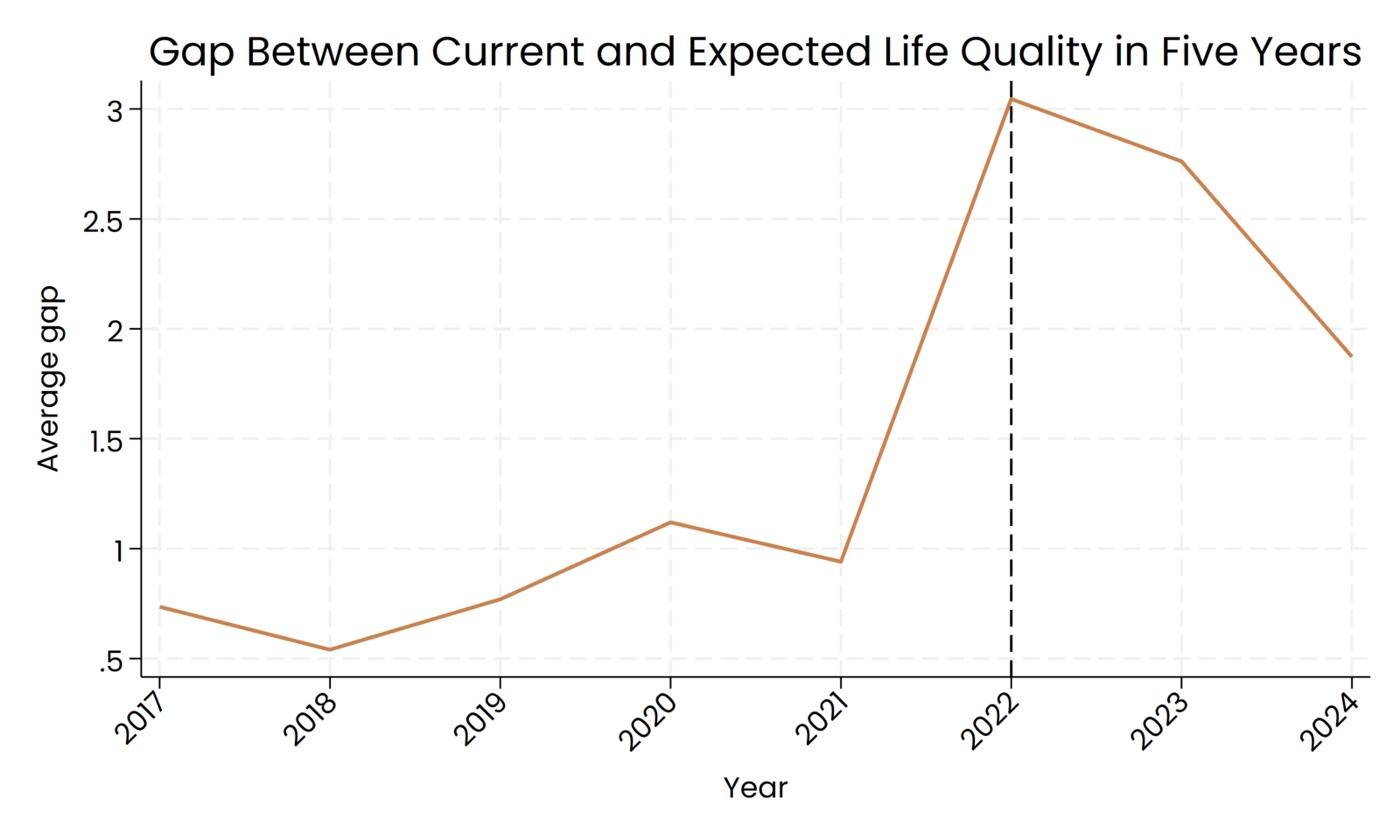
Source: Gallup World Poll, (downloaded on 6 June 2025). Notes: The average gap is defined as the difference between expected life in five years and current life evaluation (0–10 ladder). Don’t know and refused responses are excluded. Pre-war averages refer to 2017–2021; post-war averages refer to 2023–2024. The year 2022 is excluded from averaged comparisons.
The resulting gap, the difference between expected life quality in five years and life today, jumped in 2022 to its highest level in the observed period. In 2021, respondents rated their expected life quality in five years by about one point higher than at the time of the interview, corresponding to an about 20% expected increase. However, in 2021 the gap between contemporary and expected life satisfaction reached more than 3 points at the national level, an expected 60% increase. Although it narrowed slightly in 2023–2024, it remains elevated relative to pre-war years.
Figure 5 shows that the expectations of improvement in life quality increased markedly after 2022 across all regions. Pre-war (2017–2021), the difference between current and expected life satisfaction was modest, typically between 0.6 and 1 point on the 0–10 life evaluation scale. Post-war (2023–2024), it roughly doubled or even tripled, reaching between 2 and nearly 3 points depending on the region. The increase is visible nationwide, including in the East and South.
Figure 5
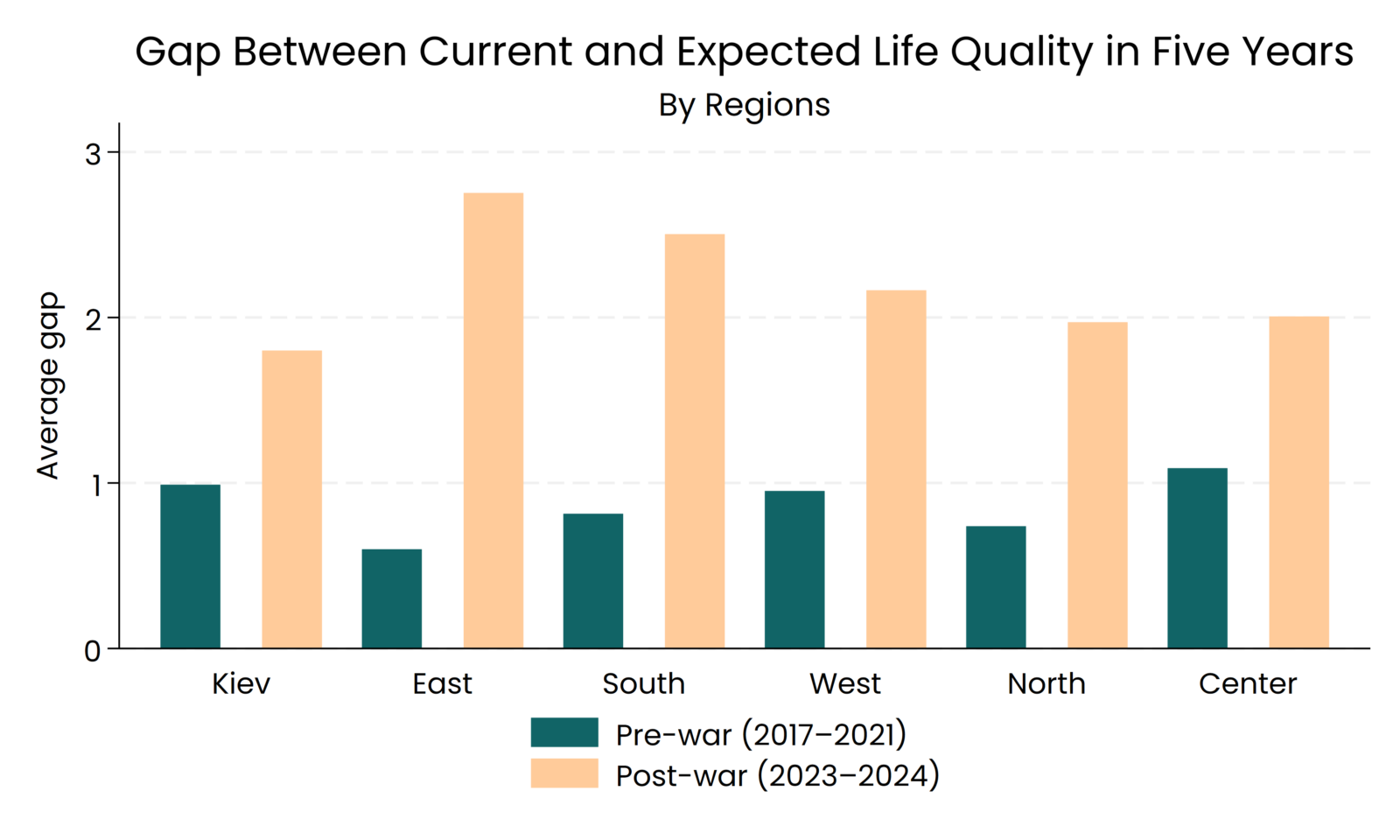
Source: Gallup World Poll, (downloaded on 6 June 2025). Notes: The graph reports the difference between expected life in five years and current life evaluation (0–10 ladder). Bars report weighted group means by Ukrainian regions and period. Don’t know and refused responses are excluded. Pre-war averages refer to 2017–2021; post-war averages refer to 2023–2024. The year 2022 is excluded from averaged comparisons.
Figure 5 highlights that this is not driven by a single region. Every macro-region exhibits a larger post-war gap compared to its pre-war average. The East and South show increases of slightly larger magnitude compared to other regions.
Figure 6
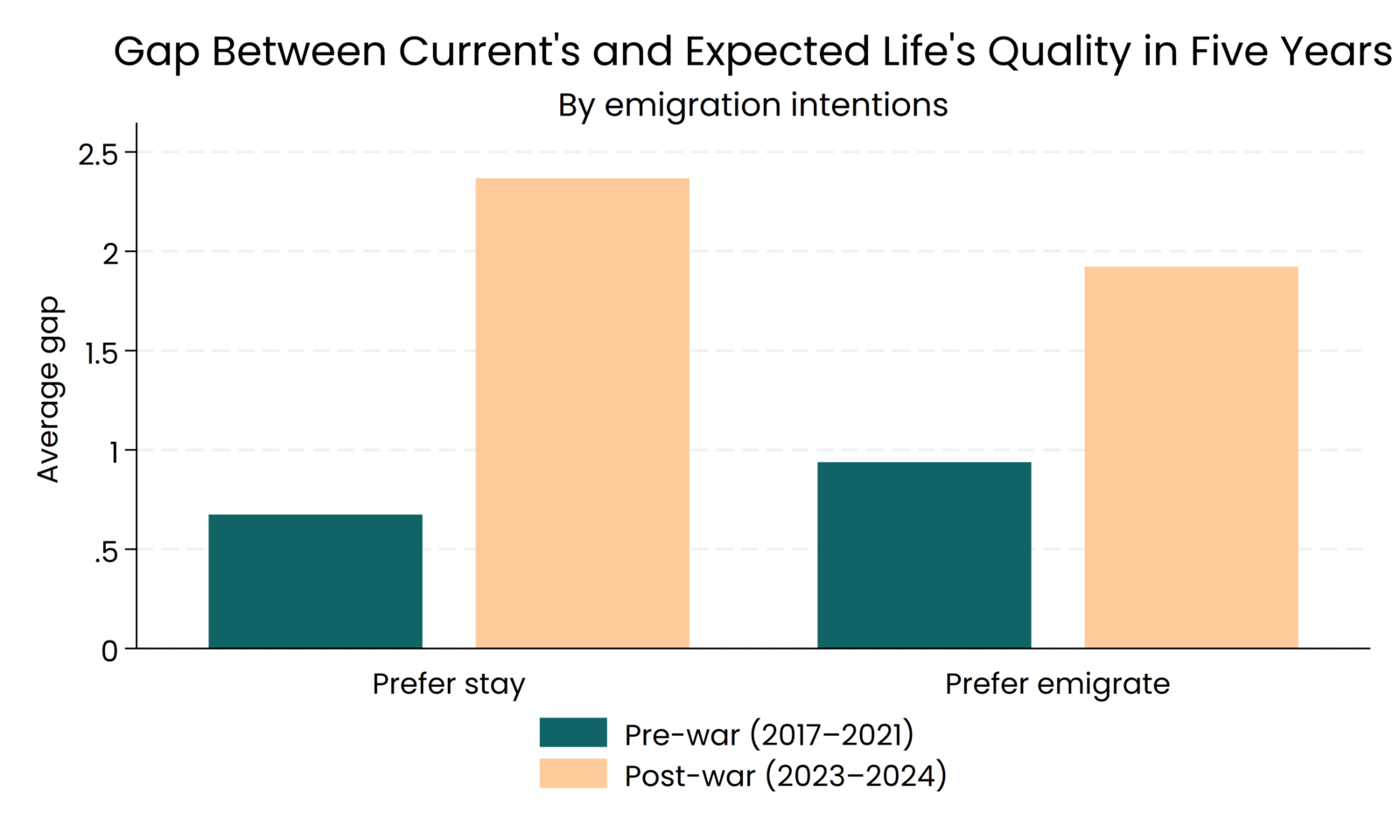
Source: Gallup World Poll, (downloaded on 6 June 2025). The graph reports the difference between expected life in five years and current life evaluation (0–10 ladder). Bars report weighted group means by migration desires and period. Don’t know and refused responses are excluded. Pre-war averages refer to 2017–2021; post-war averages refer to 2023–2024. The year 2022 is excluded from averaged comparisons.
Figure 6 adds an important dimension by distinguishing between those who prefer to stay and those who would prefer to emigrate permanently. Before the war, individuals expressing emigration desire had a slightly larger differential between current and expected life satisfaction than those preferring to stay. After 2022, this relationship reverses. The gap grows substantially for both groups, but the increase is stronger among those who say they prefer to remain in Ukraine.
Conclusion
The decline in expressed permanent emigration desire after 2022 does not imply that outward migration stopped. Millions of Ukrainians were displaced and received temporary protection abroad (Operational Data Portal – UNHCR). What the data show instead is that among those remaining in Ukraine, the balance between staying and leaving appears to have shifted.
The observed shift may reflect multiple factors. First, wartime mobilization may strengthen attachment to place and reinforce collective identity. Second, the expectations of improvement in life quality in the future, visible across regions and especially pronounced among those who prefer to stay, suggest stronger expectations of future recovery despite present hardship. Third, migration itself may have been re-framed: for many, displacement became a temporary protection strategy rather than a long-term resettlement project.
Four years into the full-scale war, these findings differ from the assumption that wartime conditions necessarily increase expressed permanent emigration desire. Expressed desire to move permanently abroad fell sharply in 2022 and remains substantially below pre-war levels. At the same time, optimism about the future increased relative to assessments of the present.
[1] See Tajfel, Henri (1974). “Social Identity and Intergroup Behaviour.” Social Science Information 13(2): 65–93 and Tajfel, H., & Turner, J. C. (1979). “An integrative theory of inter-group conflict.“ In W. G. Austin & S. Worchel (Eds.), The social psychology of inter-group relations (pp. 33–47). Monterey, CA: Brooks/Cole.
Appendix
Figure A.1
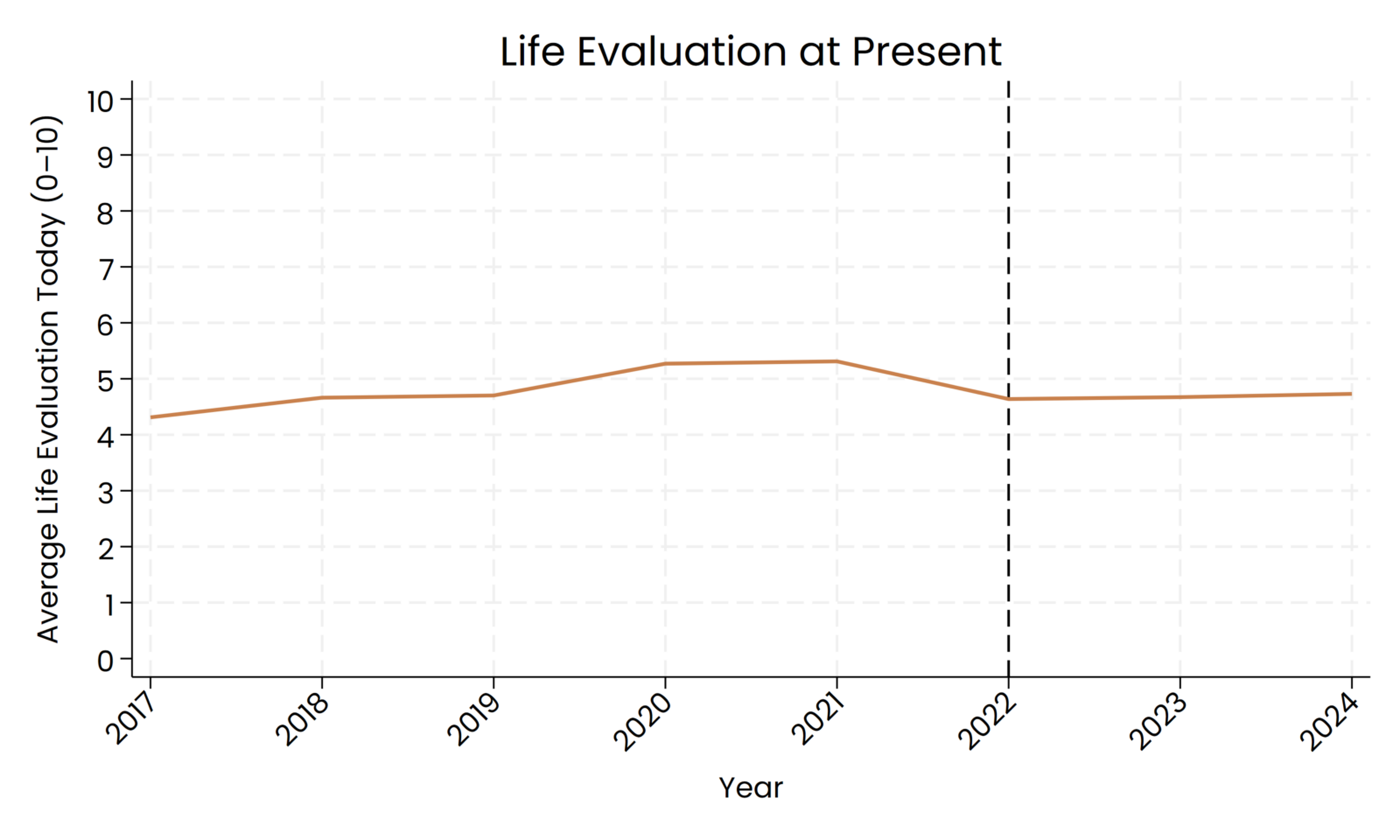
Source: Gallup World Poll, (downloaded on 6 June 2025). The average life today is defined on a 0–10 ladder. Don’t know and refused responses are excluded. Pre-war averages refer to 2017–2021; post-war averages refer to 2023–2024. The year 2022 is excluded from averaged comparisons.
