


Short Summary
Can a mental health app on your phone sustainably improve psychological wellbeing? New evidence from Mexico suggests that it can. 1,964 women experiencing at least mild psychological distress were offered free access to Mindsurf, an AI-powered well-being app based on cognitive behavioral therapy principles.
Over six months, app access improved mental health by about 0.3 standard deviations. It reduced moderate-or-higher depression by 12.6 percentage points and moderate-or-higher anxiety by 8.7 percentage points – roughly one-fifth lower than in the control group. Users also slept more, went out more often, spent less heavy time on social media, and missed fewer days of work. These findings matter because access to formal mental health care remains limited despite the high prevalence of mental disorders.
Key Findings
- The study randomly assigned 1,964 women in Mexico to receive app access or serve as a control group.
- App access improved overall mental health by about 0.3 standard deviations over six months.
- Moderate-or-higher depression fell by 12.6 percentage points; moderate-or-higher anxiety fell by 8.7 percentage points.
- Active use fell from 82% in week 1 to 22% at 3 months, yet benefits persisted; extending access after month 3 raised use but produced no added benefits.
- The app increased psychotherapy use by 5 percentage points, mainly among women with higher initial distress.
Relevance Today
One in seven people suffer from a mental disorder, yet most people do not receive formal care. At the same time, AI mental health tools are spreading faster than the evidence base around them. For health ministries, insurers, employers, and NGOs, we show how a low-cost tool can expand access and alleviate distress with no evidence of harm, while also connecting some high-need users to formal care. The evidence suggests that digital care need not crowd out in-person psychotherapy: apps can provide a helpful layer of support and, for some users, also increase professional treatment.
Author Quote
“Scalable technology can cost-effectively improve mental health and economic outcomes, without exacerbating severe symptoms or displacing skilled care.“
Reference: Based on Angelucci, Fabregas, and Vazquez (2026), “The Well-Being Effects of Digital Mental Health Care,” RF Berlin Discussion Paper 107/26
Research Summary
About 1 billion people suffer from mental disorders, which can affect daily life, work, and relationships. Yet the vast majority are untreated, partly because care can be costly and time consuming, providers can be scarce, and stigma or other barriers can stop people from starting treatment. The central question in this study is: can a low-cost AI-powered app improve well-being for people who need support?
The results are encouraging. Access to Mindsurf improved mental health, reduced moderate symptoms of depression and anxiety, and improved sleep and daily functioning. The impacts persisted after most people reduced or stopped using the app. The study also finds greater psychotherapy use among women with higher initial distress, suggesting complementarity with formal care for some users.
Digital mental health tools are attractive because they are private, flexible, and cheap. They can be used late at night, on weekends, or when symptoms suddenly become harder to manage. This matters because distress is not confined to scheduled appointment times.
The case for AI-powered care needs evidence. Many digital health products lose users quickly. There are also concerns about safety, low-quality advice, isolation, and whether apps might draw people away from evidence-based care. The study directly tests these concerns.
We partnered with a Mexican company to evaluate their wellbeing app Mindsurf. The app includes a mood diary, guided audio exercises, self-assessment tools, and an AI conversational agent. The agent was trained to provide mental health support, restricted to CBT-informed topics, and paired with multiple safety protocols, including detection of acute distress and human review of concerning content. The study recruited 1,964 women in Mexico with at least mild psychological distress. Half received access to the app for three or six months, while the control group received access later.
App improves mental health across many dimensions
The mental health effects were sizable and persistent. App access improved a combined mental health index by 0.3 standard deviations. Depression, anxiety, stress, and well-being all moved in favorable directions. The share of participants with moderate-or-higher depression fell from about 63% in the control group to about 50% in the treatment group. The share with moderate-or-higher anxiety fell from about 43% to 34%.
We also find no evidence that app access worsened severe distress. Severe depression and severe anxiety were up to 25% lower in the treatment group. This matters because safety is one of the strongest concerns around AI-based mental health support.
The benefits extended beyond symptom scores. Treated participants slept about 10 extra minutes per night, went out about 0.3 more days per week, and were less likely to report heavy social media use. They also missed about two fewer workdays over six months.
Figure 1:
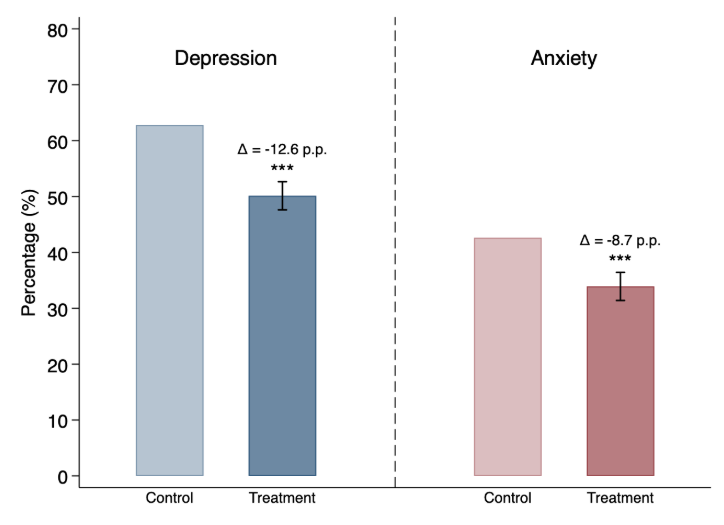
Figure 1: Effects of app access on depression and anxiety. The bars compare the control and treatment groups for moderate-or-higher depression and anxiety symptoms pooled across survey waves. Percentage-point differences are treatment-control gaps.
Figure 2:
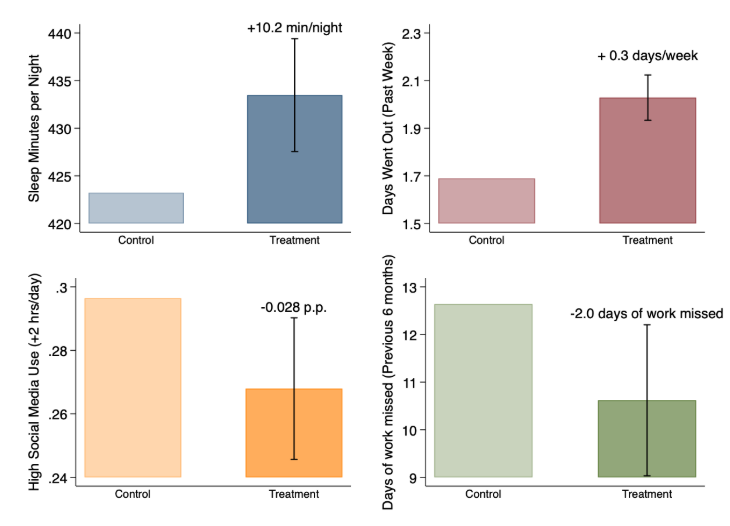
Figure 2: Effects on selected wellness and functioning outcomes. The figure shows changes in sleep, going out, heavy social media use, and work missed over six months.
Engagement and persistence
App use was varied and opportunistic, with high frequency also at times in which it is hard to reach a formal mental health care provider, such as nights and weekends. App engagement was initially high but declined sharply. About 82% of treated participants used the app in the first week. By week 8, 36% were active. By week 26, active use was below 10%. This pattern is common for digital products and is often read as a sign that users do not value them.
The persistence of sustained benefits despite declining use suggests that the app is a tool for learning and adopting CBT-inspired practices, not only a service consumed while logged in. This is consistent with CBT, which aims to teach routines that people can carry into daily life. The study finds evidence consistent with that channel: treated participants reported more frequent use of CBT-informed practices, such as journaling, self-kindness, setting boundaries, breathing exercises, and sleep routines. Improvements in sleep and healthful behaviors also explain a sizable share of the mental health gains: participants with larger mental health gains tended to show larger gains in these behaviors, while heavier app use did not predict larger gains.
The second randomization helps clarify this point. After three months, the researchers randomly extended premium access for half of the treated users from three to six months. Extended access increased use by about 39%, but it did not further improve mental health, sleep, or behavior outcomes. Thus, after the first three months, use was decoupled from benefits: more time in the app did not translate into larger gains.
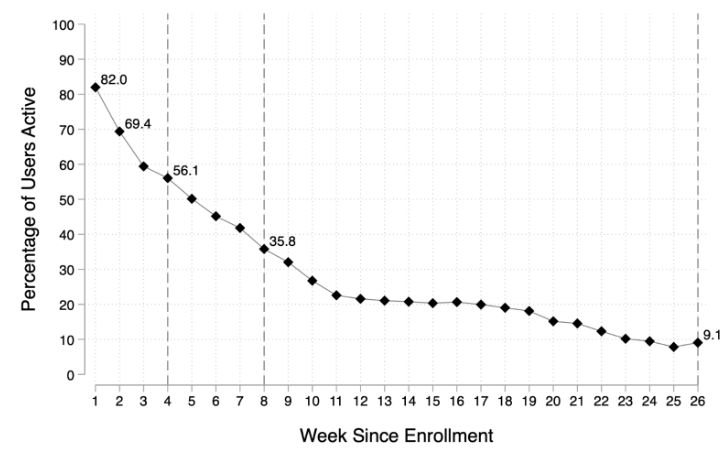
Panel A. Weekly active app use.
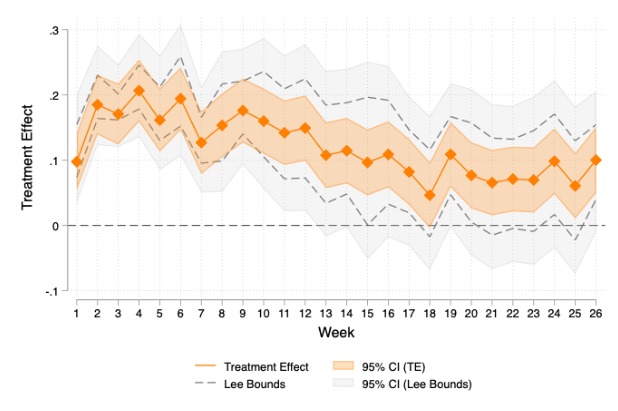
Panel B. Weekly effects on positive affect.
Figure 3. Engagement and weekly positive affect. Panel A shows the share of treated participants using the app each week. Panel B shows weekly treatment effects on reporting happy affect, with confidence intervals and Lee bounds.
Did the app replace therapy?
App access increased psychotherapy use. Participants offered the app were 5 percentage points more likely to report a recent psychotherapy visit. The increase was concentrated among women who began the study with moderate or severe distress.
This suggests that the app may have reduced non-monetary barriers to treatment. For example, it may have made symptoms more manageable, helped users understand their needs, or made the step toward formal care easier. The added psychotherapy use explains only a small share of the mental health gains, so the app itself appears to have played an important role.
Policy implications
AI-powered digital care can serve as a useful layer of support when formal care is scarce. A carefully designed app may help some users directly and help others move toward professional care.
The study also shows why evaluation needs outcome measures beyond downloads, time spent, and retention. For tools that teach skills or promote their adoption, use can fall while benefits remain. Funders and governments should measure outcomes alongside engagement.
Cost is another reason the findings matter. The paper estimates a low per-user cost and a favorable benefit-cost ratio based on reduced missed work alone. These back-of-the-envelope calculations point to a possible case for public or institutional financing, especially where subscription models may not capture benefits that persist after users stop active use.
Conclusion
This study provides clear evidence that a scalable and safeguarded AI-powered mental health app can improve well-being, sleep, daily functioning, and labor market outcomes among women experiencing psychological distress in Mexico without displacing traditional care. Thus, AI-powered digital tools can be an additional way to address the global gap in mental health care.
