



Short Summary
Across most Western countries, mothers who give birth usually take some form of leave from work. But what happens within a firm when a worker goes on a planned parental leave? We study this question in the context of Austria, using data from over 33,000 births in small firms between 1985 and 2000.
We find that firms adjust mainly by hiring new workers, but also by retaining workers they already employ. Hiring begins months before childbirth and peaks just before the birth, suggesting that firms prepare for the upcoming absence in advance. Because there is some overlap between the pregnant worker and the new hire, the number of employees rises before the birth. When the mother goes on leave the firm employs fewer workers, as it does not fully replace the mother on leave, but in the longer term, employment recovers.
Five years after the birth, on average, one in ten firms employs one extra worker compared to similar firms without a birth, but their total wage bill is similar. This is because many mothers return to work part-time, so headcount rises slightly without a corresponding increase in labor costs. Even when Austria doubled the length of available parental leave, firms’ responses changed little.
Importantly, this adjustment is not gender-neutral. Replacement hires are almost exclusively women, but firms also rely more on existing, mostly male, workers to cover any gaps. As a result, male workers are more likely to remain with firms where mothers go on leave. Thus, even when firms appear largely unaffected in aggregate, a birth can still produce meaningful gendered reallocation within the workplace.
Key Findings
- Firms prepare before the leave begins: Hiring starts months before childbirth and peaks just before the mother goes on leave.
- Replacement hiring is the main response: Firms mostly adjust by bringing in new workers.
- Firms respond similarly even when the leave lasts longer: Longer parental leave changes how long mothers stay home, but not how firms adjust to the absence, especially in the long run.
- Parental leave reshapes gender dynamics within firms: Replacement hires are mostly women, while firms rely more on existing male workers, who become more likely to stay.
Author Quote
“Our results show why it is not enough to look only at total employment or labor costs. Firms can manage a parental-leave absence in the aggregate while still changing who is hired and retained inside the firm.”
Reference: Based on Anne Brenoe & Ursa Krenk & Andreas Steinhauer & Josef Zweimueller, 2025. “How Do Firms Respond to Parental Leave Absences?,” RFBerlin Discussion Paper Series 14/25. Accepted at the Journal of Public Economics.
Research Summary
Childbirth typically creates a temporary workplace absence for mothers. From the firm’s perspective, this raises three questions. First, how does a firm absorb the temporary reduction in labor supply? It can hire a replacement, redistribute work among existing employees, or some combination of the two. Second, who absorbs that adjustment inside the firm? Since the temporarily absent worker is by definition a woman, an apparently neutral aggregate response can still mask a gendered reallocation of work. Third, do firms respond differently when leave is longer? Extended leaves may imply greater disruption, and firms may therefore adjust more strongly.
Austria provides a useful setting to study these questions. Parental leave after childbirth is relatively long compared to many other Western countries, so if extended leaves impose meaningful long-term effects on firms, Austria is where we would expect to see them. Firms also bear no direct labor costs during the leave; benefits are funded by the government, and jobs are protected by law. Three distinct policy regimes during our study period provide sharp variation in leave duration: before July 1990, leave lasted up to one year; a 1990 reform extended it to two years; and a 1996 reform reduced the de-facto duration for mothers to about 18 months (the remaining six months were reserved for fathers, but take-up among fathers was near zero).
We use the Austrian social security register, a matched employer-employee dataset covering all private-sector employment, to analyze births in small firms (fewer than 30 employees) between 1985 and 2000. Each firm with a birth is compared to a similar firm without one, with the match anchored one year before the birth to avoid bias from pregnancy-related job mobility.
How firms adjust
We find that firms adjust mainly by hiring new workers, but also by retaining workers they already employ. External hiring is anticipatory: it begins months before childbirth and peaks in the quarter immediately preceding the birth. Because there is some overlap between the pregnant worker and the new hire, both headcount and the wage bill rise before the birth. They then fall below pre-birth levels after childbirth, as the mother goes on leave, and gradually converge toward a new level once the leave period ends.
Five years after the birth, firms employ about 0.1 more workers than comparable firms without a birth, but their total wage bill is similar. This is partly because many mothers return to work part-time, so headcount rises slightly without a corresponding increase in labor costs.
Figure 1a) Employees at the firm (excluding the mothers on leave)
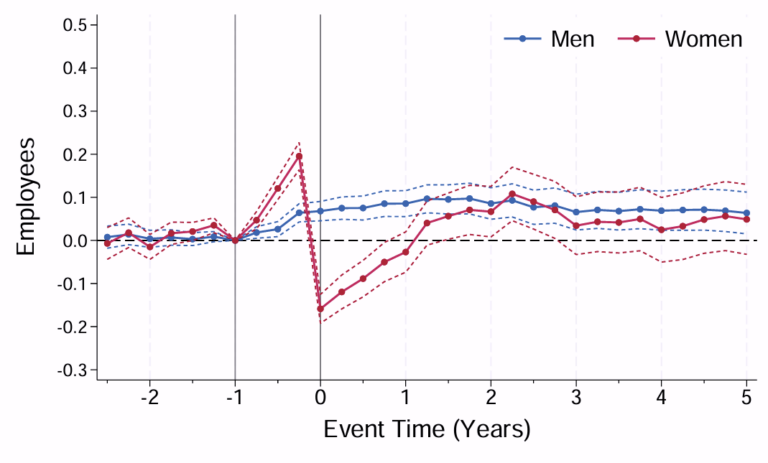
Figure 1b) Wage bill at the firm
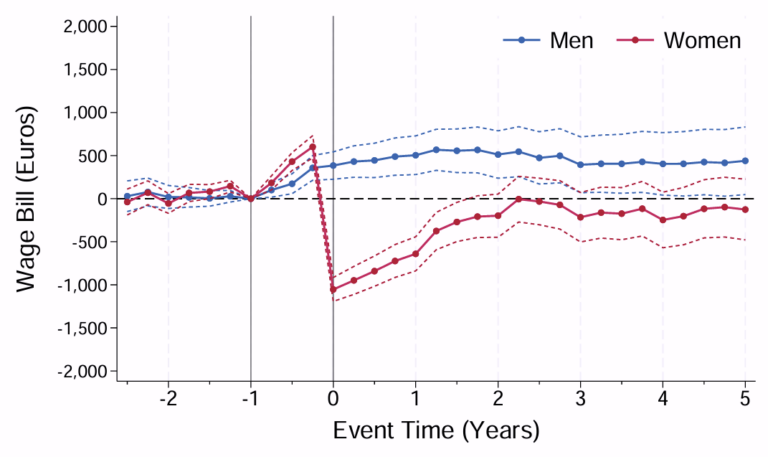
Figure 1: Panel (a) shows the number of male and female employees (excluding the mother on leave), and panel (b) the wage bill paid to male and female employees, at firms where a woman went on parental leave, compared with similar firms where a comparable employee did not go on leave. Time 0 is the quarter when the employee went on leave.
A gendered adjustment within the firm
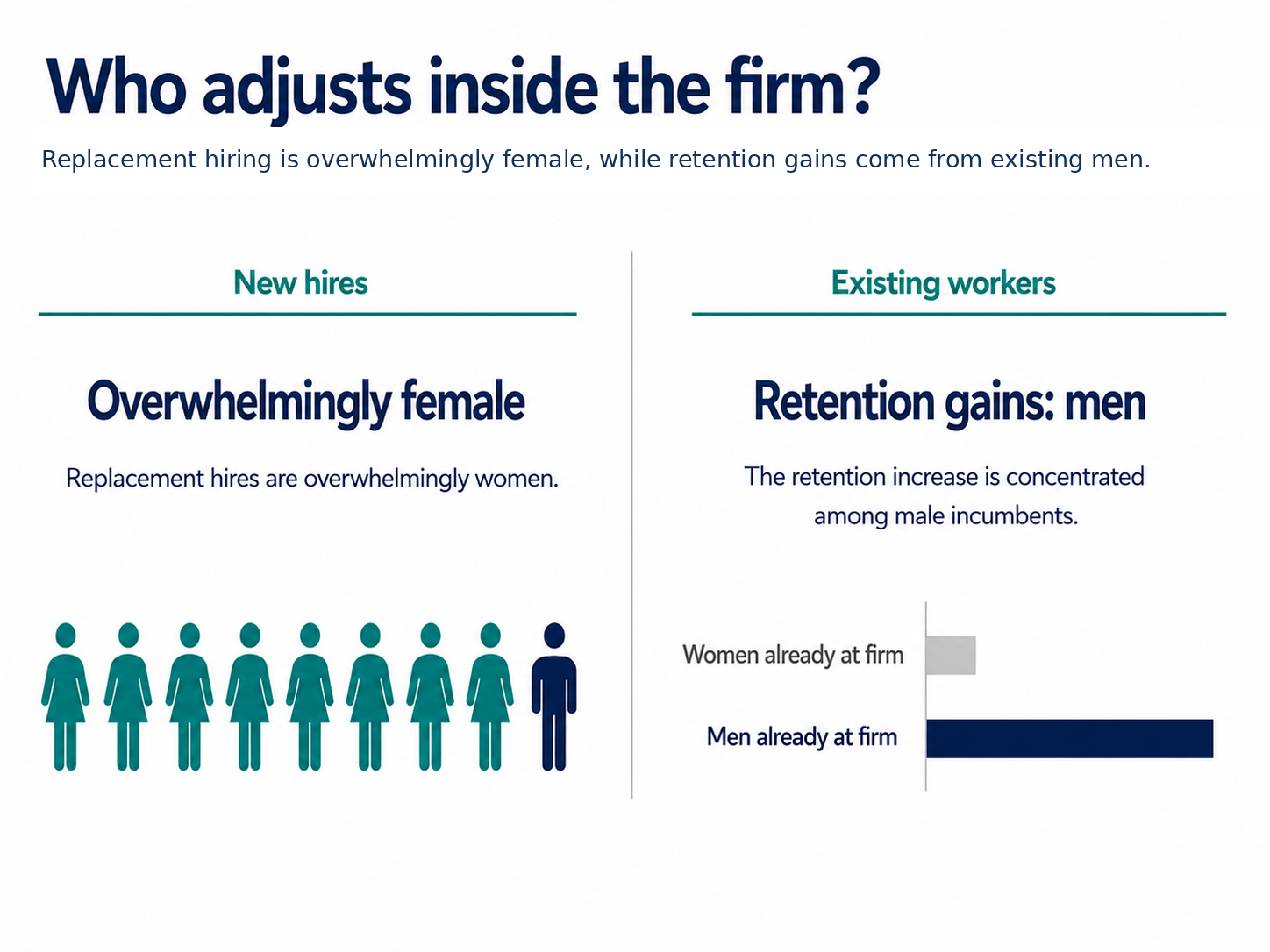
Importantly, this adjustment is not gender neutral. Almost all external hires are women; fewer than 10% of extra hires in the months around childbirth are men. The pattern is the opposite for employees who were already at the firm before the birth (incumbent workers). Incumbents represent a smaller adjustment margin overall, but all of the increase in retention comes from male employees are more likely to stay. Women who were already at the firm are no more likely to remain than in comparable firms without a birth. In short, the rise in female employment comes almost entirely from new external hires, while more than half of the increase in male employment comes from existing male employees staying longer.
Leave duration does not change firm responses
Even when Austria doubled the length of parental leave, firms’ responses changed little; in fact, firm-level outcomes look similar when the parental leave was one-year, eighteen-months, and two years long. Longer leave changes how long mothers stay home; it does not change how firms adjust to the absence. The reason is that parental leave is predictable. Firms learn about the absence months in advance and use that time to prepare, in contrast to unexpected worker exits, where replacing a worker can be very costly.
Conclusion
Our findings show that firms adjust to parental-leave absences mainly by hiring replacement workers in advance. Although these absences lead to clear short-run changes in staffing and wage costs, firms appear to absorb them without substantial long-run effects on overall employment or labor costs. Even large changes in how long mothers stay on leave do not materially alter this firm-level response.
Yet these muted aggregate effects conceal an important internal shift. Firms’ adjustments are strongly gendered: replacement hiring is overwhelmingly female, while the more persistent gains in retention are concentrated among men already employed at the firm. Parental leave, in other words, does not simply create a temporary staffing gap. It can also reshape who is hired, who stays, and who firms come to rely on.
One reason firms manage these absences relatively smoothly is that childbirth-related leave is predictable. Employers typically receive advance notice and begin adjusting before the leave starts. This distinguishes parental leave from unexpected worker exits, which often impose much larger costs. The broader lesson is that even when parental leave creates limited aggregate disruption for firms, it may still produce meaningful gendered reallocation within the workplace.
References
- Brenøe, A. A., Canaan, S. P., Harmon, N. A., and Royer, H. N. (2024). “Is Parental Leave Costly for Firms and Coworkers?” Journal of Labor Economics 42 (4): 1135–1174.
- Corekcioglu, G., Francesconi, M., and Kunze, A. (2025). “Parental Leave from the Firm’s Perspective.” IZA Discussion Paper 17893, IZA Institute of Labor Economics.
- Gallen, Y. (2019). “The Effect of Parental Leave Extensions on Firms and Coworkers.” Working paper, University of Chicago Harris School of Public Policy.
- Ginja, R., Karimi, A., and Xiao, P. (2023). “Employer Responses to Family Leave Programs.” American Economic Journal: Applied Economics, 15(1):107-135.
- Huebener, M., Jessen, J., Kuehnle, D., and Oberfichtner, M. (2025). “Parental Leave, Worker Substitutability and Firms’ Employment.” The Economic Journal, 135(669):1467-1495.
- Jäger, S., Heining, J., and Lazarus, N. (2024). “How Substitutable Are Workers? Evidence from Worker Deaths.” American Economic Review. Conditionally accepted.
- Kleven, H., Landais, C., Posch, J., Steinhauer, A., and Zweimüller, J. (2024). “Do Family Policies Reduce Gender Inequality? Evidence from 60 Years of Policy Experimentation.” American Economic Journal: Economic Policy, 16(2):110-149.
- Oi, W. Y. (1962). “Labor as a Quasi-Fixed Factor.” Journal of Political Economy, 70(6):538-555.
