
Summary
- Migration aspirations broadly mirror existing refugee corridors. In both Iran and Lebanon, respondents most frequently name destinations where sizeable diaspora communities already exist.
- Iranian and Lebanese refugee destinations are concentrated in a small number of countries, particularly Germany, Canada, and a few other high-income countries in Europe and North America.
- Germany emerges as the most prominent European destination, appearing both as the largest host of refugees and as one of the most frequently mentioned aspired migration destinations.
- Education influences destination preferences more strongly than age. Less-educated respondents are more concentrated on European destinations (in particular, Germany), while more-educated respondents consider a wider range of global destinations.
- If refugee movements increase in the current crisis, the evidence suggests that a small group of countries, particularly Germany in Europe and Canada globally, are likely to receive the largest share of arrivals.
Introduction
The recent escalation of conflict in the Middle East has raised concerns about potential new displacement from several countries in the region. The US and Israeli military strikes initiated on February 28 on Iranian targets and then expanded to Lebanon triggered a broader regional confrontation, with missile exchanges and rising tensions across the Middle East. UNHCR reports that humanitarian actors are already mobilizing across the region as the crisis intensifies, monitoring possible population movements and preparing for new humanitarian needs. As of March 10, almost 700,000 people are already internally displaced in Lebanon as a consequence of the conflict.
If refugee movements increase, and if displacements also become international, an important question is where these refugees are most likely to go. Two sources of information can provide early signals. First, the geographic distribution of existing migrant communities reveals the diaspora networks and migration corridors that are already in place. Second, survey data on migration aspirations indicate where people say they would prefer to migrate if given the opportunity.
This report combines three data sources for Iran and Lebanon: UN DESA migrant stock data, UNHCR refugee data, and Gallup World Poll data on migration aspirations.
Diaspora populations: Iran and Lebanon
Existing migrant communities provide an important indication of where future international displacement may be directed. Migrant stock data reflect the broader geographic distribution of diaspora networks that can lower the costs and risks of onward migration.
Figure 1 shows the distribution of Iranian migrants (defined as Iranian-born persons outside of Iran) across destination countries in 2024, based on UN DESA International Migrant Stock 2024. The United States hosts by far the largest share of Iranian migrants, accounting for roughly 25% of the global Iranian migrant population. Germany is the second-largest destination, with around 16%, followed by Canada and Turkey, each accounting for around 12%. The United Kingdom also hosts a sizeable share (7%), while Sweden and Australia account for smaller but still visible proportions (about 5% each).
Figure 1
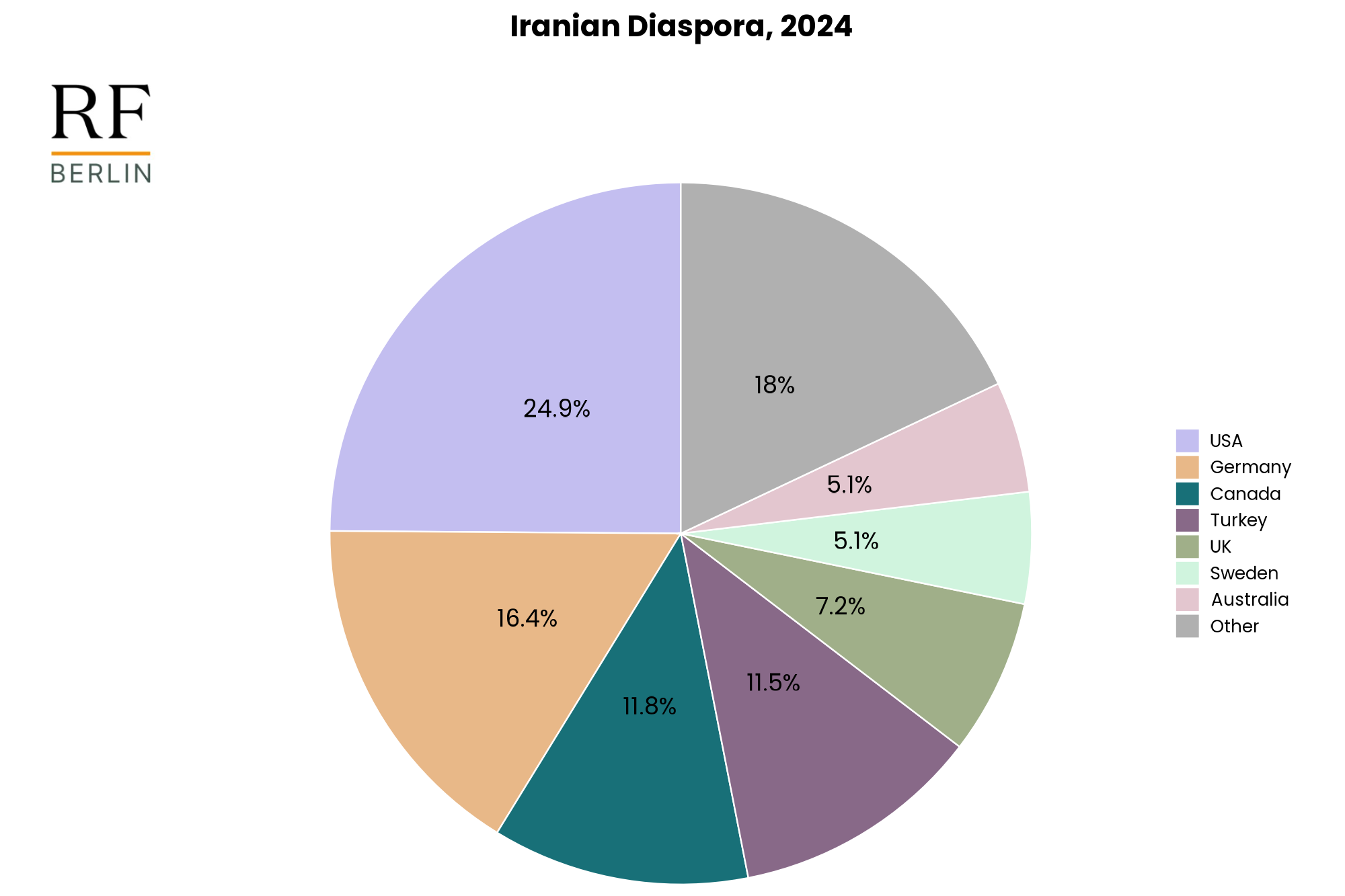
Sources: Our elaboration on UN DESA International Migrant Stock 2024, (downloaded on 11 March 2026). Notes: A migrant is defined as a person living in a country different from their country of birth or citizenship for at least 12 months. The figure shows the share of migrants from Iran residing in each destination country in 2024. “Other” groups together destination countries outside the largest destinations shown.
The distribution of Lebanese migrants exhibits a broader spread across destinations. As shown in Figure 2, the United States again accounts for the largest share of migrants from the country, hosting roughly 22% of Lebanese migrants worldwide. Canada and Australia follow, each accounting for around 14%, while Saudi Arabia and France also host sizeable shares (almost 8% each). Other important destinations include the United Arab Emirates (6%), Sweden (5%), Turkey (4%), and Brazil (2%). Compared with Iran, the Lebanese diaspora appears more diversified geographically, spanning North America, Europe, the Gulf region, and parts of Latin America.
Figure 2
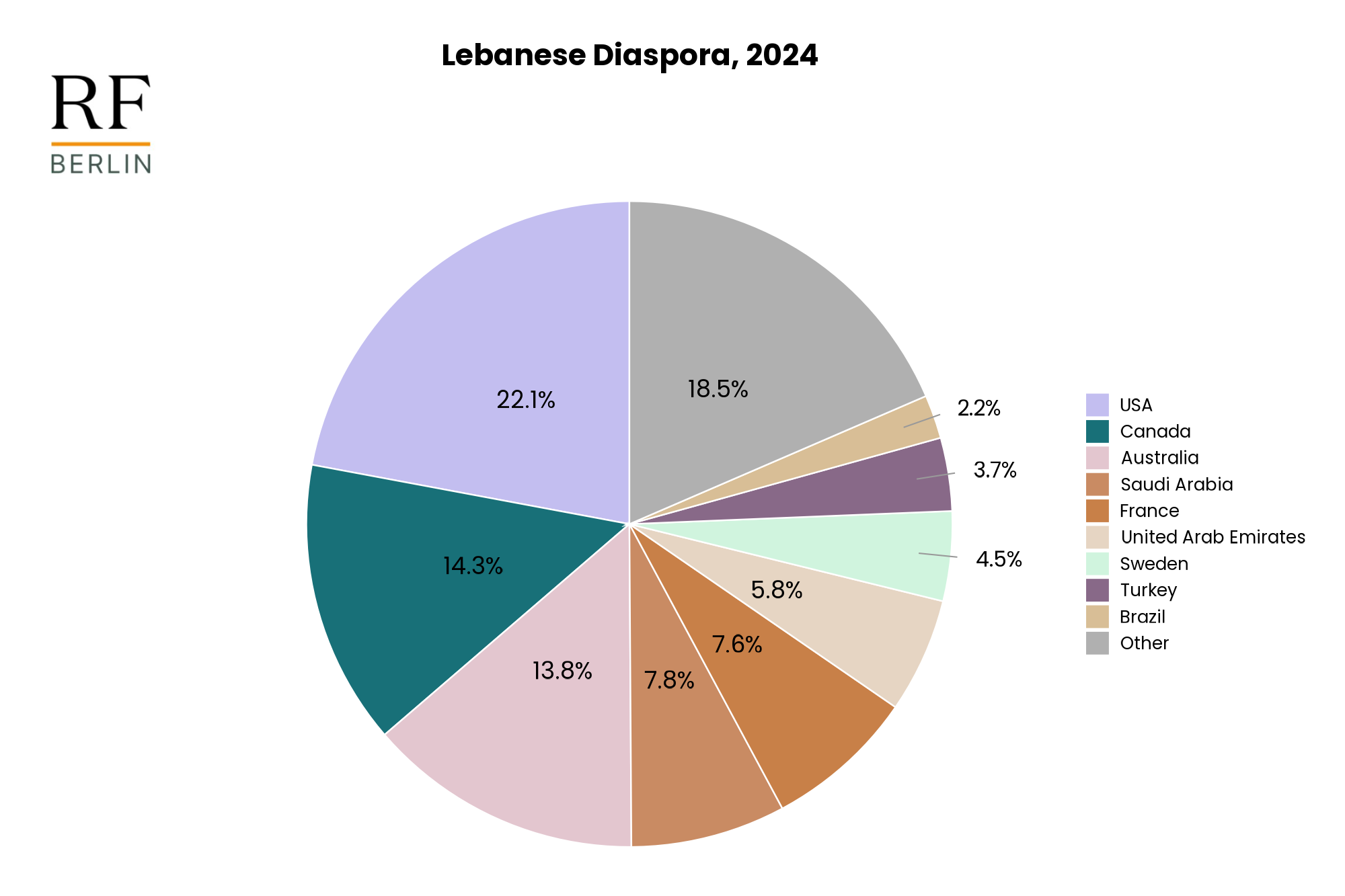
Sources: Our elaboration on UN DESA International Migrant Stock 2024 (downloaded on 11 March 2026). Notes: A migrant is defined as a person living in a country different from their country of birth or citizenship for at least 12 months. The figure shows the share of migrants from Lebanon residing in each destination country in 2024. “Other” groups together destination countries outside the largest destinations shown.
Figures 1 and 2 suggest that migrant networks from both Iran and Lebanon are concentrated in several countries, with particularly strong communities in North America and Europe. At the same time, the Lebanese diaspora appears more geographically diverse and includes a stronger Gulf component.
While migrant stocks capture the broader geography of diaspora networks, refugee populations provide information about the destinations of recent forced migrants and might be more informative of where the next wave of refugees from these countries will go. In 2025, the global number of refugees from Iran is estimated at around 160,000. Relative to Iran’s population of approximately 91.6 million in 2024, this represents 0.17%. By comparison, the number of Lebanese refugees worldwide is considerably smaller. In 2025, around 9,500 Lebanese refugees were recorded globally. Given Lebanon’s population of about 5.8 million in 2024, this represents 0.16% of the population, a share broadly comparable to that observed in Iran despite the much smaller absolute number of refugees.
Based on UNCHR data on refugee population, the distribution of refugees across host countries shows several similarities with the geography of existing migrant networks (Figure 3). For Iran, refugee populations are primarily concentrated in a small number of high-income countries, where Germany and the United Kingdom host the largest shares (respectively 29% and 26%), followed by Canada (8%) and Austria (5%). For Lebanon, refugee distribution is similarly centered on a limited number of destinations, including Canada (12%), Denmark (10%), and France (6%). Interestingly, while Germany did not rank among the nine countries with the largest diaspora populations from Lebanon, it hosts the largest refugee population, at 34%.
Figure 3
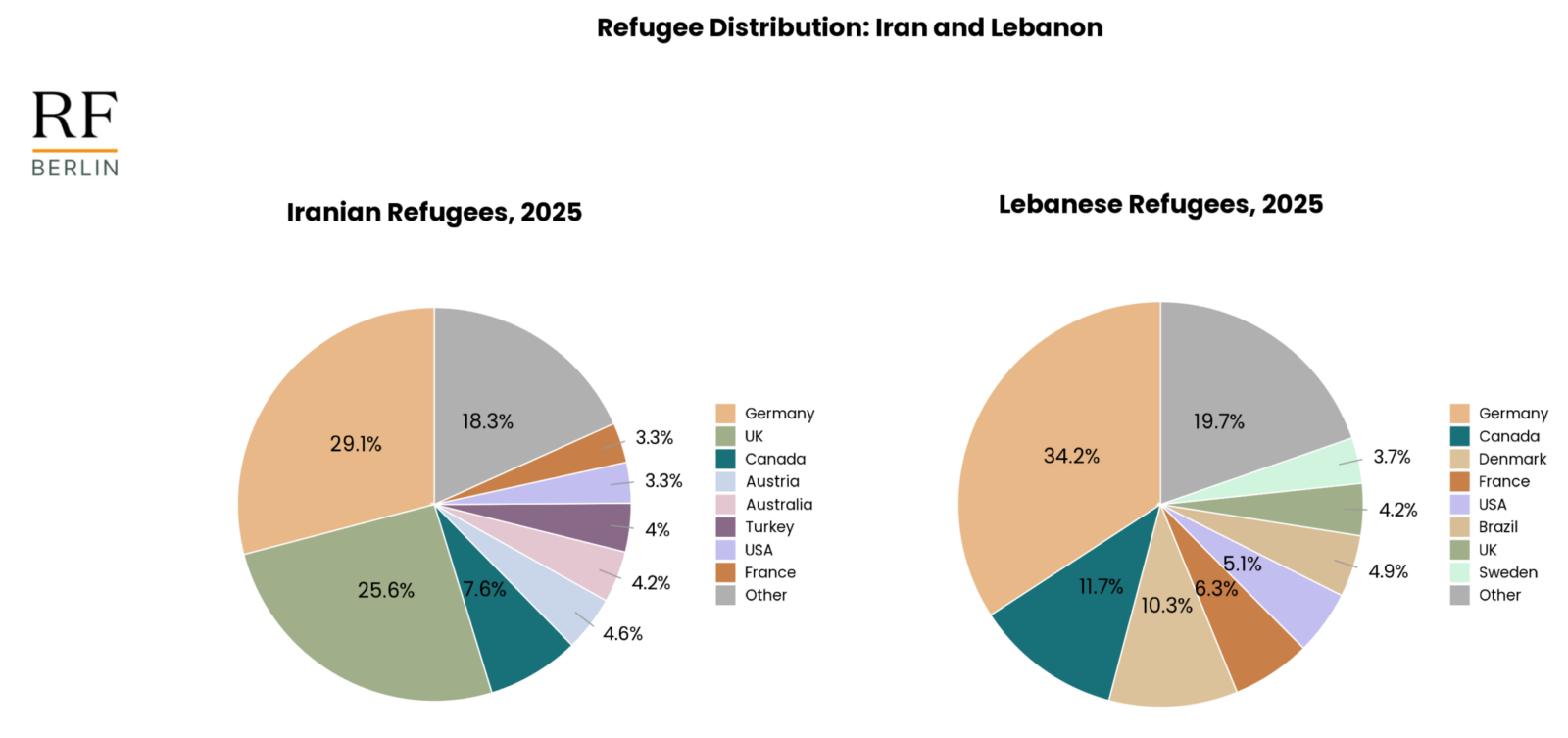
Sources: Our elaboration on UNHCR Refugee Data Finder (downloaded 6 March 2026). Notes: Refugee populations represent the number of refugees from Iran and Lebanon residing in each country at year-end.
Migration aspirations
Survey data on migration aspirations provides an additional perspective on potential refugee destinations. Migration aspirations are measured using responses to the Gallup World Poll question:
“Ideally, if you had the opportunity, would you like to move permanently to another country, or would you prefer to continue living in this country?” (WP1325)
Respondents who express a desire to migrate are then asked:
“To which country would you like to move?” (WP3120)
These responses allow us to examine where individuals say they would prefer to migrate if given the opportunity.
Figure 4 presents the distribution of preferred migration destinations among Iranian respondents who express an aspiration to migrate permanently abroad.
Figure 4
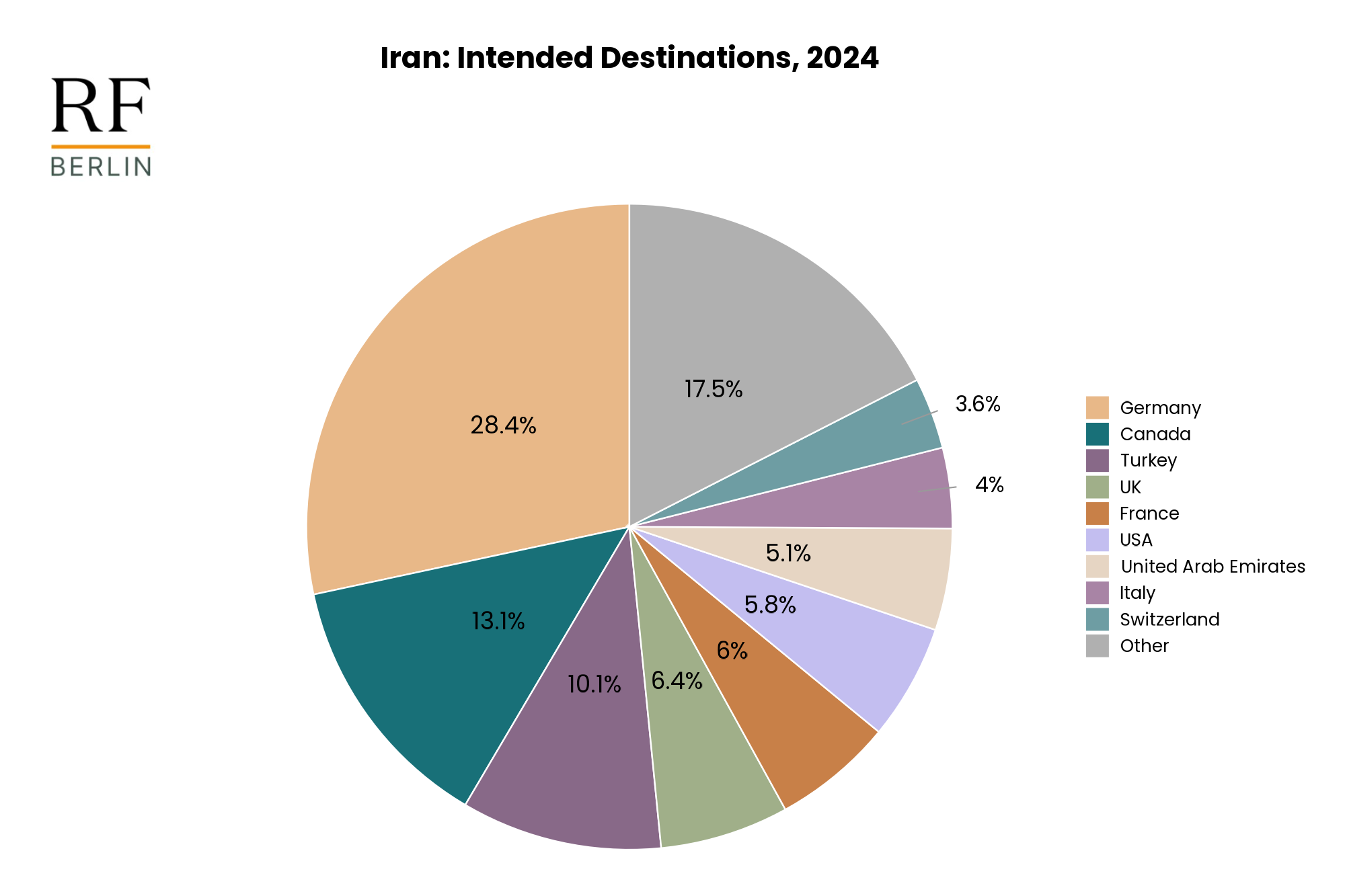
Sources: Our elaboration on Gallup World Poll (downloaded on 6 June 2025). Notes: The figure shows the share of respondents expressing a desire to migrate permanently abroad who identify each country as their preferred destination.
Germany stands out as the most frequently mentioned destination, accounting for approximately 28%, a number remarkably similar to the share of refugee settlement in Figure 3. Canada and Turkey follow, with around 13% and 10% of those with migration aspirations, respectively, citing them. Other destinations, such as the United Kingdom, France, and the United States, also appear among the preferred options, though with smaller shares of around 6% each.
Overall, migration intentions among Iranian respondents are concentrated in a relatively small number of destinations in Europe and North America. The prominence of Germany and Canada likely reflects both economic opportunities and the presence of large Iranian diaspora and refugee communities in Europe and North America, as shown in Figures 1 and 3.
Figure 5
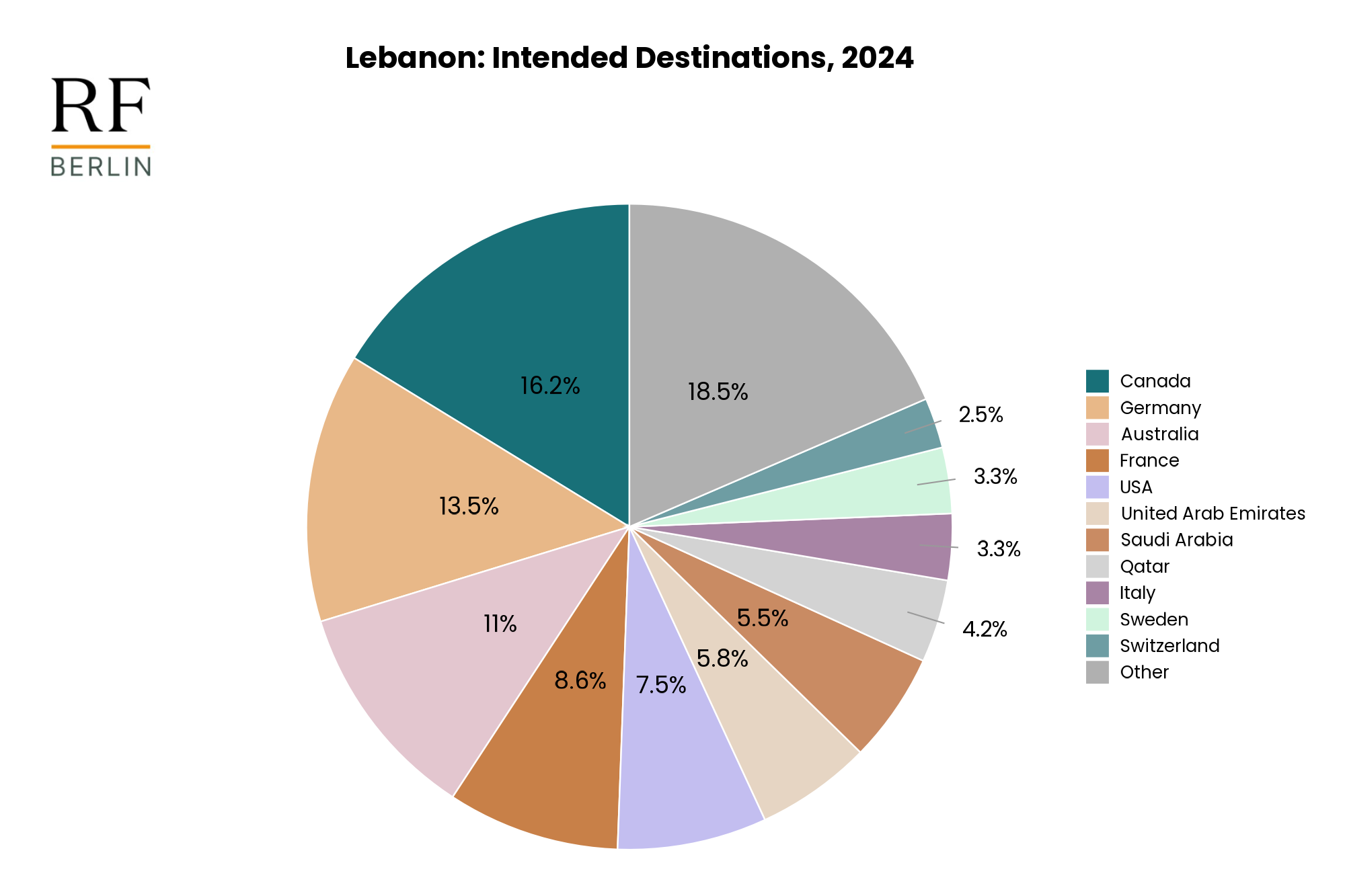
Sources: Our elaboration on Gallup World Poll (downloaded on 6 June 2025). Notes: The figure shows the share of respondents expressing a desire to migrate permanently abroad who identify each country as their preferred destination.
Figure 5 shows the preferred migration destinations among Lebanese respondents expressing a desire to migrate permanently abroad. Canada emerges as the most frequently mentioned destination (16% of respondents), followed by Germany (14%) and Australia (11%). Other European and North American countries, like France (9%) and the United States (8%), also appear prominently among the preferred destinations.
In addition, Gulf countries such as the United Arab Emirates (6%), Saudi Arabia (6%), and Qatar (4%) represent important intended destinations.
Overall, migration aspirations among Lebanese respondents appear more geographically diversified than those observed for Iran, spanning both Western countries and destinations in the Gulf region.
Age and education heterogeneity
To better understand how migration aspirations differ across population groups, the analysis can be disaggregated by age and education. This allows us to examine whether preferred migration destinations vary across individuals at different life-course stages and with different educational backgrounds.
Figure 6 shows the top intended migration destinations among Iranian respondents who express a desire to migrate, separated by age group (15–34 and 35+).
Figure 6
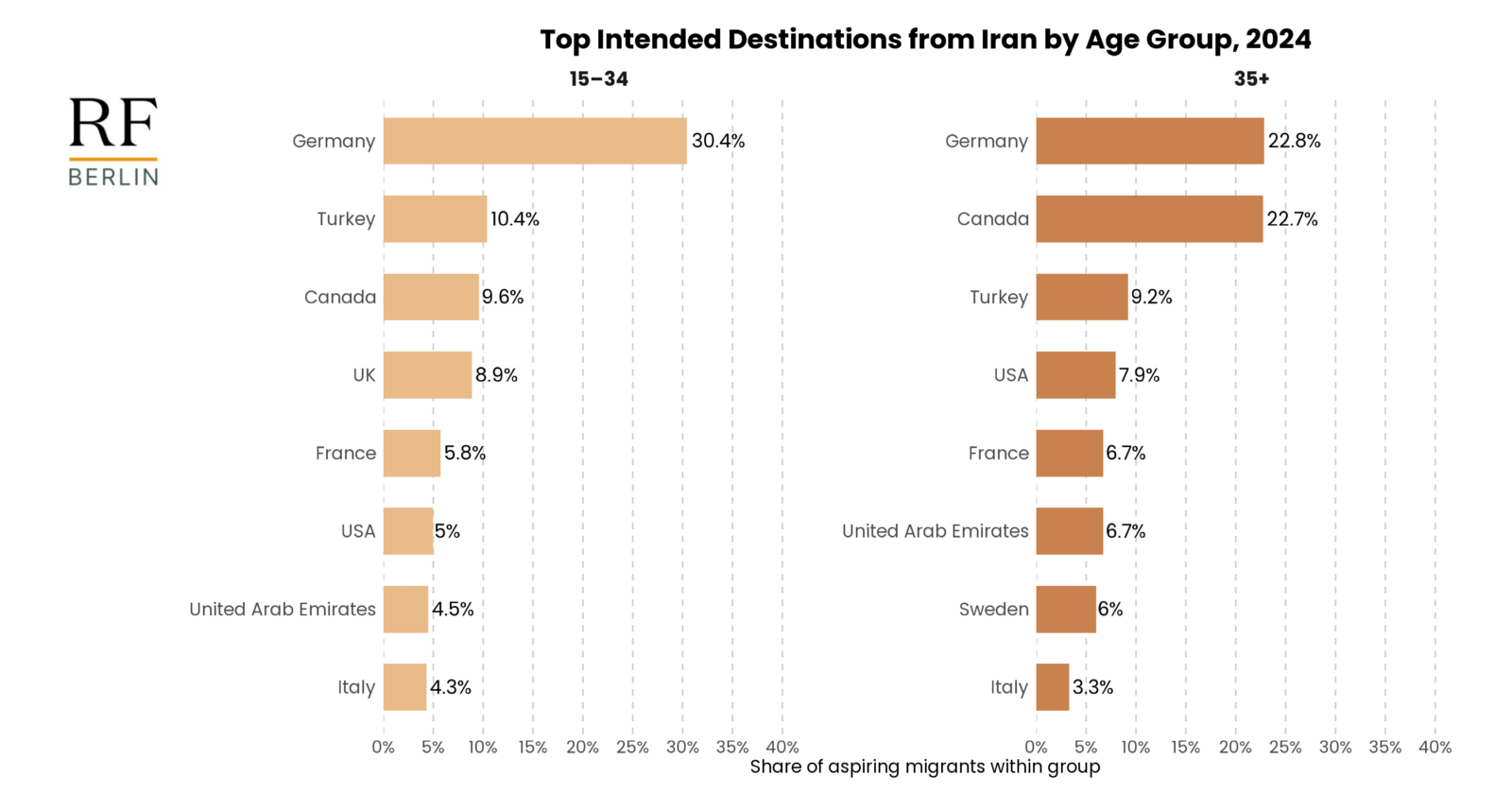
Sources: Our elaboration on Gallup World Poll (downloaded on 6 June 2025). Notes: The figure shows the share of Iranian respondents expressing a desire to migrate permanently abroad and identify each country as their preferred destination. Results are calculated among respondents reporting a desire to migrate and are disaggregated by age group (15–34; 35+).
Germany is the most frequently mentioned destination for both groups, though the share is higher among younger respondents (30%) than among those aged 35 and above (23%). Among the older group, Canada becomes almost equally prominent, attracting 23% of aspiring migrants compared with 10% among younger respondents. Other destinations, such as Turkey, France, and the United States, appear among the leading options for both age groups, although their relative rankings differ.
Differences by education are more pronounced, as shown in Figure 7, where higher education refers to respondents with tertiary education, and lower education includes respondents with secondary education or less.
Figure 7
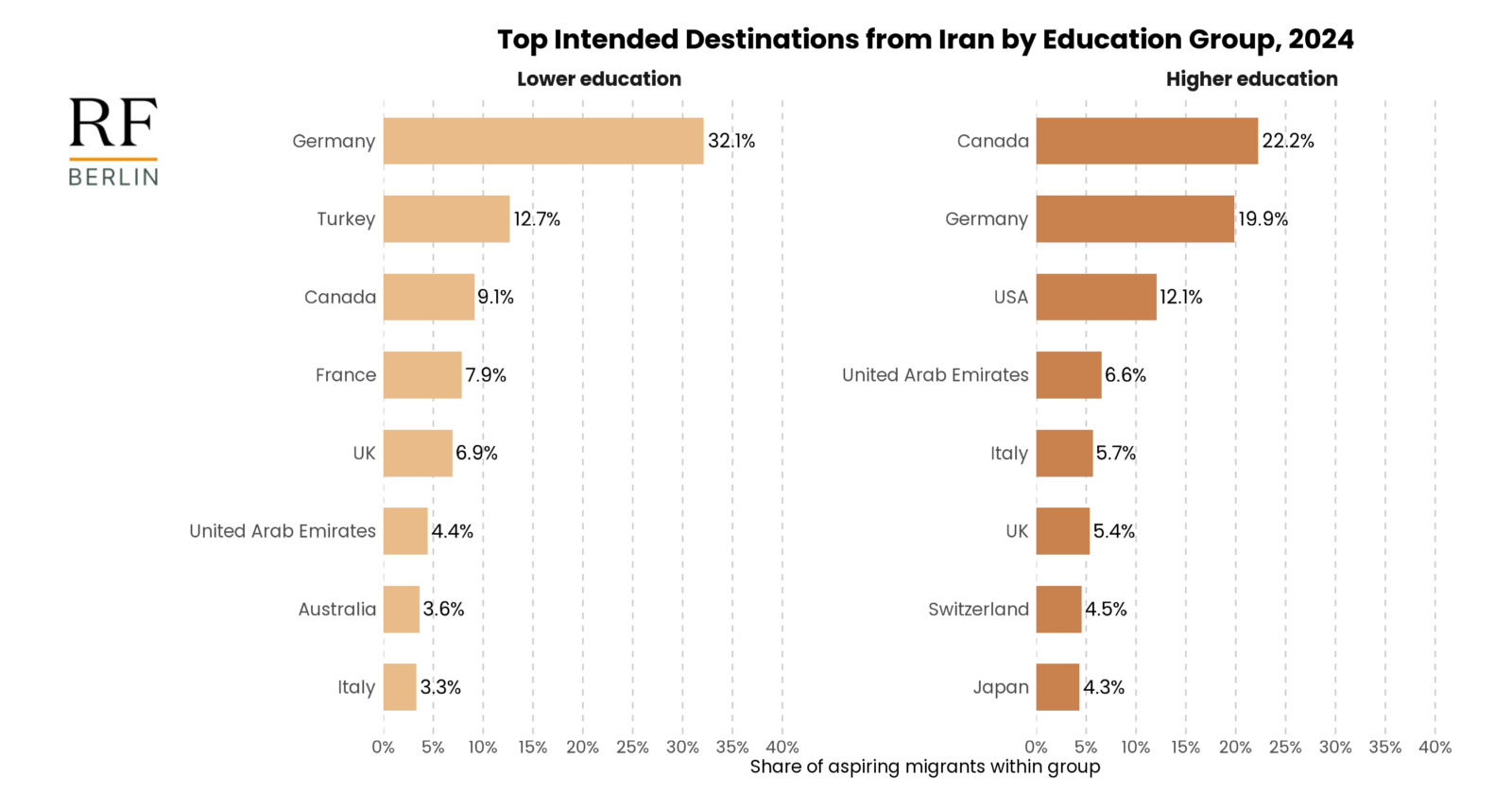
Sources: Our elaboration on Gallup World Poll (downloaded on 6 June 2025). Notes: The figure shows the share of Iranian respondents expressing a desire to migrate permanently abroad and identify each country as their preferred destination. Results are calculated among respondents reporting a desire to migrate and are disaggregated by education level. High education refers to respondents with four or more years of education beyond secondary school (tertiary education). Lower education includes respondents with secondary education or less.
Among respondents with lower levels of education, European destinations dominate clearly, with Germany accounting for by far the largest share and Turkey also ranking prominently. Among higher-educated respondents, the distribution is less centered on Europe and shifts toward destinations outside the continent, including Canada, the United States, the United Arab Emirates, and Japan. More educated individuals, therefore, appear to consider a broader range of migration pathways, including destinations associated with skilled migration or non-European labor markets.
For Lebanon, age differences are again fairly limited (Figure 8). Canada remains the leading destination in both age groups, while Germany and Australia also rank prominently.
Figure 8
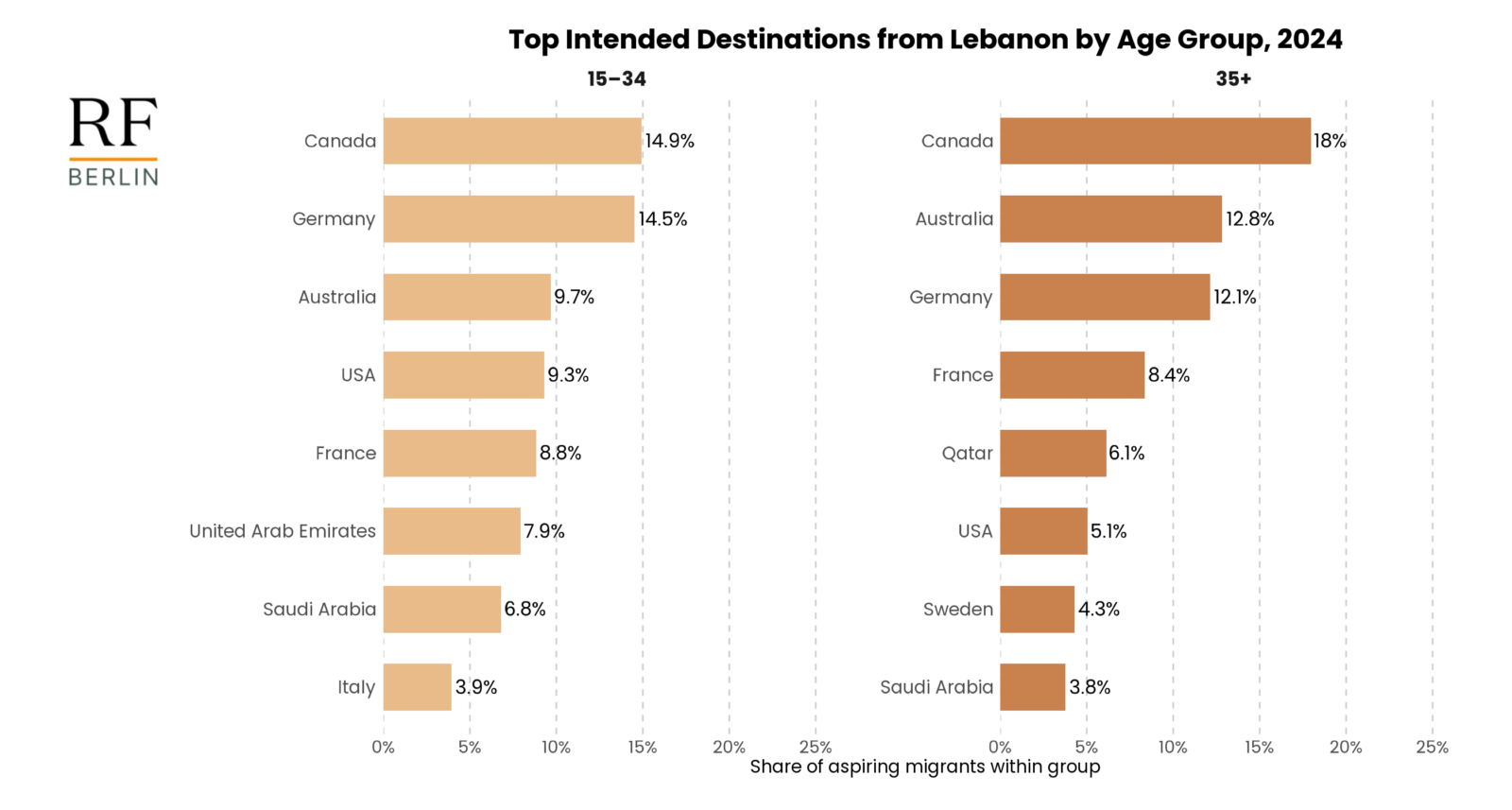
Sources: Our elaboration on Gallup World Poll (downloaded on 6 June 2025). Notes: The figure shows the share of Lebanese respondents expressing a desire to migrate permanently abroad and identify each country as their preferred destination. Results are calculated among respondents reporting a desire to migrate and are disaggregated by age group (15–34; 35+).
Differences by education are visible here as well, though less pronounced than in Iran (Figure 9). Canada is a prime location for both groups. Germany is, like Iran, a sought-after destination for the less educated, while the more educated prefer the US and the UAE.
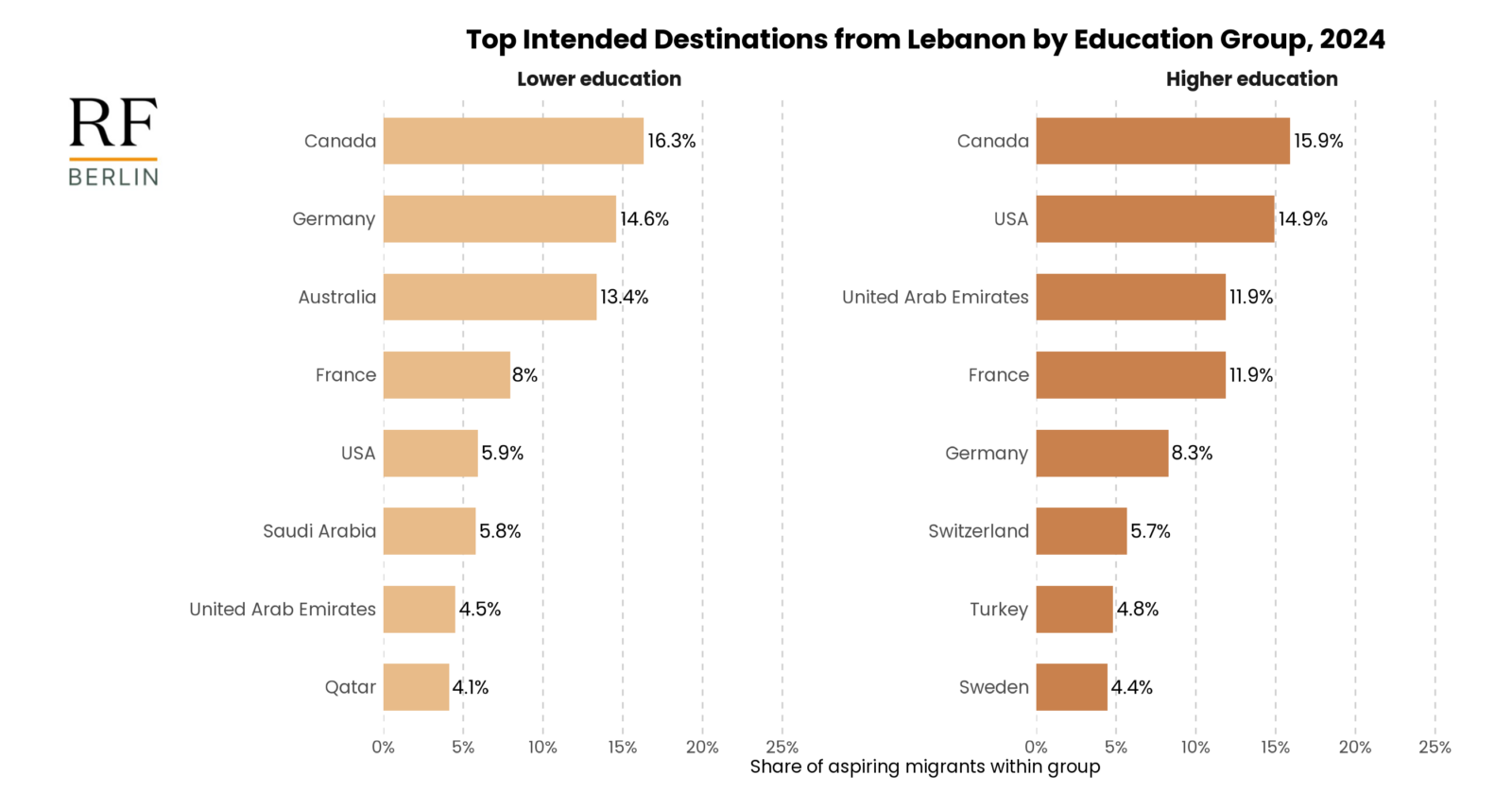
Sources: Our elaboration on Gallup World Poll (downloaded on 6 June 2025). Notes: The figure shows the share of Lebanese respondents expressing a desire to migrate permanently abroad and identify each country as their preferred destination. Results are calculated among respondents reporting a desire to migrate and are disaggregated by education level. High education refers to respondents with four or more years of education beyond secondary school (tertiary education). Lower education includes respondents with secondary education or less.
Taken together, the results suggest that age mainly affects the relative ranking of destinations, whereas education is more strongly associated with differences in their broader geographic orientation. In Iran, the divide is particularly clear: less-educated respondents tend to focus on European destinations, while more educated respondents are more likely to consider destinations beyond Europe. For Lebanon the same pattern is visible, though less sharply.
Given the current instability across parts of the Middle East, some regional destinations may become less feasible or less attractive in the event of renewed displacement. At the same time, long-distance destinations such as Canada, Australia, and the United States generally require air travel and greater financial resources, which may limit their relevance in the early stages of forced migration. These considerations suggest that European destinations (and, in particular, Germany) may play a particularly important role if refugee movements increase.
Indeed, restricting the analysis to destinations within the European Union reveals a strong concentration of migration intentions toward a small number of countries, particularly Germany and France.
Comparing migration aspirations and migrant networks
Migration research emphasizes the distinction between the desire to migrate and the ability to do so. According to the aspirations–capabilities framework (de Haas, 2021), migration occurs when individuals both aspire to move and possess the resources and opportunities necessary to migrate.
At the same time, migration flows often follow existing migration corridors and diaspora networks, which reduce the costs and risks of migration by providing information, financial support, and assistance in navigating migration systems (Massey et al., 1993; Beine, Docquier & Özden, 2011). Refugee movements may follow similar patterns, but they can also be shaped by geographic proximity, asylum policies, and the availability of migration routes.
Figure 10 examines how migration aspirations relate to the global distribution of migrants originating from Iran and Lebanon.
Figure 10
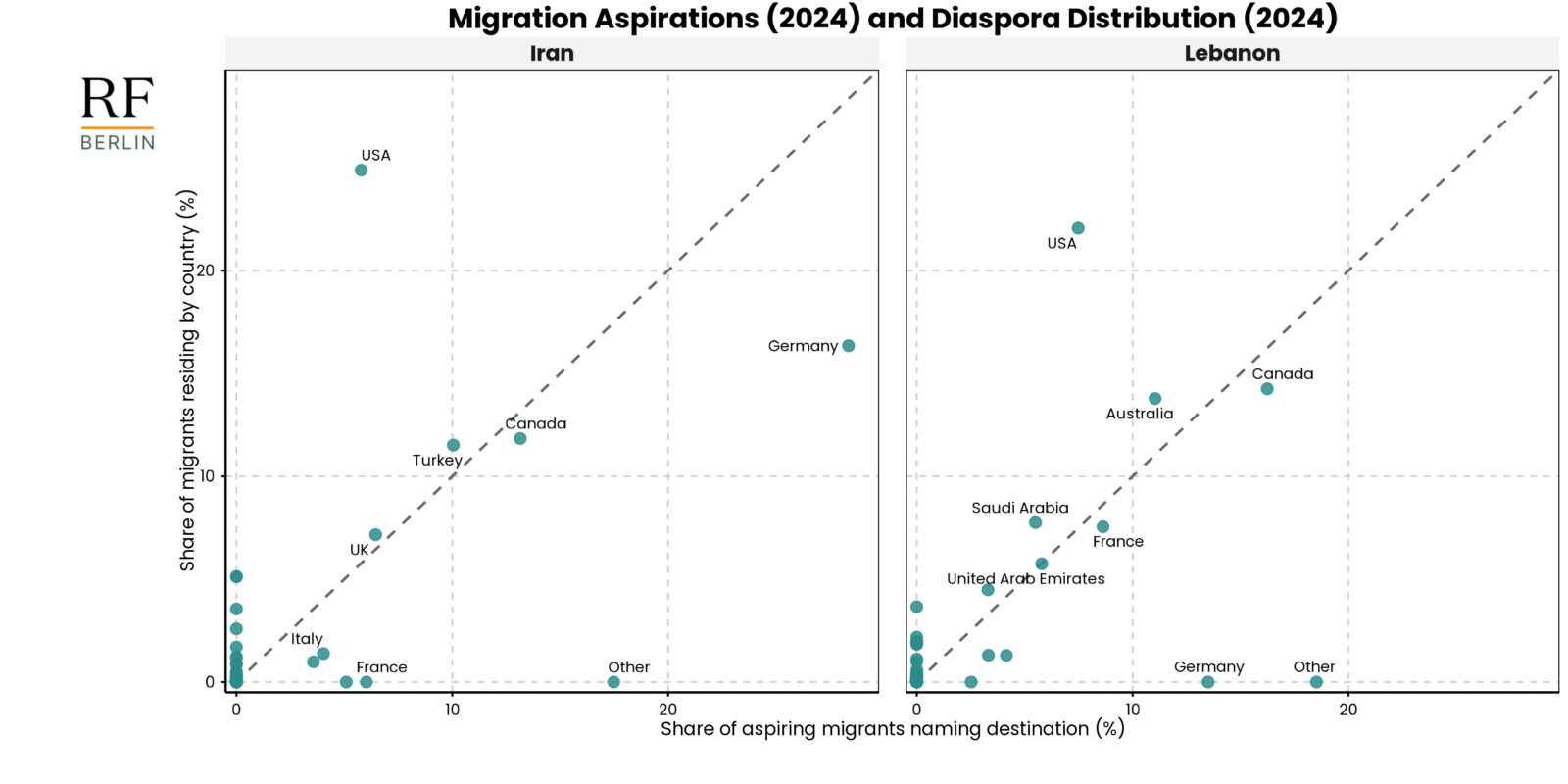
Sources: Our elaboration on Gallup World Poll (downloaded on 6 June 2025); UN DESA International Migrant Stock 2024 (downloaded on 11 March 2026). Migration aspirations are calculated as the share of respondents who report a desire or intention to move permanently abroad and who name a specific destination country in 2024. Diaspora distribution refers to the share of migrants from the origin country residing in each destination country. Each point represents a destination country. The dashed 45-degree line indicates where the share of migration aspirations toward a destination equals the share of migrants already residing there.
For Iran, several destinations appear prominently in both migration aspirations and the existing diaspora. Canada, UK and Turkey lie relatively close to proportional alignment, indicating that these countries are both major locations of Iranian migrant communities and frequently mentioned destinations among aspiring migrants.
Other destinations show more divergence. The United States hosts by far the largest share of the Iranian diaspora, yet it accounts for a much smaller share of stated migration aspirations. Germany shows the opposite pattern, attracting a larger share of current migration aspirations than the share of migrants residing in the country.
For Lebanon, the relationship between migration aspirations and diaspora networks appears to be closer across several destinations. Countries such as Canada, Australia, France, and several Gulf states lie relatively near proportional alignment, indicating that aspiring migrants often identify destinations where Lebanese migrant communities are already well established.
At the same time, some important differences remain. Germany, for example, attracts a notable share of migration aspirations despite hosting no sizeable Lebanese diaspora, according to the UN DESA International Migrant Stock 2024, compared with countries such as the United States or Australia. This suggests that migration preferences are shaped not only by existing networks but also by perceptions of economic opportunity and migration accessibility.
There is stronger alignment between the distribution of refugees (rather than overall migrant communities) and stated migration-aspiration destinations (Figure 11).
Figure 11
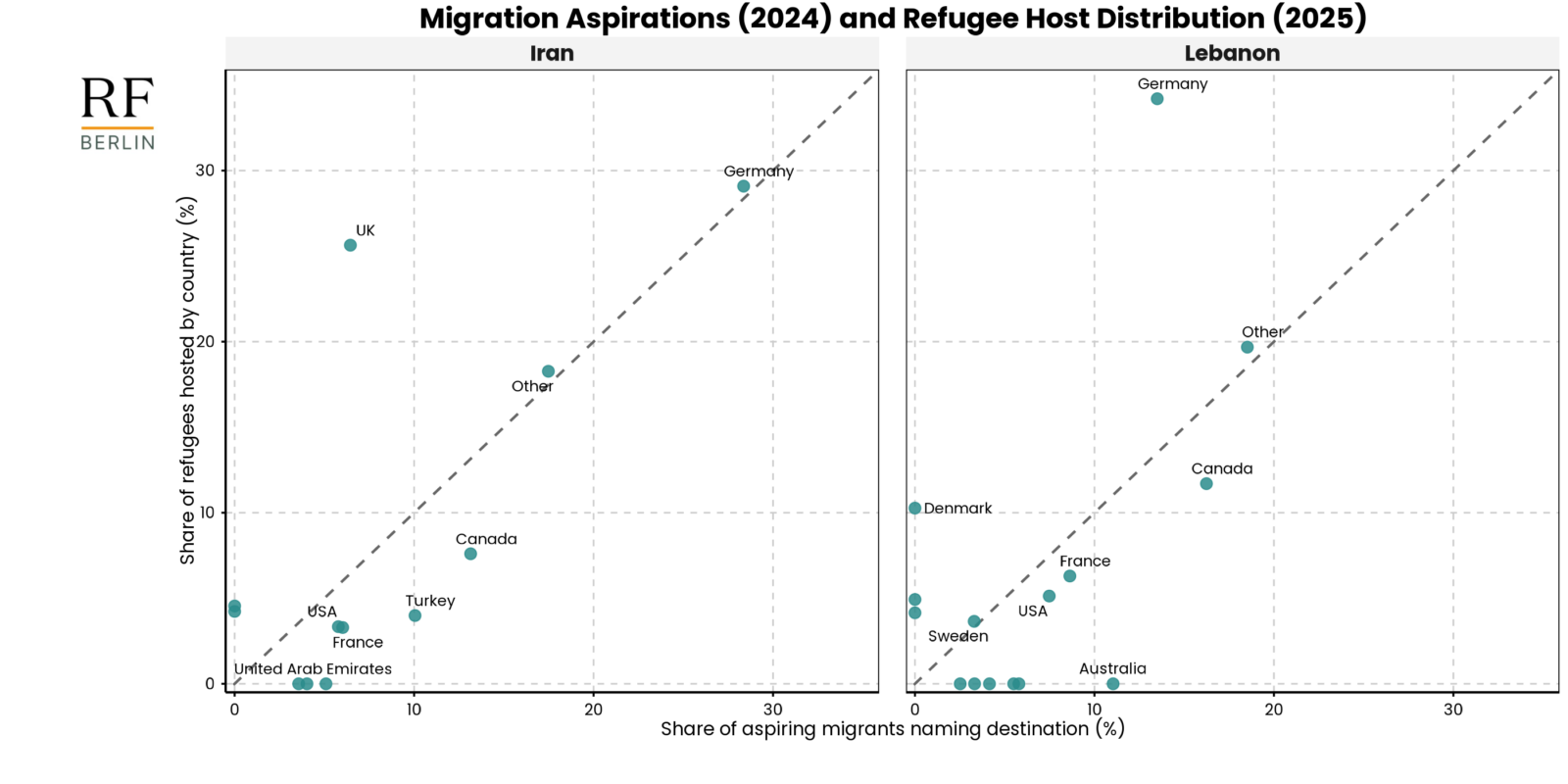
Sources: Our elaboration on Gallup World Poll, (downloaded on 6 June 2025); UNHCR Refugee Data Finder, (downloaded 6 March 2026). Migration aspirations are calculated as the share of respondents who report a desire or intention to move permanently abroad and who name a specific destination country in 2024. Refugee populations represent the number of refugees from Iran residing in each country at year-end. Each point represents a destination country. The dashed 45-degree line indicates where the share of migration aspirations toward a destination equals the share of migrants already residing there.
For Iran, Germany stands out as both the most frequently mentioned migration destination and the largest host country for Iranian refugees. Canada also appears prominently in both dimensions, while other destinations such as the United Kingdom host relatively large shares of refugees compared with their share in migration aspirations.
A similar pattern emerges for Lebanon. Germany hosts the largest share of Lebanese refugees and is also frequently mentioned among intended migration destinations. Canada likewise appears prominently as a destination for both current refugees and for potential migrants, while countries such as Denmark and the USA host sizable refugee populations even though they attract smaller shares of stated migration preferences.
Taken together, these patterns suggest that migration aspirations are more closely aligned with the geographic distribution of current refugees than with the broader historical geography of diaspora networks.
Unreported regression analysis confirms that. For Iran, refugee distributions explain about 85% more variation in migration intentions than diaspora networks, while for Lebanon the difference is smaller but still notable at about 54%.
This suggests that recent displacement corridors play a particularly important role in shaping both Iranian and Lebanese migration expectations, potentially reflecting the visibility of asylum routes and recent migration experiences.
Policy Implications
These findings have important implications in the context of the current regional conflict. First, the strong alignment between migration aspirations and existing refugee corridors suggests that recent asylum destinations are likely to remain central if displacement increases. Countries that already host significant refugee populations from Iran and Lebanon, particularly Germany in Europe, are therefore likely to remain key destinations.
Second, the broader distribution of diaspora populations indicates that long-standing migrant communities could shape migration patterns over the longer term. Diaspora networks may facilitate onward migration, family reunification, or secondary movements beyond the initial phase of displacement.
Finally, practical constraints may influence migration outcomes in the early stages of a crisis. Long-distance destinations such as Canada, Australia, and the United States typically require air travel and financial resources, whereas European destinations may be more accessible through existing asylum routes and migration corridors. Thus, a relatively small group of countries is likely to receive a large share of potential refugee flows if displacement increases, particularly Germany within Europe.
Bibliography
Beine, M., Docquier, F., & Özden, Ç. (2011). Diasporas. Journal of Development Economics, 95(1), 30–41. doi:https://doi.org/10.1016/j.jdeveco.2009.11.004
de Haas, H. (2021). A theory of migration: the aspirations-capabilities framework. Comparative Migration Studies, 9(8). doi:https://doi.org/10.1186/s40878-020-00210-4
Massey, D. S., Arango, J., Hugo, G., Kouaouci, A., Pellegrino, A., & Taylor, J. (1993). Theories of International Migration: A Review and Appraisal. Population and Development Review, 19(3), 431-66. doi:https://doi.org/10.2307/2938462
