

Summary
- The refugee population in the EU grew sharply from about 1 million in 2014 to 7.8 million in 2024. The Syrian crisis triggered the first surge (2015–2017), while the Russian invasion of Ukraine in 2022 produced the fastest and largest inflow in decades.
- Under the Temporary Protection Directive, over 4.27 million Ukrainians were admitted in 2022, followed by 1.04 million in 2023 and 0.79 million in 2024. Arrivals from Afghanistan, Venezuela, Colombia, Bangladesh, and Turkey also contributed to recent growth.
- Refugee shares in national populations remain highly uneven: as of 2024, the highest are in Cyprus (4.7%), Czechia (3.6%), and Germany (3.3%), with Germany hosting nearly 2.75 million refugees.
- In 2024, the EU received nearly 912 thousand first-time asylum applications, with the largest groups originating from Syria, Afghanistan, Venezuela, and Colombia.
- Pressures on asylum systems continue. Pending cases exceeded 1.16 million in 2024, as inflows again outpaced processing capacity, echoing the bottlenecks first observed after the 2015 Syrian crisis.
The refugee[1] population in the EU grew sharply from approximately 1 million in 2014 to 7.8 million in 2024, as shown in Figure 1. The first major surge followed by the Syrian crisis, which escalated around 2015 and pushed the number of refugees from 1 million in 2014 to more than 2 million by 2017.
Figure 1
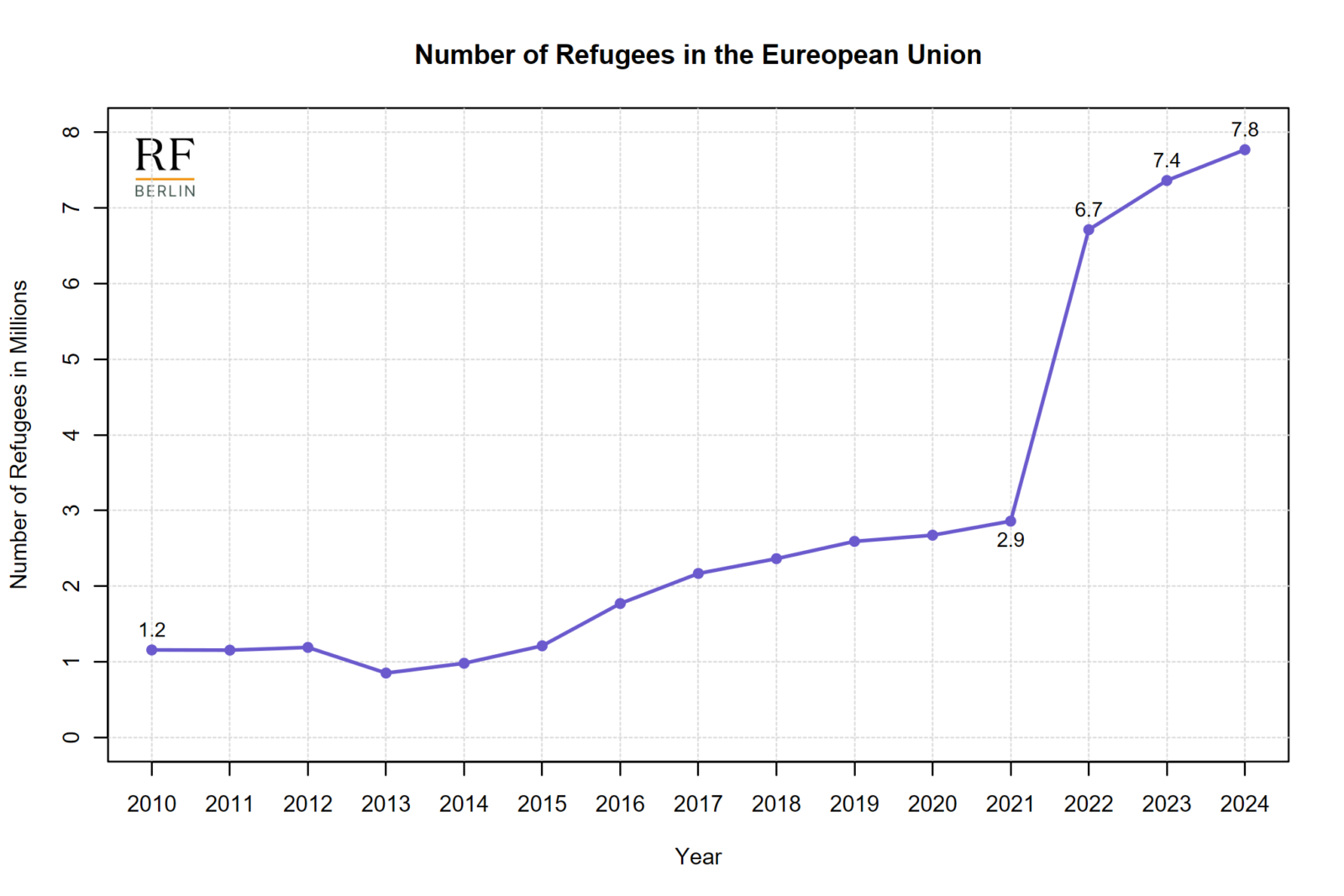
Source: UNHCR, (downloaded on 22 July 2025). Notes: Refugees include individuals recognized under the 1951 Convention relating to the Status of Refugees, its 1967 Protocol, the 1969 Organization of African Unity (OAU) Convention Governing the Specific Aspects of Refugee Problems in Africa, the refugee definition contained in the 1984 Cartagena Declaration on Refugees as incorporated into national laws, those recognized in accordance with the UNHCR Statute, individuals granted complementary forms of protection, and those enjoying temporary protection. The refugee population also includes people in refugee-like situations. The figure reports data for the 27 member states in the European Union as of February 1, 2020. A temporary decline in the 2013 data is attributed to a methodological change in Germany, which began applying stricter counting criteria by including only individuals with formal refugee status.
The sharpest increase began in February 2022 with the Russian invasion of Ukraine, triggering the largest and fastest inflow of refugees into the EU in decades. Just weeks later, on 4 March 2022, the EU activated the Temporary Protection Directive, creating a legal framework to manage the mass arrival of Ukrainian refugees. The Directive sets out the obligations of EU member states toward individuals under temporary protection. The inflows of Ukrainian citizens under temporary protection in Europe amounted to 4,270,030 in 2022, 1,043,235 in 2023, and 787,865 in 2024.[2]
Alongside these defining events, ongoing arrivals from countries such as Afghanistan, Venezuela, Colombia, Bangladesh, and Turkey have also contributed to the upward trend in recent years (see Table A.1 in Appendix).
Figure 2
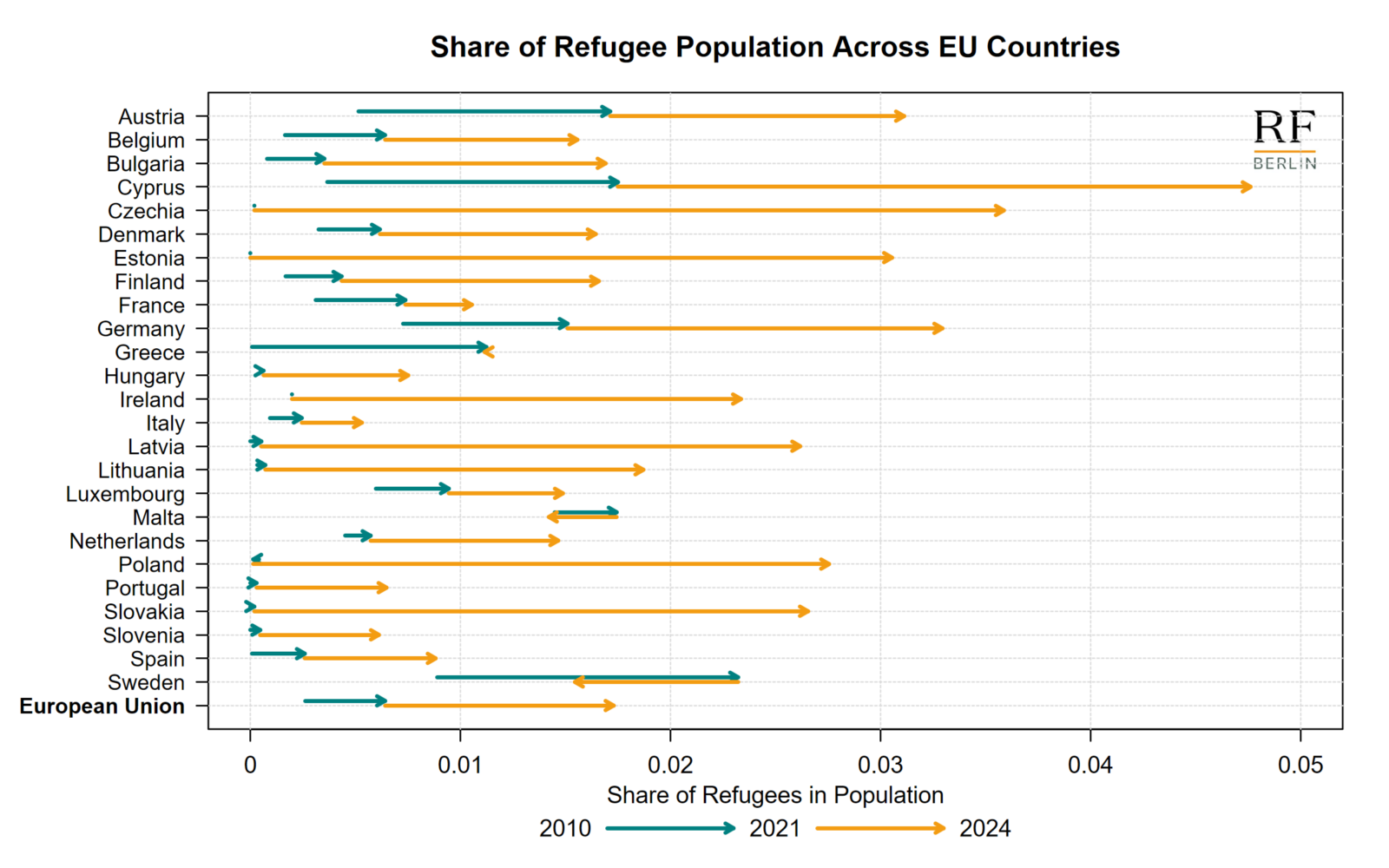
Source: UNHCR, Eurostat MIGR_POP3CTB, (downloaded on 05 September 2025). Notes: The figure reports data for the member states in the European Union as of February 1, 2020, except for Croatia and Romania, due to missing data. Refugees include individuals recognized under the 1951 Convention relating to the Status of Refugees, its 1967 Protocol, the 1969 Organization of African Unity (OAU) Convention Governing the Specific Aspects of Refugee Problems in Africa, the refugee definition contained in the 1984 Cartagena Declaration on Refugees as incorporated into national laws, those recognized in accordance with the UNHCR Statute, individuals granted complementary forms of protection, and those enjoying temporary protection. The refugee population also includes people in refugee-like situations. Due to missing information, population for Bulgaria is taken from MIGR_POP2CTZ.
The distribution of refugees across EU member states is highly uneven, both in absolute terms and relative to national population size. Figure 2 shows the change in the share of refugees in the population between 2010 and 2024, dividing the period into two intervals: an initial interval from 2010 to 2021 and a subsequent three-year period from 2021 to 2024. A key finding is the much faster pace of intake in recent years, with most countries recording a larger increase in their refugee share between 2021 and 2024 than over the entire previous eleven years. This contrast highlights the profound impact of recent crises, especially the Russian invasion of Ukraine in 2022.
This pattern is not uniform, however. France saw stronger growth in its refugee share during 2010–2021 than in the following three years, while Greece, Malta, and Sweden registered declines between 2021 and 2024. As of 2024, the countries with the highest shares of refugees in their populations are Cyprus (4.7%), Czechia (3.6%), and Germany (3.3%).
Figure 3
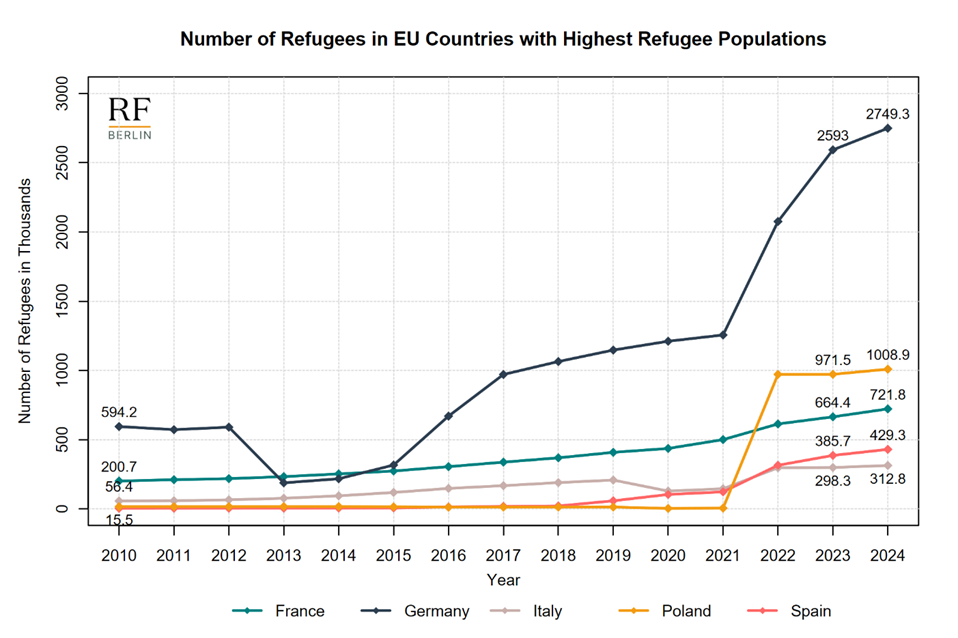
Source: UNHCR, (downloaded on 22 July 2025). Notes: Refugees include individuals recognized under the 1951 Convention relating to the Status of Refugees, its 1967 Protocol, the 1969 Organization of African Unity (OAU) Convention Governing the Specific Aspects of Refugee Problems in Africa, the refugee definition contained in the 1984 Cartagena Declaration on Refugees as incorporated into national laws, those recognized in accordance with the UNHCR Statute, individuals granted complementary forms of protection, and those enjoying temporary protection. The refugee population also includes people in refugee-like situations. The decline in Germany’s 2013 data is attributed to a methodological change, whereby stricter counting criteria were adopted to include only individuals with formal refugee status.
Figure 3 tracks the growth of the refugee population in the five EU member states with the largest absolute numbers as of 2024: Germany, France, Spain, Italy, and Poland. Germany’s refugee population rose from about 594,200 in 2010 to nearly 2.75 million in 2024, with sharp increases after the Syrian crisis in 2014 and the Ukrainian crisis in 2022, confirming its role as the EU’s leading host country. France recorded steadier growth, reaching about 721,800 by 2024. Spain and Italy followed similar upward trajectories, reaching 429,300 and 312,800, respectively. Poland’s case is particularly striking: from a low base, its refugee population surged after 2022 to over 1 million by 2024, almost entirely due to arrivals from Ukraine, making it one of the EU’s major host countries.
Figure 4
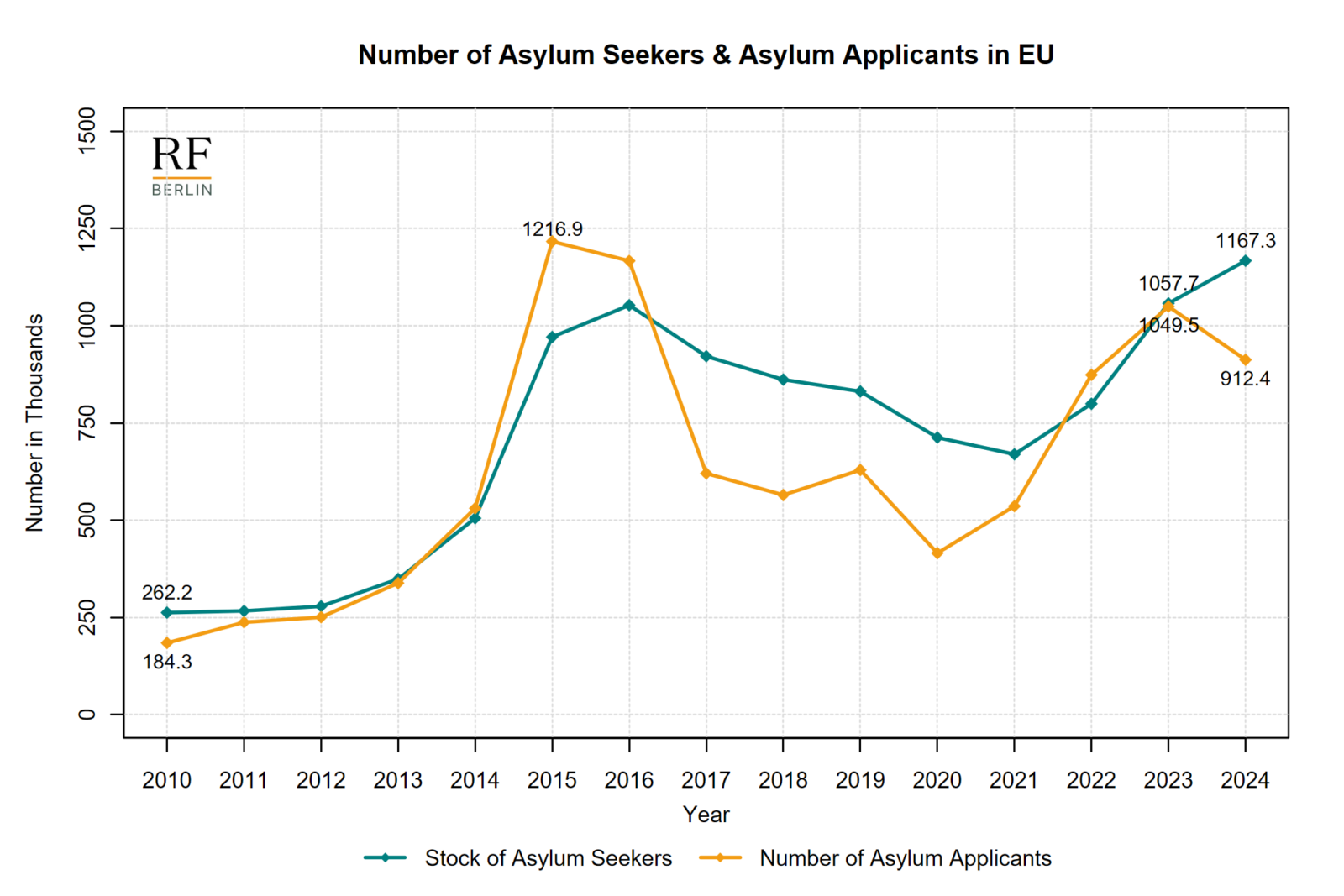
Source: UNHCR, Eurostat MIGR_ASYAPPCTZA (downloaded on 22 July 2025). Notes: Stock of asylum seekers represents the number of immigrants residing in the country who are waiting for their asylum claim to be processed. The number of asylum applicants represents the flow of first-instance applications lodged within a specific year.
With the exception of holders of temporary protected status, which was automatically granted to residents in Ukraine at the onset of the war (see footnote [2]), refugees have to apply for asylum first, and receive international protection only if their case is successful. Figure 4 shows the relationship between new asylum applications (inflows) and the stock of pending cases (asylum seekers). Before 2015, the two series moved largely in parallel, indicating that processing capacity in the EU kept pace with inflows on average. This balance broke down in 2015, when applications surged in response to the Syrian crisis. From 2017 to 2021, the number of pending cases outnumbered annual new arrivals, highlighting capacity constraints in Europe’s asylum system.
After 2016, inflows declined, and by 2021, the gap between asylum seekers and new applicants had narrowed considerably. But the renewed increase in inflows from 2022 led to a similar pattern, such that by 2024, the backlog once again exceeded new applications, with more than 1.16 million cases pending. As shown in Table A.1 in the Appendix, the increase in applications over the past three years was driven mainly by higher inflows from Syria, Venezuela, Afghanistan, Colombia, Turkey, and Bangladesh.
[1] Throughout – unless otherwise specified – we use the term “refugee” to refer to anyone under international or temporary protection (i.e. “Geneva convention” refugees, and holders of subsidiary, humanitarian or temporary protection). Thus, asylum seekers, i.e. individuals whose asylum claim is being processed are not included.
[2] Source: Eurostat (migr_asytpfa). Coverage of Temporary Protection includes any Ukrainian nationals residing in Ukraine until 24 February 2022, as well as third-country nationals residing in Ukraine on the basis of refugee status and who entered the EU after 24 February 2022. Third-country nationals with permanent residence permits in Ukraine are also protected. The family members are also covered.
Methodological Notes and Data
The decline in the number of refugees observed in 2013 in Figures 1 and 3 is attributable to changes in Germany’s reporting methodology. In 2013, the UNHCR revised its methodology for estimating the refugee population in Germany, leading to a sharp drop in reported figures. Previously, the data encompassed a broader category of individuals, including those under various forms of protection or with pending asylum claims. The revised methodology more closely aligned with Germany’s official statistics, applying stricter criteria by including only individuals with formal refugee status or equivalent forms of protection, and excluding asylum seekers.
Appendix
A.1 – Main origin countries of asylum applicants in the EU over the period 2021-2024
| 2021 | 2022 | 2023 | 2024 | |
| Syria | 98,530 | 131,790 | 183,065 | 148,185 |
| Afghanistan | 84,420 | 113,850 | 100,675 | 72,240 |
| Turkey | 20,200 | 48,600 | 89,990 | 46,840 |
| Venezuela | 17,380 | 50,050 | 67,065 | 72,790 |
| Colombia | 13,140 | 42,420 | 62,000 | 50,320 |
| Bangladesh | 18,820 | 31,935 | 39,025 | 41,245 |
Source: Eurostat, MIGR_ASYAPPCTZA. Notes: the table reports the number of first-instance asylum applications submitted in EU countries in the year, from the top 6 origin countries of citizenship over the period 2021-2024. The European Union includes all 27 member states as of February 1, 2020.
