
Short summary
Governments across advanced economies are trying to raise fertility without discouraging women from working. Germany devotes substantial public resources to families—around 2.5% of GDP— yet fertility remains currently at 1.5 children per woman, well below replacement level which is at 2.1 children. This insight piece reveals the problem: Germany’s tax system rewards marriage, not children. Married couples get tax breaks whether they have kids or not. By switching to individual taxation and redirecting that money to child-focused benefits, Germany could raise fertility by nearly 6%—without spending more or making families worse off. In particular, the optimal policy would raise most child subsidies, including fixed monthly subsidies (Kindergeld), annual tax-deductions (Kinderfreibetrag), and childcare subsidies.
Key Findings
- Jointly designing child subsidies and the way couples are taxed is crucial.
- Under Germany’s current joint taxation system, even an optimally designed mix of family policies only raises completed fertility by 0.8%.
- Alternatively, switching to individual taxation and redesigning child subsidies could increase fertility by 5.7% (roughly 1 additional child per 10 women).
- Abolishing joint taxation without reforming child benefits reduces fertility.
Relevance Today
Population aging, low fertility, labor shortages, and gender equality are major policy concerns in most developed countries. These challenges are closely linked to the design of family policies, which shape both fertility outcomes and women’s labor market participation. In Germany, recent reform proposals have focused on moving away from joint taxation (Ehegattensplitting) and expanding public childcare provision to strengthen work incentives which the findings of this paper support.
Author Quote
“Carefully calibrated combinations of policies, notably a shift from joint taxation to individual taxation, can deliver substantial improvements over the status quo. The optimal policy mix depends on whether the priority is to enhance welfare or to increase birth rates. The results indicate that it is possible to achieve either a 0.5% increase in welfare or a 5.7% increase in the birth rate.”
Reference: Based on RFBerlin Discussion Paper 29/26, January 2026: Wang, Fertility and Family Leave Policies in Germany: Optimal Policy Design in a Dynamic Framework
Research summary
The Fertility–Career Trade-Off
Low fertility has become one of the central challenges facing aging populations. Governments worry about shrinking populations, pressure on pension systems, while at the same time seeking to preserve women’s attachment to the labor market and reduce gender inequality. These objectives often sit uneasily together (Kleven et al., 2019; Olivetti and Petrongolo, 2017). Policies that encourage childbearing can weaken work incentives, while policies that strengthen women’s labor supply may make having children more costly. Germany illustrates this tension particularly clearly. Despite generous parental leave, extensive childcare subsidies, substantial tax advantages for married couples, and other child-based subsidies, fertility has remained persistently low at around 1.5 children per woman.
This raises a fundamental policy question. How can we design policy optimally to raise long-run fertility without undermining women’s careers or reducing household welfare? The central contribution of the paper is to show that the answer does not only lie in changing child-based policies but also in reforming the taxation of couples. The largest improvements can be achieved when moving away from joint taxation and simultaneously increasing the generosity of child-based policies such as monthly per-child subsidies or child-tax deductions.
A Life-Cycle Perspective on Work and Fertility
“To answer this, the study built a model that tracks women’s decisions over their lives—when to have children, how much to work, and how marriage and divorce affect those choices. Eckstein and Wolpin ,1989; Francesconi, 2002; Adda et al., 2017). This perspective is essential for understanding fertility responses because the costs of children extend far beyond the immediate period after birth. Having a child reduces labor supply in the short run, but it also affects future wages by slowing career progression during employment interruptions or part-time work. These dynamic career costs play a central role in shaping fertility decisions and differ substantially across women. For example, the career costs of children are much larger for highly educated women, whose wages tend to increase more rapidly with work experience.
The model incorporates a broad set of family policies including parental leave benefits, childcare subsidies, joint taxation and monthly fixed subsidies and annual tax deductions per child. Policy incentives generate very different labor supply and fertility responses across socioeconomic groups.
The model is estimated using German panel data and successfully matches observed patterns of employment, wages, and fertility over the life cycle. It is further validated by its ability to replicate responses to Germany’s 2007 parental leave reform.
What Recent Reforms Achieved
This insight evaluates two major family policy reforms in Germany: the 2007 parental leave reform and the expansion of subsidized childcare.
In 2007, Germany replaced a flat parental leave benefit with a wage-related payment, substantially increasing benefits for higher-earning women. The reform led to an increase in completed fertility, but this effect was concentrated almost entirely among highly educated women. It also reduced childlessness at the top of the education distribution. However, these fertility gains came at a cost. The longer women stayed out of work, the less they earned over their careers.
A key insight from this analysis is that short-run birth responses can be misleading. While some older women have more children immediately following the reform, the increase in the long-term is much smaller. By contrast, the expansion of subsidized childcare produced a very different pattern of effects. Increased access to childcare raised fertility more evenly across education groups while simultaneously strengthening maternal employment. Per euro spent, childcare subsidies benefitted families more than the parental leave reform. The takeaway: policies work better when they help parents balance work and family.
Optimal Family Policy and Taxation of Couples Per euro spent
The central contribution is an optimal policy exercise that jointly designs the entire portfolio of family policies rather than considering each policy in isolation. (Domeij and Klein, 2013; Gayle and Shephard, 2019). The policy is required to be budget-neutral and to not reduce current women’s welfare or fertility. Achievable gains depend fundamentally on the tax system. Germany’s joint taxation of married couples lowers work incentives for secondary earners—typically women—and implicitly subsidizes marriage rather than children. As a result, this design is ineffective at raising labor supply and fertility.
Under the current joint taxation system, the fertility-maximizing combination of parental leave benefits, childcare subsidies, and other child transfers has only modest effects. Completed fertility rises by just 0.8 percent, equivalent to roughly 0.01 children per woman. Simply abolishing joint taxation, however, is not a solution. If joint taxation is replaced by individual taxation without reforming child-related benefits, fertility falls sharply. Married couples lose income, work incentives increase, and the opportunity cost of children rises.
The picture changes dramatically when individual taxation is combined with redesigned child-based subsidies. Moving to individual taxation frees fiscal resources that were previously used to subsidize marriage. Redirecting these resources toward per-child transfers and childcare support proves far more effective at encouraging births. Under this policy mix, completed fertility rises by 5.7 percent while household welfare increases slightly and the reform remains budget-neutral (penultimate column of Table 1).
Fertility Versus Welfare Objectives
This study also examines policy design to maximize family wellbeing rather than just births. The solution prioritizes supporting women’s work while preventing fertility from falling. Again, switching to individual taxation is optimal. Relative to the fertility-oriented solution, it features higher tax deductions and fully subsidized childcare. Aggregate welfare rises by about 0.5 percent of consumption, with gains concentrated among highly educated women, who benefit most from improved work incentives and reduced childcare costs (last column of Table 1).
This comparison highlights an important tension. Policies that maximize fertility are not necessarily those that maximize welfare, and vice versa. Policymakers must therefore be explicit about their objectives and the trade-offs they are willing to accept.
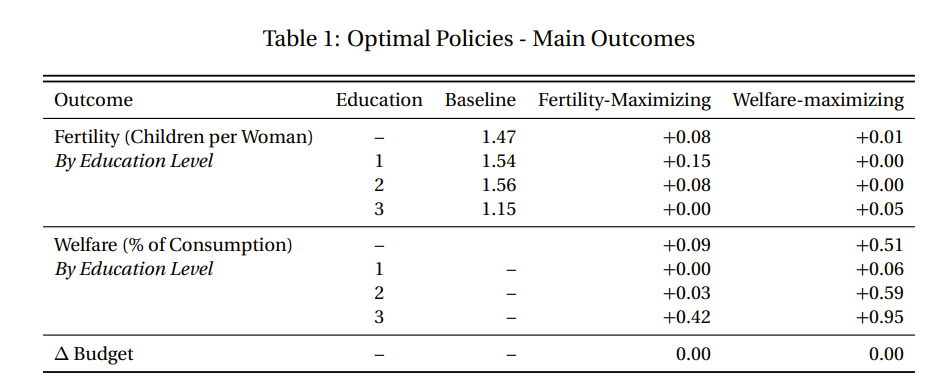
Notes: The Baseline column reports levels; the Fertility-Maximizing and Welfare-Maximizing columns report changes relative to the baseline. Fertility is measured as the average number of children born per woman over her lifetime. Education level 3 corresponds to university education, while level 2 corresponds to completed apprenticeships, and level 1 the rest. Welfare is expressed as a percentage of consumption equivalent. Δ Budget denotes the change in government budget as a percentage of the baseline budget; a value of 0.00 indicates budget neutrality.
Policy Implications
The findings of the paper carry clear implications for policy design. Family policies affect different socioeconomic groups in different ways, largely because the opportunity costs of having children vary across women. The largest gains are achieved when family policies are designed jointly with the tax system, in particular when inefficient joint taxation is eliminated. For countries considering reforms to marital taxation, parental leave, or childcare provision, the key message is that these policies should be designed as part of a single, coherent system. Finally, fertility and welfare objectives may conflict, requiring a careful weighing of the long-term societal value of higher fertility against immediate consumption losses for the current generation.
Conclusion
Raising fertility is not primarily a question of spending more public money. Instead, it is about spending existing resources more effectively. This paper shows that shifting support away from marriage-based tax advantages toward child-based policies, within an individual taxation system, can substantially increase fertility without sacrificing welfare. Aligning family policy with tax design offers a powerful and realistic blueprint for future reform.
References
Adda, J., Dustmann, C., & Stevens, K. (2017). The career costs of children. Journal of Political Economy, 125(2), 293–337.
Domeij, D., & Klein, P. (2013). Should day care be subsidized? Review of Economic Studies, 80(2), 568–595.
Eckstein, Z., & Wolpin, K. I. (1989). Dynamic labour force participation of married women and endogenous work experience. Review of Economic Studies, 56(3), 375–390.
Francesconi, M. (2002). A joint dynamic model of fertility and work of married women. Journal of Labor Economics, 20(2), 336–380.
Gayle, G.-L., & Shephard, A. (2019). Optimal taxation, marriage, home production, and family labor supply. Econometrica, 87(1), 291–326.
Kleven, H. J., Landais, C., & Søgaard, J. E. (2019). Children and gender inequality: Evidence from Denmark. American Economic Journal: Applied Economics, 11(4), 181–209.
Olivetti, C., & Petrongolo, B. (2017). The economic consequences of family policies: Lessons from a century of legislation in high-income countries. Journal of Economic Perspectives, 31(1), 205–230.
Disclaimer
The opinions and views expressed in this publication are those of the author(s) and do not necessarily reflect those of the ROCKWOOL Foundation Berlin (RFBerlin). While research disseminated through this series may address policy-relevant topics, RFBerlin, as an independent research institute, does not take institutional policy positions.
Publications in the RFBerlin Research Insights series may represent preliminary or ongoing work that has not been peer-reviewed. Readers are advised to consider the provisional nature of such research when citing or applying its findings.
These publications aim to make scientific work accessible to a broader audience and to encourage informed, research-based discussion. All materials are provided by the respective authors, who bear responsibility for appropriate attribution and rights clearance. While every effort has been made to ensure accuracy and proper acknowledgment, RFBerlin welcomes notifications of any concerns regarding authorship, citation, or intellectual property rights. Please contact RFBerlin to request corrections if needed.
Use of these materials for the development or training of artificial intelligence systems is strictly prohibited.
