

Short Summary
How do local governments use additional funds, and how do they adjust to revenue cuts? These questions are central to the design of fiscal equalization schemes and of large public investment programs that channel funds to municipalities. They are difficult to answer, however, because transfers typically respond to local conditions. We draw on an unusual natural experiment: the 1987 West German census. Because errors had accumulated in the population registers, the census led to considerable revisions of official population counts at the municipal level. For example, Munich’s official population fell by 7 percent, while Krefeld gained 7.2 percent. Because fiscal transfers depend on population counts, these corrections permanently shifted revenues across more than 4,000 municipalities (about 450 million per year) — for reasons unrelated to their economic situation.
We show that municipalities tend to invest additional funds rather than expand their staff. They acquire assets and improve local infrastructure, with investment rising for about five years after a positive shock. Municipalities take up loans to co-finance these investments and recoup part of the costs through fees and contributions from residents. Each additional euro of transfers ultimately raises municipal budgets by about two euros. Local tax rates adjust even more gradually: ten years after the shock, municipalities had passed about 11 percent of their gains on to residents through lower tax rates, with the adjustment still ongoing. Municipalities adjust more quickly to revenue losses, but in the long run the responses to gains and losses are largely symmetric. Municipal budgets thus adjust substantially — but far more slowly than short-run evidence suggests
Key Findings
- Municipalities invest additional transfers: they acquire assets and improve local infrastructure rather than expanding staff. Investment rises for about five years and then remains permanently higher.
- Each additional euro of transfers ultimately raises municipal budgets by about two euros, as municipalities take up loans to finance the investments, recoup part of the costs through fees and contributions, and initially collect higher tax revenues.
- Local tax rates decline only gradually, over more than a decade. Ten years after the shock, municipalities had returned about 11 percent of their gains to residents; after fifteen years, 16 percent.
- Following transfer losses, municipalities cut spending quickly, but expand only slowly following gains. In the long run, responses to gains and losses are largely symmetric: there is no built-in bias towards ever-larger budgets.
Relevance Today
Germany’s new infrastructure fund channels 100 billion euros to states and municipalities. How effectively such funds translate into real investment is an open policy question. Our findings suggest that additional transfers do flow into local investment — but that the full investment response builds over roughly five years. In fact, there are considerable multiplier effects, with each additional euro increasing spending by about two euros. This is an encouraging result — transfers do not merely fill budget gaps but stimulate local investment. Since these spending responses are symmetric for transfer gains and losses, there does not appear to be a bias towards fiscal expansion in the German context.
Author Quote
“Municipalities invest higher transfers: They acquire more assets and invest in local infrastructure, rather than restructuring their finances or increasing their workforce. Each additional euro in transfers increases local budgets by about two euros.”
Reference: Based on “The Dynamic Response of Municipal Budgets to Revenue Shocks” by Ines Helm and Jan Stuhler, published in the American Economic Journal: Applied Economics, 2024, 16(4), 484–527.
Research Summary
Many public goods are provided at the local level: municipalities maintain school buildings and local roads, run swimming pools, and provide childcare, water, and waste collection. To finance these services, municipalities in Germany and elsewhere rely on transfers from higher levels of government. Yet we know surprisingly little about how municipal budgets respond when such transfers rise or fall. Do local governments expand services, invest, or lower taxes — and how quickly do they adjust? Drawing on a natural experiment in Germany, we show that additional transfers flow above all into local investment, and that the full adjustment of municipal budgets stretches over more than a decade.
Intergovernmental transfers are a central element of public finance in Germany and many other countries. They compensate for differences in economic strength across regions and allow municipalities to provide comparable public services regardless of their own tax base. How well such schemes work depends on how municipalities respond to them. Additional transfers may translate into better services and local infrastructure; they may be offset elsewhere in the budget; or they may be passed on to residents through lower local taxes and fees. Which of these responses dominates bears directly on the design of fiscal equalization schemes and of investment programs that channel funds to specific municipalities.
Evidence on these questions is scarce, however. Transfers typically change in response to local conditions — municipalities in economic difficulty, for example, receive additional support — so their effects are difficult to isolate. Moreover, most shifts in transfers are small, temporary, or soon overlaid by further changes, and reveal at best a snapshot. Identifying the full response therefore requires a shift in transfers that is unrelated to the local economy, and large and permanent enough to be traced over many years.
The 1987 Census as a Natural Experiment
The 1987 West German census provides exactly this variation. In the seventeen years since the previous count, errors had accumulated in the population registers from which official figures were carried forward. The census corrected these counts. For West Germany as a whole, the correction was small; for individual municipalities, however, it was often substantial: revisions exceeded 10 percent in 119 municipalities. Munich alone lost 89,000 official inhabitants (Figure 1).
For municipal finances, these corrections were consequential. Within Germany’s fiscal equalization scheme, transfers are allocated largely according to population counts. A municipality whose count rose by 4 percent — a typical revision — received about 7 percent more transfers, or roughly 12 euros per inhabitant each year. Crucially, these permanent shifts were essentially random, reflecting old bookkeeping errors rather than current local economic trends. Drawing on newly digitized budget and tax records for more than 4,000 municipalities, we can therefore trace the causal effect of a permanent revenue shock over nearly two decades — the next census did not take place until 2011.
Figure 1: The 1987 census correction to official population counts
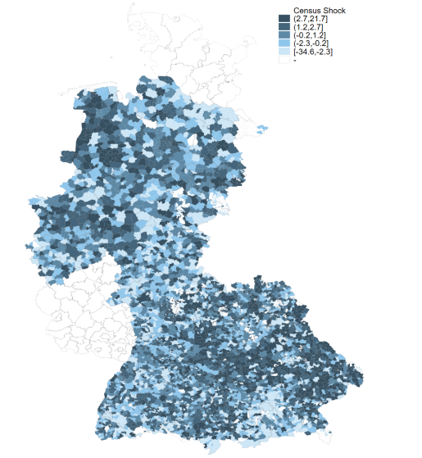
Notes: The figure shows the distribution of the Census Shock — the 1987 census correction to official population counts — by quintile groups across municipalities in the five federal states in our main sample. Darker colors imply a stronger Census Shock for the respective municipality. West German states without budget data and municipalities excluded because of border changes are marked white.
Transfers Flow into Investment
Municipalities that gained transfers did not expand their payrolls, nor did they use the additional funds to pay down debt. They invested in roads, buildings, and other local infrastructure. This response took time: investment rose for about five years before settling at a permanently higher level. The investments also set further budgetary responses in motion: ultimately, each additional euro of transfers increased municipal budgets by about two euros (Figure 2). Roughly half of this effect is mechanical, as municipalities have to pass part of the cost of new infrastructure on to residents. The remainder largely stems from loans taken up to finance large investment projects, and from a temporary rise in tax revenues — likely reflecting the boost that public spending gives to the local economy.
Figure 2: The multiplier effect of transfers on municipal revenues
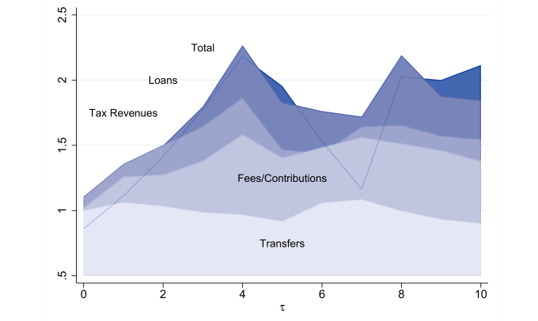
Notes: Decomposition of the multiplier effects of fiscal transfers on municipal revenues. The figure shows the effect of an additional euro of transfers on total revenues and its components in the years after the census correction (τ = 0). Sub-category effects of the respective revenue categories shown in the graph are stacked on top of each other. The shaded blue line shows total revenues (net of double accounting). Observations from Hesse are excluded for better comparability. The temporary drop in the multipliers after τ = 4 coincides with a general, recession-related drop in municipal revenues and expenditures.
A Gradual Tax Response
A second set of results concerns local taxes. German municipalities set their own business and property tax rates, and theory predicts that part of a windfall should be passed on to local residents through lower rates. Yet this adjustment takes time. In the first few years after the census, tax rates barely moved — consistent with the flypaper effect. Then the response builds steadily, however. A decade after the shock, municipalities had lowered their property and business tax rates markedly, and rates continued to decline thereafter (Figure 3). By that time, municipalities had returned about 11 percent of their gains to residents; after fifteen years, 16 percent. A study covering only the first three or four years would have concluded that taxes do not respond at all.
Why is the tax response so slow? Two frictions appear central. The first is tax competition: municipalities competing intensely with their neighbors for mobile firms adjust their tax rates markedly less than municipalities facing little competition. The second is electoral competition: administrations with slim majorities pass on considerably more of their gains to residents than those backed by comfortable majorities — suggesting that political competition aligns fiscal decisions with the preferences of residents. Moreover, municipalities rarely reduce tax rates outright; transfer gains instead lead them to cancel or postpone future tax increases. The slow adjustment thus reflects identifiable frictions rather than mere inertia.
Figure 3: The gradual response of local tax rates
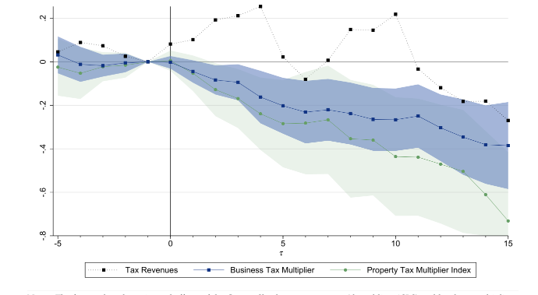
Notes: The figure plots the estimated effects of the Census Shock on tax revenues (dotted line) and on local tax multipliers (solid lines). Regressions are heteroscedasticity-weighted and the areas represent 95% confidence intervals. For readability the confidence interval for the tax revenue coefficients are omitted.
Gains versus Losses
The census produced transfer gains in some municipalities and losses in others, allowing a direct comparison. In the short run, these responses were indeed asymmetric: municipalities losing transfers cut expenditures and investment quickly, while municipalities gaining transfers expanded only gradually. Within a few years, however, the responses converged, mirroring each other in the long run. We thus find no evidence of an expansionary bias that would threaten the sustainability of decentralized public finances in the German setting.
Heterogeneous Reactions
The average response conceals substantial differences across municipalities. Large municipalities respond quickly and reduce their tax rates considerably more, so that part of their initial budget expansion recedes over time. Small municipalities respond with delay but sustain higher investment in the long run. Local conditions matter as well: municipalities in favorable economic and fiscal circumstances primarily invest, whereas municipalities with high unemployment cut business taxes — possibly to attract firms and jobs — and highly indebted municipalities reduce property taxes. The size and timing of the fiscal response thus vary systematically with local conditions.
Policy Implications
Our findings have two main implications. First, transfers to municipalities generate multiplier effects: each euro of support ultimately raises local budgets by about two euros, as investments induce further revenues. For fiscal equalization and other unconditional transfers, this is an encouraging result — such funds do not merely fill budget gaps but stimulate local investment. At the same time, the response varies considerably with municipal size and economic conditions. These heterogeneities are relevant for the design of equalization schemes, though firmer conclusions require further research.
Second, the effects of transfers materialize with delay. Predictable, long-term funding therefore matters: municipalities are more likely to commit to investments — often financed through loans — when they can rely on future revenues. And evaluations of transfer programs must account for these dynamics: assessments covering only the first years capture only a fraction of the response and can be qualitatively misleading.
Conclusion
Municipalities put additional funds to productive use: transfers flow into local infrastructure, and their effect on municipal budgets is roughly twice their nominal size. The adjustment takes time, however — investment builds over five years, and local taxes respond over more than a decade. In the long run, responses to gains and losses are largely symmetric, and a substantial share of gains is passed on to citizens. The well-known “anomalies” of local public finance, including the flypaper effect, thus largely reflect the short run; standard theories describe long-run behavior considerably better. Why local taxes take a decade to adjust, and whether they are equally sluggish in countries with different institutions, remain open questions for future research.
References
Helm, I., and J. Stuhler (2024). “The Dynamic Response of Municipal Budgets to Revenue Shocks.” American Economic Journal: Applied Economics, 16(4), 484–527.
