


Short summary
Western policy discussions often centre on the idea that military spending, economic sanctions, and battlefield losses will eventually erode domestic support for the Kremlin. Our recent study (Elinder et al., 2026) provides evidence of what happened to Russian public opinion when Russia launched its full-scale invasion of Ukraine on February 24, 2022. Using survey data collected by the Levada Center and the Gallup World Poll, this insight analyses how the invasion and the subsequent mobilisation affected Russian public opinion across a wide range of attitudes.
After the invasion, support for Putin rose by 13 percentage points within weeks. Russians became more optimistic about their country’s future, their attitudes toward the EU became more negative, and fewer Russians said they wanted to emigrate. These shifts were broad-based across age, gender, education levels, and income groups. Only Moscow stood apart, showing no significant rally effect. The military mobilisation in September 2022, on the other hand, decreased support for Putin; but these effects were only temporary and had fully dissipated once the mobilisation ended. Meanwhile, Russians abroad broke sharply with their compatriots at home: their approval of Putin fell by 25 percentage points, converging with global opinion.
Key Findings
- Support for Putin jumped 13 percentage points in the weeks after the invasion.
- Russians became more optimistic about Russia’s future, more anti-Western, and fewer wanted to emigrate.
- The surge in Putin’s approval was seen across almost all demographic groups. Only Moscow showed no significant effect.
- During the subsequent mobilisation, approval of Putin fell, mood turned fearful and irritable, and optimism dipped. But once the mobilisation ended, sentiments returned to pre-mobilisation levels.
- Russians living abroad turned against Putin. Among Russians living outside Russia, approval of Putin fell by 25 percentage points.
Relevance Today
These findings have two immediate implications for Western policymakers as the war in Ukraine continues. First, they suggest that expectations of regime change from within Russia are unlikely to materialise in the short term. Second, they indicate that the decline in support among the Russian diaspora may have longer-term significance, as this estrangement could gradually influence attitudes inside Russia through personal networks.
Author Quote
“The invasion not only increased support for Putin but also fostered greater optimism about the future, strengthened anti-Western attitudes, and reduced migration aspirations. These effects were broadly consistent across demographic groups, with the notable exception of residents in Moscow.”
Reference: Based on RFBerlin Discussion Paper No. 044/26: Mikael Elinder, Oscar Erixson, and Olle Hammar (2026), “The Effects of the Invasion of Ukraine on Russian Sentiments.”
Research summary
Foreign wars sometimes boost leaders’ popularity at home. Citizens rally behind their government in moments of national conflict, critics fall quiet, and approval ratings climb. This so-called “rally ‘round the flag” effect is well-documented in political science (Mueller 1970; Hetherington and Nelson 2003). But how it works in authoritarian settings, whether it extends beyond mere approval to affect deeper attitudes and life choices, and how it varies across a population, are questions that have been harder to answer (Guriev and Treisman 2020; Seo and Horiuchi 2024). Russia’s full-scale invasion of Ukraine in February 2022 offers an opportunity to examine these questions in detail (Hale 2022; Kizilova and Norris 2024).
Our study draws on two independent surveys: the Levada Center and the Gallup World Poll. By comparing people surveyed just before and just after the invasion, as well as the subsequent mobilisation, our study aims to estimate the causal effects of these war events on a wide range of sentiments in Russia.
Figure 1: Effects of the invasion on approval of Putin
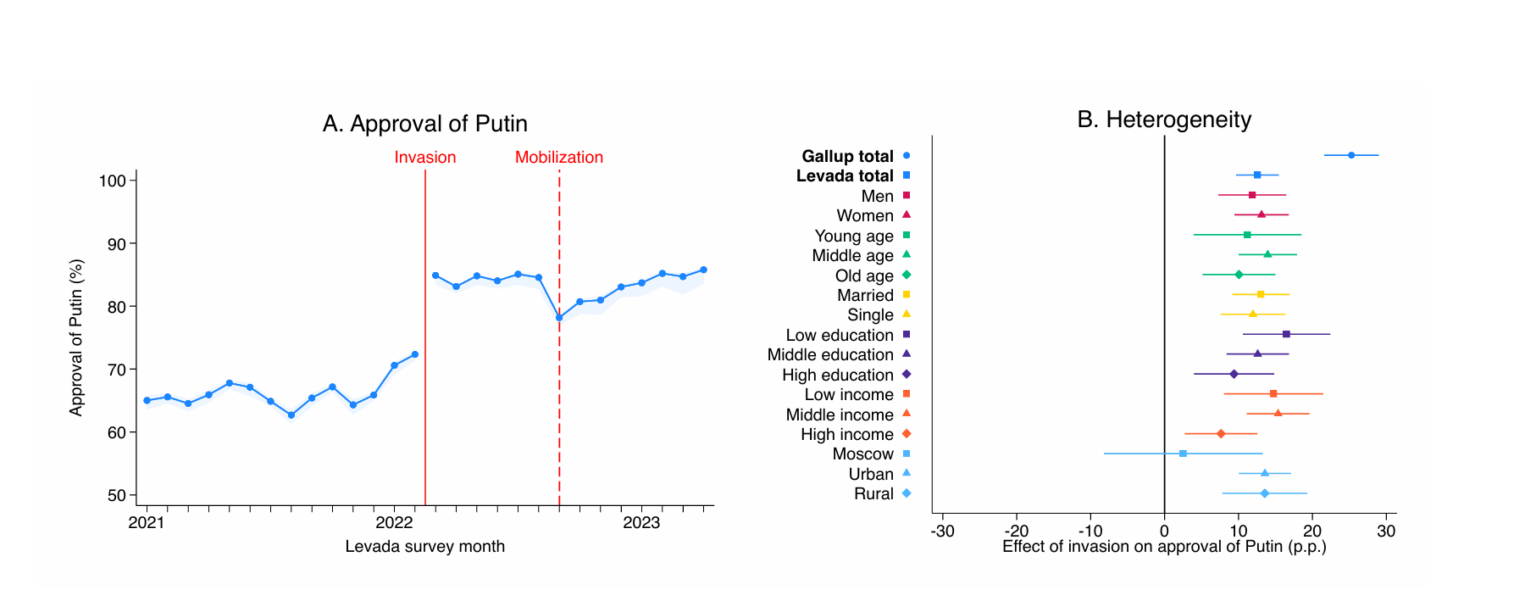
Note: The figure shows the effects of the Russian invasion of Ukraine on February 24, 2022, on the approval of Putin in Russia. Panel A shows monthly averages from the Levada Center’s public opinion surveys in Russia between January 2021 and April 2023. Panel B shows the invasion effects in percentage points for various segments of the Russian population, estimated as the difference between the March and February 2022 Levada surveys for each subgroup.
Key Findings
The results are striking. Between February and March 2022, approval of Putin rose by 13 percentage points. Russians also became more optimistic about their country’s future, while views of the European Union became more negative, and migration aspirations dropped.
Breaking the results down by gender, age, education, income, marital status, and region, the pattern is remarkably consistent across almost all groups. The one notable exception is Moscow, where residents showed no significant rally effect.
In September 2022, Putin announced a partial military mobilisation, calling up men of conscription age to fight in Ukraine. The response was immediate: approval of Putin fell, optimism declined, and moods such as fear, melancholy, tension, and irritation increased. Support for the Russian military’s actions in Ukraine also halted. Importantly, these results also indicate that Russians were still willing to express dissatisfaction when they felt it. At the same time, these effects were short-lived. The mobilisation was declared complete in October 2022, and within a few months, approval of Putin and other indicators had returned to their post-invasion levels.
The picture is very different among Russians living abroad. Before the invasion, Russians abroad were more favourable toward Putin than those living inside Russia. The invasion changed that completely. Among Russians living abroad, approval of Putin fell by 25 percentage points between 2021 and 2022. This drop was especially sharp among Russians living in countries that were already critical of Putin before the war. For the first time, the diaspora’s views have converged with global opinion and diverged from those of Russians at home.
Figure 2: Long-run trends and support for Putin among Russians abroad
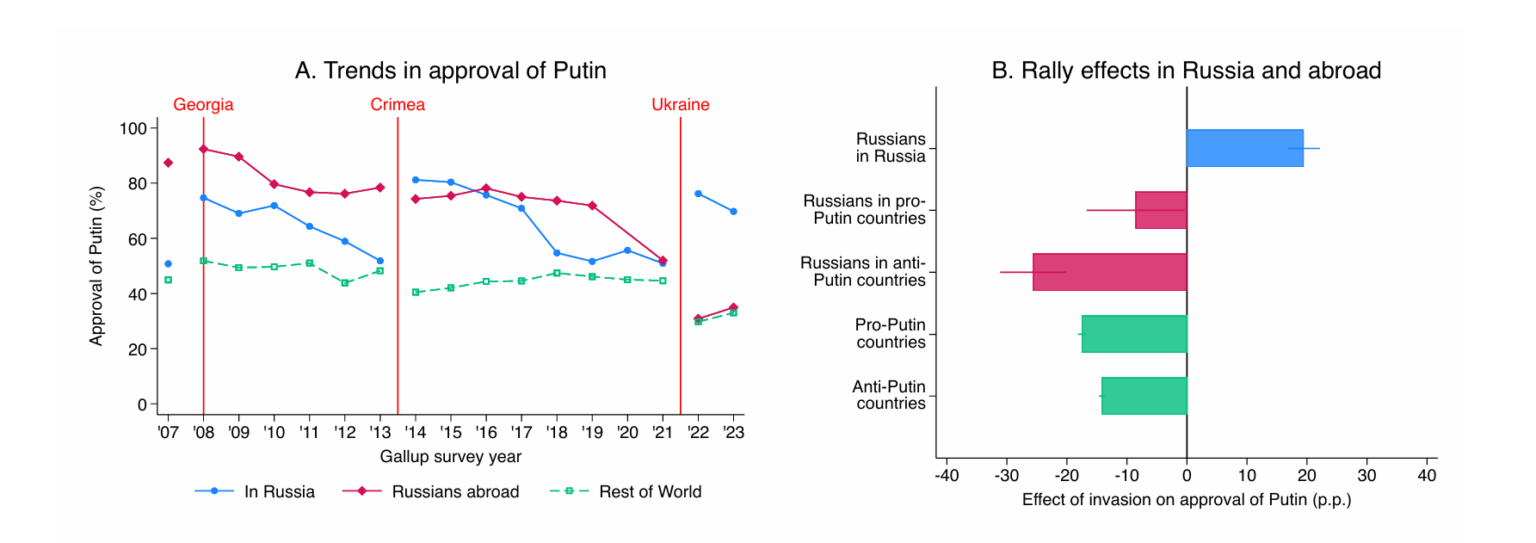
Note: The figure shows the approval of Putin in Russia, among Russians abroad, and in the rest of the world. Panel A shows the trends in Gallup between 2007 and 2023. Panel B shows the effects of the invasion in percentage points, estimated as the difference between the 2022–2023 and 2020–2021 Gallup survey waves.
Policy Implications
The invasion of Ukraine produced strong and lasting popular support for the Kremlin. The mobilisation showed that public tolerance has limits, but also that it rebounds quickly. These findings suggest that internal popular pressure as a mechanism for ending the war faces significant constraints, at least in the near term.
At the same time, the data show that the Russian diaspora holds markedly different views from the domestic population, representing a potential channel of influence back into Russia. Whether and how this divergence might eventually affect opinion inside Russia remains an open empirical question.
Conclusion
Russia’s invasion of Ukraine produced a clear example of a rally ‘round the flag effect. Support for Putin surged across nearly all demographic groups, accompanied by rising optimism, deepening anti-Western sentiment, and a reduced desire to emigrate. The partial mobilisation punctured this mood, but only temporarily. At the same time, the data reveal a sharp divergence between domestic Russian opinion and that of the diaspora. Together, these findings suggest that foreign conflict can strengthen domestic support for a government, and that such support may prove resilient even under significant human and economic costs.
References
Elinder, M., Erixson, O., & Hammar, O. (2026). The Effects of the Invasion of Ukraine on Russian Sentiments (No. 26044). ROCKWOOL Foundation Berlin (RFBerlin).
Guriev, S., and Treisman, D. (2020). “The popularity of authoritarian leaders: A cross-national investigation,” World Politics 72(4): 601–638.
Hale, H. E. (2022). “Authoritarian rallying as reputational cascade? Evidence from Putin’s popularity surge after Crimea,” American Political Science Review 116(2): 580–594.
Hetherington, M. J., and Nelson, M. (2003). “Anatomy of a rally effect: George W. Bush and the War on Terrorism,” PS: Political Science and Politics 36(1): 37–42.
Kizilova, K., and Norris, P. (2024). “‘Rally around the flag’ effects in the Russian–Ukrainian war,” European Political Science 23(2): 234–250.
Mueller, J. E. (1970). “Presidential popularity from Truman to Johnson,” American Political Science Review 64(1): 18–34.
Seo, T., and Horiuchi, Y. (2024). “Natural experiments of the rally ‘round the flag effects using worldwide surveys,” Journal of Conflict Resolution 67(2–3): 269–293.
Disclaimer
The opinions and views expressed in this publication are those of the author(s) and do not necessarily reflect those of the ROCKWOOL Foundation Berlin (RFBerlin). While research disseminated through this series may address policy-relevant topics, RFBerlin, as an independent research institute, does not take institutional policy positions.
Publications in the RFBerlin Research Insights series may represent preliminary or ongoing work that has not been peer-reviewed. Readers are advised to consider the provisional nature of such research when citing or applying its findings.
These publications aim to make scientific work accessible to a broader audience and to encourage informed, research-based discussion. All materials are provided by the respective authors, who bear responsibility for appropriate attribution and rights clearance. While every effort has been made to ensure accuracy and proper acknowledgment, RFBerlin welcomes notifications of any concerns regarding authorship, citation, or intellectual property rights. Please contact RFBerlin to request corrections if needed.
Use of these materials for the development or training of artificial intelligence systems is strictly prohibited.
