

Short Summary
How does access to public childcare shape the career trajectories of parents? And, what is the active ingredient behind the long-term impacts of childcare programs on children’s labor market outcomes? We show that Finland’s first public childcare program allowed mothers to enter the labor market when their children were still young. As a result, the entire career trajectory of mothers changes: they enter more skill-intensive industries, and experience substantial wage growth throughout their careers. Interestingly, the fathers of children with access to public childcare also improve their earnings trajectories – partly driven by shifting away from agricultural work near their homes to industrial employment.
In terms of children’s outcomes, we find that public childcare improved the outcomes of children from poor families, while the effects on children from higher income families were more muted or sometimes negative. As a result, we document that the policy reduced intergenerational persistence in income. We leverage Finnish Defence Forces data on the near universe of males to link effects on labor market outcomes to effects on measures of a broad range of cognitive and socio-emotional skills measured in adulthood. Our results indicate that the effects of public childcare on labor market outcomes are accompanied by a parallel pattern of effects on social competences – not fluid intelligence. Children from poor families exposed to public childcare experience reduced secondary school dropout, improved social competence, and a shift from manually intensive occupations to more varied social-skill intensive occupations. In turn, children from more affluent families experience more muted and sometimes even negative effects.
Key Findings
- Public childcare boosts parental employment for both mothers and fathers when children are young.
- The benefits for parents extend far beyond the childcare years, their earnings continue to grow with gains increasing untill around age 55.
- Public childcare access improves the labor market outcomes of children from poor families, with muted or even negative effects on children from higher income families.
- Effects on labor market outcomes are accompanied by a similar pattern of effects in terms of social competence – not fluid intelligence. This highlights social competence as the active ingredient behind the effects of childhood programs for children.
- Public childcare generates a high value of public funds, but this would have been obscured without the ability of following parental outcomes over the life-cycle.
Reference: Based on RFBerlin Discussion Paper No. 004/26: Mikko Silliman, Juuso Mäkinen (2026): Life-cycle effects of public childcare: Evidence on children and their parents.
Research Summary
Public childcare programs are often considered the central bedrocks of the modern welfare state. They have the capacity to both help parents, especially mothers, remain attached to the labor market and improve children’s long-term opportunities. Despite the wide-ranging interest in childcare policies, the potential long-term implications of both these channels obscure assessments of the value of these programs.
Our focus is the Childcare Law of 1973, which established the first national public childcare program in Finland. Without sufficient resources for the government to provide public childcare in all municipalities right away, only some could receive funding for public childcare in the first years following the law. Since there were already municipality-provided public childcare programs in urban areas before 1973, we focus on rural municipalities for which the reform provided access to public childcare for the first time. Prior to the policy, childcare was provided primarily by mothers as well as a patchwork of informal and private services, though even these were often unavailable. We compare cohorts born in the first set of rural municipalities to receive public childcare (treatment) to the same cohorts born in similar municipalities that only received public childcare in later years (comparison). Just a few years after the introduction of the policy, about 35 percent of eligible cohorts in the treatment municipalities attended public childcare while there remained no public childcare in comparison municipalities.
Figure 1: Effects of public childcare on parental earnings
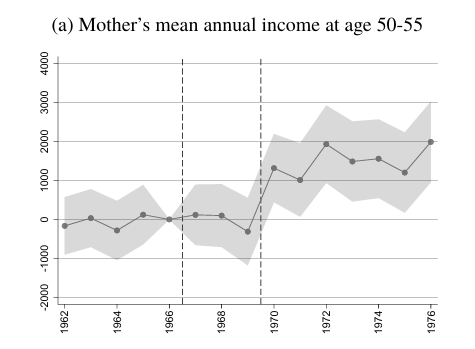
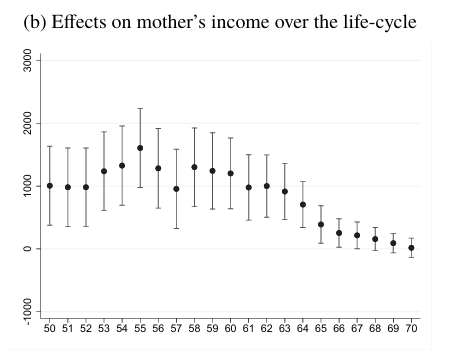
Notes: Figure (a) shows event study estimates of the effects of public childcare access – based on children’s birth year – on mothers’ labor supply. Figure (b) presents estimates of the effects of public childcare access when children were childcare aged on the earnings of mothers from age 50 to age 70.
As increasing maternal employment was the major motive for the policy, we begin our analysis with parents. We find that access to public childcare increased the family incomes of parents whose children were eligible for childcare by 1,141 euros annually when children were between the ages of three and six. Perhaps more interestingly, these effects persist through retirement. In fact, the magnitude of the effects grows in both absolute and relative terms, such that by the time children are in their late teens, families whose children were eligible for childcare when they were young earn 2,078 euros (5.3 percent of the baseline) more each year than their untreated counterparts. We find that these total effects are primarily driven by higher wage income and lower self-employment income. Mothers shift away from manufacturing related occupations and towards more skill-intensive jobs in teaching and healthcare. Further, fathers also exhibit a shift away from manually intensive jobs towards more skill-intensive occupations. Interestingly, while we are unable to detect heterogeneity on short term effects by baseline family income, we find that parents from higher income families exhibit larger effects over time, consistent with the idea that they may have been able to use the increased labor supply when their children were young to accumulate human capital and progress in their careers.
Next, we turn to children. Childcare access does little to affect aggregate outcomes of treated cohorts exposed to childcare. However, these average estimates mask important heterogeneity between children growing up in different childhood environments. Children from poor families with access to public childcare are more likely to be employed and rank higher in the adult income distribution (2 percentile ranks).By contrast, the effects are much smaller for children from higher-income families, and in some cases even negative. Together, these effects reduce the link between parents’ and children’s income ranks by 18 percent, indicating greater intergenerational mobility. Broadly, the pattern of results for girls is similar to that for boys – with the exception that the effects on dropout are muted, and effects on tertiary completion are heightened. These results are robust to the inclusion of controls, regional trends, and alternative estimators. This pattern of divergent effects for children from rich and poor families is consistent with prior work from various contexts (e.g. Havnes and Mogstad, 2015; Cornelissen et al., 2018; Ichino et al., 2019).
Researchers have long argued that the lasting benefits of childcare stem from improvements in children’s social rather than cognitive skills, but evidence has been limited because adult skill measures are rarely available. Using detailed Finnish Defence Forces data covering most men, we are able to test this hypothesis directly by linking public childcare to both adult skills and later labor market outcomes.
As for labor market outcomes, we find that children from poor families with access to public childcare experience improvements in both academic skills and social competence by nearly 0.1 standard deviations, while children from higher income families experience decreases in their skill levels. We find clear evidence of this pattern of reduced persistence by family income for academic skills and social competence, but are unable to detect similar effects on visual-spatial skills. Next, we study whether these effects are accompanied by changes in the types of jobs people do as adults. Our results suggest that access to public childcare shifts boys from low-income families away from manual labor and toward social-skill-intensive occupations. The added benefit of the data on occupational tasks is that it is also available for females. Compared to boys, the results for girls exhibit a greater shift towards math (analytic) intensive jobs. These differences by gender may be explained by dynamic complementarities, and where public childcare prevented poor boys from dropping out, it helped girls from poor families continue to college.
Figure 2: Event-study plots of the relationship between family income and skills in treatment versus comparison municipalities
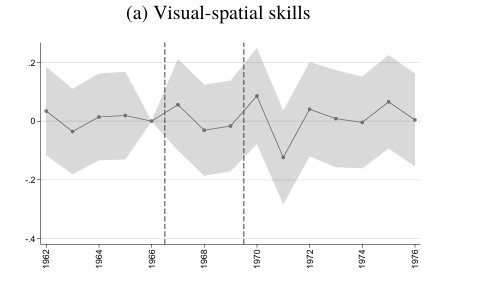
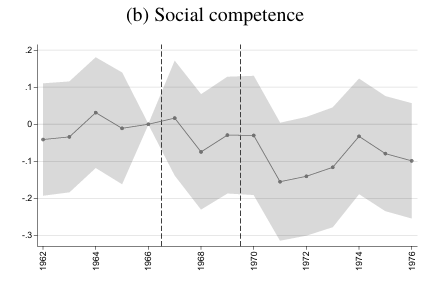
Notes: Figures (a) and (b) show event-study plots which study the intergenerational persistence between family income and children’s skills – standardized to have a mean of zero and a standard deviation of one. Skills are measured using data from the Finnish Defence Forces, and standardized to have a mean of zero and standard deviation of one in the base period.
To more directly assess the role of skills in explaining the effects of public childcare, we perform a decomposition-based approach to mediation following Imai et al. (2010) and Heckman et al. (2013). We find that improvements in social skills (46%) account for a much larger share of the gains than improvements in academic (37%) or cognitive skills (13%). As public childcare is a complex bundle of treatments, these results should not be interpreted as showing that effects on social competence are the only driver of the labor market results. Still, these results point to the outsize role of social competence above and beyond academic –and particularly visual-spatial– skills. Adding all three skills as mediators simultaneously has no additional explanatory power beyond the inclusion of social competence. This suggests that the effects on academic skills are subsumed by effects on social competence – and is consistent with dynamic complementarities between early childhood social competence and later academic development. Together, these results —linking the effects of childcare on earnings, to effects on skills measured in adulthood— provide some of the first large-scale empirical support for the idea that the persistent effects of childcare on adult outcomes might operate through lasting effects on social competence.
The parallel effects we observe on children and parents, and particularly mothers, suggest that the effects we see on children are likely to be explained by the quality of early childhood socialization in the absence of access to public childcare (Kline and Walters, 2016). The reduction in the family income gradient of skills might be explained by differences in the quality of children’s counterfactual environments. For example, prior research shows that more affluent mothers provide more attention to their children (Guryan et al., 2008; Falk et al., 2021).
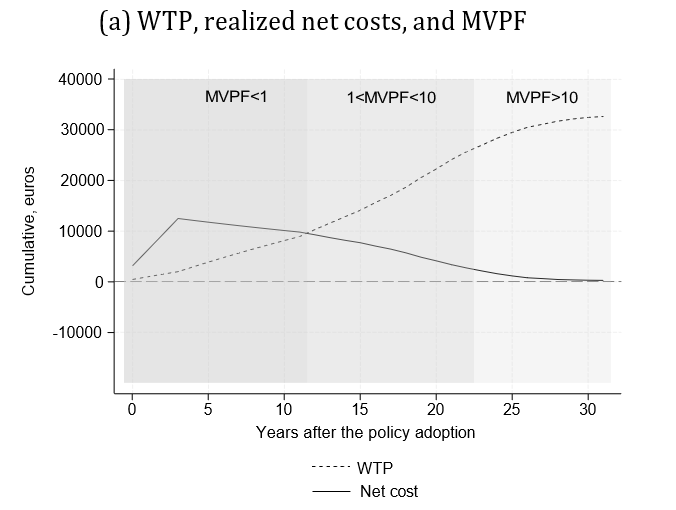
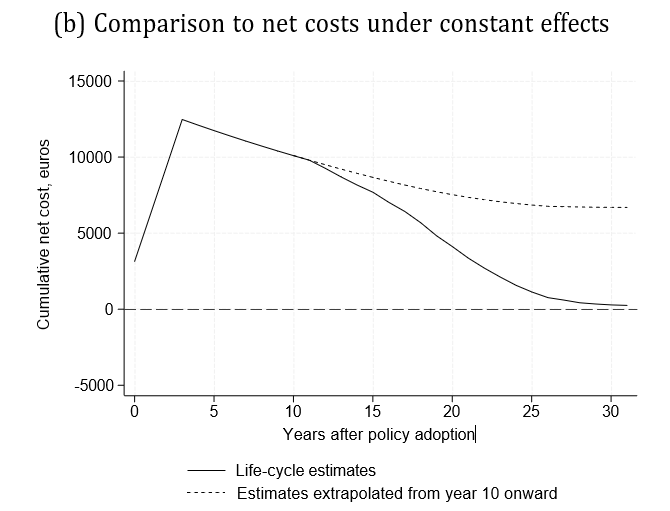
Notes: Figure (a) plots the willingness to pay, net costs, and marginal value of public funds. Willingness to pay (WTP) measures the policy’s effect on parents’ after-tax earnings. Net cost is the sum of costs and fiscal externalities. The marginal value of public funds (MVPF) is the ratio of WTP to net costs (Hendren and Sprung-Keyser, 2020). When net cost is either zero or negative, the policy pays for itself and the ratio is either not defined or meaningful and MVPF is set to infinity. Figure (b) plots the policy’s net cost that are used in calculating the MVPF. For the solid line, the net cost is based on life-cycle estimates. As a comparison, we assume that we only have estimates 10 years after the policy implementation. We follow Hendren and Sprung-Keyser (2020) and use available estimates to extrapolate life-cycle effects under the assumption that the effect size stays constant relative to the counterfactual mean after 10 years of policy implementation.
More broadly, our findings show that the value of public childcare cannot be judged using only short-term outcomes. The benefits continue to accumulate over decades as parents’ careers develop. Had we followed families for only the first ten years after the reform, we would have substantially underestimated the program’s long-term economic returns. This suggests that evaluations of childcare and other early childhood programs should take a life-cycle perspective whenever possible.
Finally, we bring together the life-cycle effects on parental labor supply and the (null) average effects on children to conduct an evaluation of the cost-effectiveness of the program. Our results show that the program pays for itself, but that it takes more than thirty years for it to do so. Given that we observe effects through parents’ retirement – something usually unavailable to researchers, we also assess the sensitivity of cost-effectiveness measures to estimates given shorter follow-up periods under the common assumption of constant effects. This counterfactual exercise suggests that, since effects on parental earnings increase through their late fifties, we would have under-estimated the cost-effectiveness and marginal value of public funds (MVPF) (Hendren and Sprung-Keyser, 2020) had we assumed constant effects over the life-cycle.
Policy Implications
Our findings carry two primary implications for policy. First, our results for parents suggest that cost-effectiveness estimates based only on short term effects of policies can obscure the true value of policies in the presence of dynamics in treatment effects over the life-cycle. Second, our results for children provide a basis for optimism regarding the longer-term effects of childhood programs which generate effects on children’s social competencies in the short to medium term. This also suggests that the increased attention beginning to be paid to programs which generate gains in socio-emotional skills may be warranted.
Conclusion
We find that Finland’s first public childcare program promoted parental employment while increasing intergenerational mobility for children. These results advance the literature in economics in two primary ways. First, we show that effects of public childcare on parental outcomes increase in magnitude over the life-cycle. Second, we show that the effects of public childcare on children’s labor market outcomes are underlined by persistent effects on social competence rather than fluid intelligence.
References
Acemoglu, D. and Autor, D. (2011). Skills, tasks and technologies: Implications for employment and earnings. In Handbook of labor economics, volume 4, pages 1043–1171. Elsevier.
Athey, S., Chetty, R., Imbens, G. W., and Kang, H. (2025). The surrogate index: Combining short-term proxies to estimate long-term treatment effects more rapidly and precisely. Review of Economic Studies, page rdaf087.
Chetty, R., Friedman, J. N., Hilger, N., Saez, E., Schanzenbach, D. W., and Yagan, D. (2011). How does your kindergarten classroom affect your earnings? evidence from project star. The Quarterly Journal of Economics, 126(4):1593–1660.
Cornelissen, T., Dustmann, C., Raute, A., and Schönberg, U. (2018). Who benefits from universal child care? estimating marginal returns to early child care attendance. Journal of Political Economy, 126(6):2356–2409.
Deming, D. (2009). Early childhood intervention and life-cycle skill development: Evidence from head start. American Economic Journal: Applied Economics, 1(3):111–34.
Deming, D. J. (2017). The growing importance of social skills in the labor market. The Quarterly Journal of Economics, 132(4):1593–1640.
Duncan, G., Kalil, A., Mogstad, M., and Rege, M. (2023). Investing in early childhood development in preschool and at home. Handbook of the Economics of Education, 6:1–91.
Falk, A., Kosse, F., Pinger, P., Schildberg-Hörisch, H., and Deckers, T. (2021). Socioeconomic status and inequalities in children’s iq and economic preferences. Journal of Political Economy, 129(9):2504–2545.
Guryan, J., Hurst, E., and Kearney, M. (2008). Parental education and parental time with children.
Journal of Economic Perspectives, 22(3):23–46.
Havnes, T. and Mogstad, M. (2015). Is universal child care leveling the playing field? Journal of Public Economics, 127:100–114.
Heckman, J., Pinto, R., and Savelyev, P. (2013). Understanding the mechanisms through which an influential early childhood program boosted adult outcomes. American Economic Review, 103(6):2052–86.
Hendren, N. and Sprung-Keyser, B. (2020). A unified welfare analysis of government policies. The Quarterly Journal of Economics, 135(3):1209–1318.
Ichino, A., Fort, M., and Zanella, G. (2019). Cognitive and non-cognitive costs of daycare 0–2 for children in advantaged families. Journal of Political Economy, 704075.
Imai, K., Keele, L., and Tingley, D. (2010). A general approach to causal mediation analysis. Psychological methods, 15(4):309.
Kline, P. and Walters, C. R. (2016). Evaluating public programs with close substitutes: The case of head start. The Quarterly Journal of Economics, 131(4):1795–1848.
