

Short summary
Picture a marketing professional drafting ad copy with a chatbot, an IT support specialist troubleshooting user issues, or a teacher spotting AI-generated student homework. Two years after ChatGPT’s launch, generative AI has rapidly become part of white-collar work. Yet for adopters, the data show no differential changes in earnings or hours.
This stable surface masks a workplace transformation already underway. Surveys of 25,000 Danish workers in 11 exposed occupations, linked to administrative records, show employers embracing AI chatbots, new tasks emerging in drafting, oversight, and integration, and adopters moving into new occupations.
Key Findings
- Most employers embrace AI chatbots: 43 percent encourage their use, another 21 percent allow it, and only 6 percent prohibit it.
- Adoption ranges from 41 percent of workers in workplaces without AI policies to 93 percent where employers combine encouragement, enterprise tools, and training. Nearly one in five users save more than an hour per day of usage.
- One in five users in supportive workplaces takes on entirely new AI tasks — drafting content, reviewing AI outputs, and integrating AI into workflows.
- AI chatbot adoption has not led to differential changes in earnings or hours.
- Occupational mobility is the one shift to surface: adopters work 4 percent of a full-time equivalent more in their latest occupation (often IT support or clerical), with occupation switchers seeing earnings growth 12 percentage points faster than other Danish workers.
Relevance Today
Measuring AI’s labor market effects requires combining administrative data with surveys. Administrative data alone miss the workplace transformation AI is producing inside firms; surveys alone may overstate AI’s reach, since reported time savings do not always translate into changed wages or employment.
While AI-exposed occupations have seen falls in early-career jobs, our data show these trends are not driven by firms adopting generative AI. On the more optimistic side, our evidence on occupational mobility aligns with the view (Autor 2024) that AI may help workers move into better-paying jobs.
Whether and how AI’s productivity gains eventually translate into worker pay and employment is a key open question. The transformation runs beneath the surface — a modern echo of Solow’s (1987) IT-era paradox.
Author Quote
“The fastest technology adoption in recent history has rapidly reshaped how people do their jobs — but two years in, those changes have not yet surfaced in workers’ paychecks. Looking only at headline employment and wage numbers will miss the transformation already underway.” — Anders Humlum
Reference: Based on RFBerlin Discussion Paper No. 078/26: Humlum, A., & Vestergaard, E. (2026). Still Waters, Rapid Currents: Early Labor Market Transformation under Generative AI. Rockwool Foundation Berlin.
Research summary
Early Labor Market Transformation under Generative AI
Two years after ChatGPT’s launch, generative AI has become part of everyday white-collar work. Marketing professionals use chatbots to draft ad copy, IT support workers use them to troubleshoot user problems, and teachers use them to detect AI-generated homework. Yet despite this rapid adoption, workers who use AI do not yet see clear changes in earnings or hours. Linking surveys of 25,000 Danish workers in 11 highly exposed occupations to monthly administrative records through December 2024, our paper provides one of the first comprehensive answers. The headline result: no effects on earnings and hours — both for workers who use chatbots and for the firms that adopt them. Yet beneath this still surface, a substantial reorganization of work is already underway.
Context
Experts disagree sharply about the direction and magnitude of generative AI’s labor effects. . Anthropic CEO Dario Amodei (2025) warns of large-scale displacement of white-collar work within a few years; Nobel laureate Daron Acemoglu (2025) expects modest productivity gains over decades. The stakes are especially high for workers early in their careers — is this the worst or the best time to enter an AI-exposed occupation? Brynjolfsson, Chandar, and Chen (2025) document sharp declines in early-career employment in AI-exposed occupations, raising concerns that AI may already be displacing entry-level jobs. A more optimistic view, advanced by Autor (2024), holds that generative AI may help workers access otherwise scarce expertise and move into better-paying careers. Direct evidence to weigh these views has been scarce.
Denmark provides an unusually clean window into this process. Danish workers are at the international forefront of generative AI adoption, and the labor market is flexible. Critically, Statistics Denmark’s monthly administrative records can be linked to surveys measuring which workers actually use AI chatbots and which firms support adoption. This lets us weigh the contrasting views against each other and separate AI-driven changes from other labor market trends.
The Currents: How Workplaces Are Adopting AI
Employers have rapidly embraced AI chatbots. Figure 1 shows that 43 percent of workers in our 11 occupations are in workplaces that explicitly encourage chatbot use, while only 6 percent face an outright prohibition. Among them, 61 percent provide enterprise chatbots and 39 percent offer training. About 41 percent of workers use chatbots even in workplaces that take no active steps. In workplaces combining encouragement with enterprise tools and training, adoption climbs to 93 percent, and one in five workers save more than an hour per day of usage.
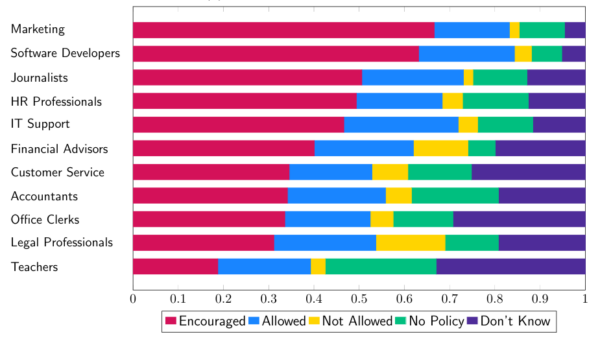
Figure 1: Most employers in AI-exposed occupations encourage chatbot use. Share of workers reporting different employer policies on AI chatbot use, by occupation. Across 11 highly exposed occupations, 43 percent of workers face employer-encouraged use, 21 percent allow it, and only 6 percent prohibit it. Source: 2024 survey of Danish workers.
AI chatbots do more than speed up existing work; they create new tasks. Figure 2 shows what this new work looks like. About 42 percent involve content generation — ideating, drafting, and analyzing data. Another 35 percent involve reviewing AI outputs and ensuring compliance, such as detecting AI-generated homework or checking legal accuracy. The largest single category, at 26 percent, is integration: fine-tuning AI assistants, writing usage policies, and embedding chatbots into workflows. About 8 percent of users in workplaces with no AI policy take on entirely new tasks, doubling where employers actively support adoption. Most users (85 percent) reallocate time savings to other job tasks, with far fewer doing more of the tasks they saved time on or taking more leisure.
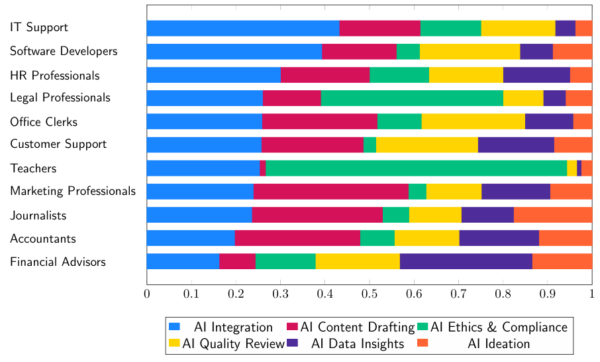
Figure 2: What workers do with AI: composition of new AI-related job tasks. Distribution of reported new tasks created by AI chatbots, by occupation and task category. Roughly 42 percent of new tasks involve generating content (ideating, drafting, analysis), 35 percent involve reviewing AI outputs and compliance, and 26 percent involve integrating AI into workflows. Source: free-text task descriptions from the 2024 survey, categorized by the authors.
The Surface: Why Wages and Employment Have Not Yet Moved
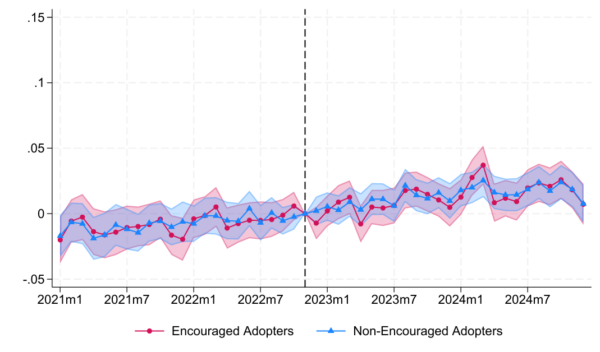
Despite rapid AI adoption, there is little evidence that workers have seen higher pay as a result. Workers who use chatbots earn more on average than non-users, but these differences existed before ChatGPT was introduced. Comparing earnings before and after adoption shows no meaningful effect on wages. This finding holds across all 11 occupations in our study, including software development and marketing, and among the workers most heavily exposed to AI: daily users, workers who save more than an hour per day, those who take on new AI-related tasks, and those whose employers actively encourage adoption. Workers themselves report the same pattern: 98 percent of AI users say chatbots have had no effect on their earnings.
The exception, shown in Panel (b), is occupational mobility. Adopters work about 4 percent of a full-time equivalent more in their latest occupation than comparable non-adopters. The destinations cluster in IT support and clerical roles — occupations with greater tool flexibility and no formal credential requirements. Adopters who switch see their earnings grow 12 percentage points faster than other Danish workers, moving into roles with higher wage premia and where chatbots are more directly relevant. These switchers are still too few to move the average for adopters, but hint at how AI’s labor-market effects may surface over time.
(a) Earnings of adopters relative to comparable non-adopters
(b) Hours worked in latest (December 2024) occupation
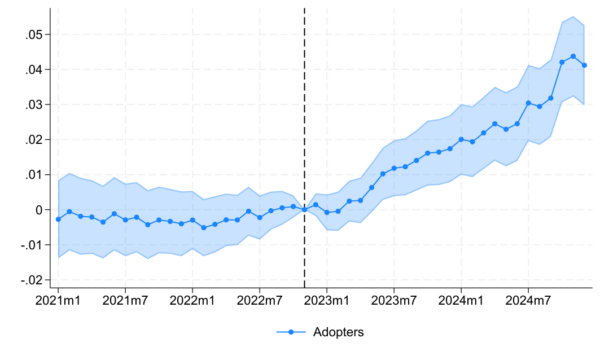
Figure 3: The surface stays still — except for occupational mobility. Panel (a) compares earnings of AI chatbot adopters to comparable non-adopters in the same occupation, indexed to ChatGPT’s launch in November 2022. Confidence intervals rule out average earnings effects larger than 2 percent. Panel (b) shows hours worked in the latest (December 2024) occupation: adopters are about 4 percent of a full-time equivalent more likely to be working in their latest role, indicating greater occupational mobility. Source: Danish administrative records linked to the 2024 survey.
What This Means for Policy
Measuring the labor market effects of AI requires combining administrative data with surveys. Administrative data alone miss the workplace transformation AI chatbots are already producing — in tasks, work organization, and occupational mobility. Surveys alone may overstate AI’s reach: reported time savings and new responsibilities do not always translate into changed wages or employment. Statistical agencies should track these new margins jointly. Policy makers should also be careful attributing aggregate trends to AI; measuring the separate impact of adoption is key, especially in the early years of technology diffusion. On the other hand, while AI-exposed occupations have seen falls in early-career jobs, our data show that these trends are not driven by firms adopting generative AI.
At the same time, our evidence on occupational switching aligns with the vision in Autor (2024) of generative AI as a tool that can rebuild middle-class career ladders. Whether this channel scales as adoption deepens — and whether AI’s productivity gains eventually translate into higher worker pay — is an open question for research and policy.
Conclusion
The early labor-market record on generative AI looks like still waters running over rapid currents. Workplaces are adopting, work is reorganizing, and adopters are moving into new occupations — yet earnings and hours stay flat. The pattern echoes Solow’s famous 1987 observation about the IT revolution: “You can see the computer age everywhere but in the productivity statistics.” Our data reveal what lies beneath: the reorganization of work absorbs change before it surfaces in earnings. We are still in the early innings of generative AI; tracking how the surface eventually catches up with the currents is an important avenue for further research.
References
Acemoglu, D. (2025). The Simple Macroeconomics of AI. Economic Policy, 40(121), 13–58.
Amodei, D. (2025). Behind the Curtain: A White-Collar Bloodbath. Interview reported by Axios.
Autor, D. (2024). Applying AI to Rebuild Middle Class Jobs. NBER Working Paper No. 32140.
Brynjolfsson, E., Chandar, B., & Chen, R. (2025). Canaries in the Coal Mine? Six Facts about the Recent Employment Effects of Artificial Intelligence. Stanford Digital Economy Lab.
Humlum, A., & Vestergaard, E. (2025). The unequal adoption of ChatGPT exacerbates existing inequalities among workers. Proceedings of the National Academy of Sciences, 122(1), e2414972121.
Humlum, A., & Vestergaard, E. (2026). Still Waters, Rapid Currents: Early Labor Market Transforma-tion under Generative AI. RFBerlin Discussion Paper No. 078/26.
Solow, R. M. (1987). We’d Better Watch Out. New York Times Book Review, July 12.
Disclaimer
The opinions and views expressed in this publication are those of the author(s) and do not necessarily reflect those of the ROCKWOOL Foundation Berlin (RFBerlin). While research disseminated through this series may address policy-relevant topics, RFBerlin, as an independent research institute, does not take institutional policy positions.
Publications in the RFBerlin Research Insights series may represent preliminary or ongoing work that has not been peer-reviewed. Readers are advised to consider the provisional nature of such research when citing or applying its findings.
These publications aim to make scientific work accessible to a broader audience and to encourage informed, research-based discussion. All materials are provided by the respective authors, who bear responsibility for appropriate attribution and rights clearance. While every effort has been made to ensure accuracy and proper acknowledgment, RFBerlin welcomes notifications of any concerns regarding authorship, citation, or intellectual property rights. Please contact RFBerlin to request corrections if needed.
Use of these materials for the development or training of artificial intelligence systems is strictly prohibited.
