




Short summary
In the United States, Black, Hispanic, and female workers are more likely to have wages at or close to the statutory minimum wage relative to White and male workers. When the minimum wage increases, these lower-wage groups are disproportionately affected. This is due to direct wage gains for workers earning the minimum wage, but also due to “spillover” wage gains for workers close to the minimum wage. So, although minimum wage policies are not explicitly designed to reduce between-group wage differences, the policies should still have that effect. Since minimum wages in the United States are relatively low, these inequality-reducing effects are expected to impact the lower end of the wage distribution.
Using hourly wage data spanning 1979 to 2019, we find that wage gains following minimum wage increases are indeed concentrated among lower-wage groups. This has the effect of reducing wage gaps between Black and White workers, Hispanic and White workers, and female and male workers. As expected, these effects are concentrated near the bottom of the wage distribution. Further, we find no evidence of adverse effects on employment for these lower-wage groups. This suggests that the wage inequality reductions from minimum wage increases do not come at the expense of employment.
In addition to government-mandated wage increases, the importance of the minimum wage is also governed by inflation. Statutory minimum wages are usually set in fixed dollar amounts. This means that when prices rise the “real” or inflation-adjusted value of the minimum wage generally declines. As expected, we show that a stagnant minimum wage level over an extended period can lead to increases in between-group inequality.
Key Findings
- Increases to the minimum wage decrease White-Black, White-Hispanic, and male-female wage inequality at the bottom of the wage distribution, at least up to the 20th percentile of the wage distribution. (So, for example, the 20th percentile Black wage is brought closer to the 20th percentile White wage.) Reductions in White-Hispanic inequality extend to the 40th wage percentile.
- We are unable to detect employment losses for affected Black, Hispanic, and female workers following minimum wage increases.
- Between 1979 and 1989, the value of the federal minimum wage was eroded by inflation. If the 1989 minimum wage had instead remained at its real (inflation-adjusted) 1979 value, male-female, White-Black, and White-Hispanic wage gaps at the lower end of the wage distribution would have been considerably smaller.
- Since 2007, minimum wage policies have especially benefited Hispanic workers due to their propensity to live in states like California, Colorado, and New York that passed substantial minimum wage increases beyond the federal level.
- We simulate the effects of increasing the 2019 federal minimum wage from its current value of $7.25 to about $15. We find that such a minimum wage increase could reduce male-female, Black-White, and Hispanic-White wage gaps below the 15th percentile of the wage distribution by between a quarter to half of existing levels.
Relevance Today
As of 2026, most US states have a minimum wage which exceeds the $7.25 federal minimum. This is an active legislative priority at the state and local level, as evidenced by recently passed increases in Maryland (2023), Michigan (2025), Missouri (2025), and Rhode Island (2025). Additionally, several states adjust their minimum wages annually for inflation (for example, California, Illinois, Florida, New York, and Virginia). Further, a $15 minimum wage continues to be a priority among Democratic lawmakers in Congress. Our results show that these policies will have important implications for between-group inequality.
Author Quote
“Minimum wage policies are not explicitly designed to reduce between-group wage inequality, but we show that they do have that effect.”
Reference: Based on RFBerlin Discussion Paper No. 002/26, Blau, Cohen, Comey, Kahn, and Boboshko (2026) The Minimum Wage and Inequality Between Groups
Research summary
A central question in the evaluation of minimum wage policies is the extent to which they reduce wage inequality. In addressing this question, recent studies have focused on the effect of minimum wages in reducing either population-wide inequality or inequality within certain subpopulations, like men or women. In contrast, our study focuses on the impact minimum wages have on reducing inequality between groups. Since lower-wage groups like Black, Hispanic, and female workers have wages closer to the minimum, minimum wage increases are likely to boost wages more for these groups than for Whites and men. This is the case even when minimum wage effects spill over to wages above the minimum, since the effect remains strongest for low-wage workers. Thus, although the minimum wage is not explicitly designed to reduce wage differences between groups, it is still expected to have that effect.
Context/Motivation
Progress in closing between-group wage inequality has slowed, stalled, or even reversed during the past several decades in the United States. In 2025, at the median, women earned 18 percent less than men, while Black workers earned 19 percent less than White workers and Hispanic workers earned 23 percent less than White workers. Progress in closing the gender pay gap has slowed since the 1990s. There has been little consistent progress in narrowing the Black-White earnings gap since the mid-1970s. And, the Hispanic-White gap has risen since the mid-1970s. Minimum wage policies may be a natural place for policymakers to look if seeking to reduce these gaps, especially at the bottom of the wage distribution. The relationship between minimum wage policies and inequality between groups is also a pressing question because raising the minimum wage is an active policy area in the United States. Since 2014, 30 states have raised their minimum wage, with many of those states implementing $12 and $15 minimum wages. Further, at the national level, there has been a push by some Democrats in Congress to enact a $15 federal minimum wage.
Key Findings
We explore the relationship between minimum wages and between-group wage inequality using wage data from the Current Population Survey, collected from 1979 to 2019. We start by measuring wage gaps between different groups of workers across U.S. states and over time. We then examine how these gaps are related to the level of the minimum wage in each state.
To measure wage inequality, we compare wages at similar points in the wage distribution for each group. For example, we look at the difference between the wages of men and women at the 10th percentile of each group’s wage distribution; the 20th percentile of each group’s wage distribution; and so forth. This allows us to focus on the low-paid workers who are most likely to be affected by minimum wage policies.
We express these differences in percentage terms, which makes them easier to interpret. We then relate these wage gaps to the relevant minimum wage in each state—either the federal minimum wage or a higher state-level minimum wage if there is one, adjusted for inflation.
Finally, we take into account that the same minimum wage can matter more in some places than others. A given minimum wage has a larger impact in states where wages are generally lower. To reflect this, we compare the minimum wage to the typical (median) wage in each state.
We summarize our main findings in Figures 1 a-c below. Each figure shows the estimated effects of minimum wage changes for one of three between-group comparisons: male-female, White-Black, or White-Hispanic wage gaps. The results are shown separately by percentile of the wage distribution to examine how the minimum wage effects differ at various points in the distribution. The plotted effects can be interpreted as roughly the percentage impact on the relevant group differential (for example, the male-female differential at the 10th percentile) of a one percent increase in the minimum wage.
Figure 1A
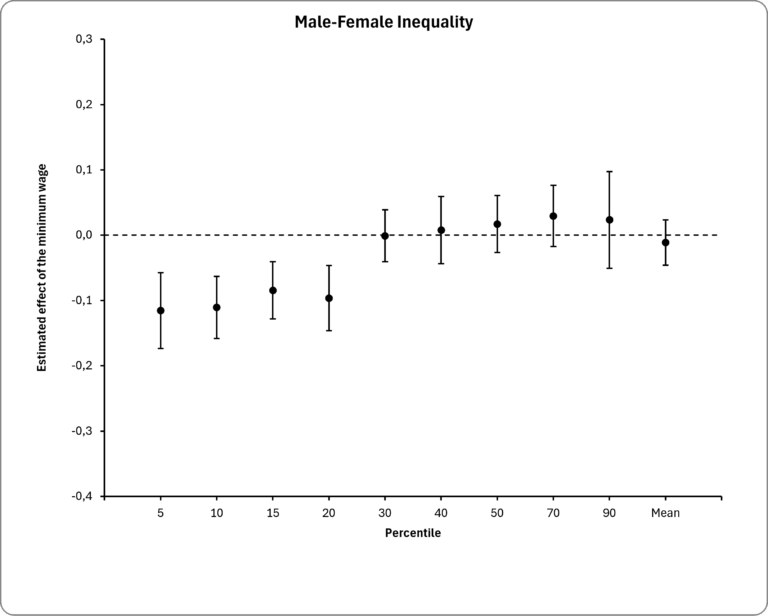
Notes: This figure plots minimum wage effects from regressions that use inequality in log wages between men and women at various percentiles as the key dependent variable. At each percentile, as well as at the mean, we show estimated effects from our two-way fixed effects (TWFE) specification estimated by two-stage least squares in levels. The confidence intervals in this figure are 95% confidence intervals constructed from standard errors that are clustered at the state-level.
Figure 1B
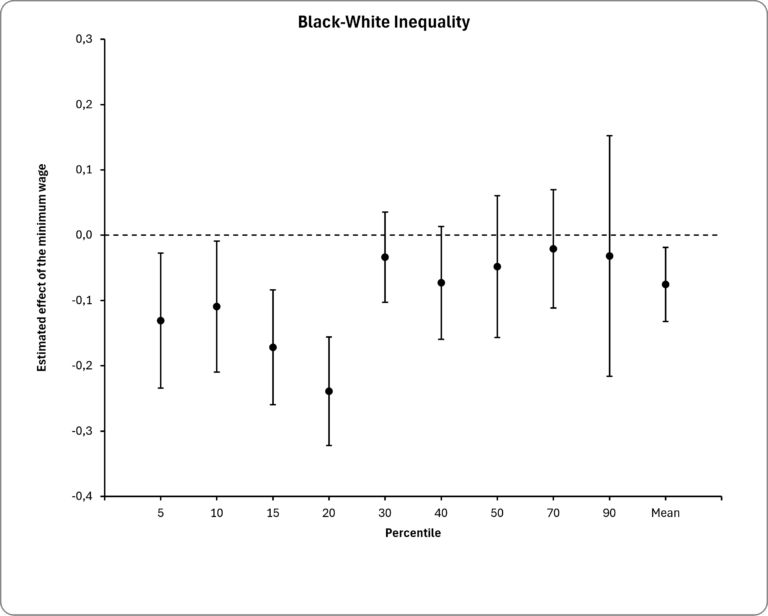
Notes: This figure plots minimum wage effects from regressions that use inequality in log wages between Black and White workers at various percentiles as the key dependent variable. At each percentile, as well as at the mean, we show estimated effects from our two-way fixed effects (TWFE) specification estimated by two-stage least squares in levels. The confidence intervals in this figure are 95% confidence intervals constructed from standard errors that are clustered at the state-level.
Figure 1C
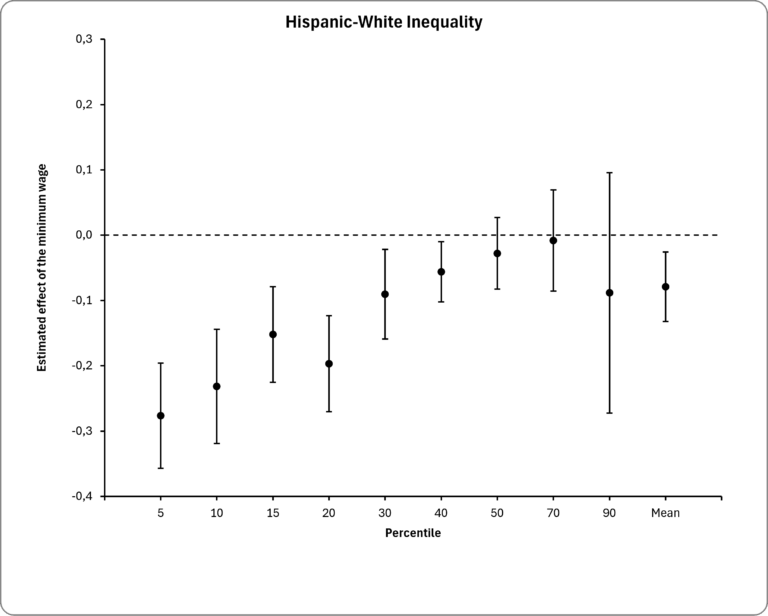
Notes: This figure plots minimum wage effects from regressions that use inequality in log wages between Hispanic and White workers at various percentiles as the key dependent variable. At each percentile, as well as at the mean, we show estimated effects from our two-way fixed effects (TWFE) specification estimated by two-stage least squares in levels. The confidence intervals in this figure are 95% confidence intervals constructed from standard errors that are clustered at the state-level.
In each case, we see that the minimum wage significantly lowers between-group wage gaps at the lower end of the wage distribution. For male-female and White-Black gaps, there are significant inequality-reducing effects through the 20th percentile. These effects mean that, for example, a 10% increase in the minimum wage lowers male-female inequality by 0.8-1.1% and White-Black inequality by 1.0-2.3%. For White-Hispanic gaps, significant inequality-reducing effects persist through the 40th percentile, and a 10% minimum wage increase would lower White-Hispanic inequality by 0.6-2.7%. These effects are substantial relative to the existing male-female, White-Black, and White-Hispanic wage gaps at these percentiles. A 10% minimum wage increase would lower gender inequality by 5-13%, White-Black inequality by 12-25%, and White-Hispanic inequality by 1-22% (as fractions of pre-existing wage gaps). The figures show that, as expected, there are no significant effects of the minimum wage at higher wage deciles of the wage distribution. And, while a minimum wage hike does not significantly impact the male-female wage gap at the mean, there are small, significant negative effects at the mean for both White-Black and White-Hispanic wage inequality.
To put our results in context, we consider the implications of several important periods in minimum wage policy since 1979. We highlight two here. First is a period of stark decline in the real value of the minimum wage between 1979 and 1989 because the minimum wage did not keep pace with inflation. We found that this decline substantially increased male-female and White-Black wage gaps below the mean. And this episode had a smaller but noticeable effect of raising White-Hispanic gaps as well. Second is a period of rising state minimum wage policies between 2007 and 2019, where a number of states elected to raise their minimum wage substantially above the federal minimum. We found that this episode decreased White-Hispanic wage inequality substantially at the lower end of the wage distribution. Minimum wage effects were concentrated among Hispanic workers in this period because Hispanics tended to reside in states like California, Colorado, and New York that had the largest increases.
A common critique of minimum wage policies is that they could reduce employment of affected groups. Theoretically, businesses may hire fewer minimum wage workers when the minimum wage increases, as the hiring decision may no longer be profitable. However, the empirical evidence on this is mixed. We explored this question by first characterizing individuals by their likely wage, predicted using information like sex, race, age, and educational attainment. We then examined whether minimum wage changes affected the employment probability of individuals with low predicted wages. We found no evidence that minimum wage policies affected the probability of employment.
Policy Implications
Our study shows that minimum wage policies are an important determinant of wage inequality between demographic groups, especially at the bottom of the wage distribution. This means that continued efforts by state and local governments to raise the minimum wage will disproportionately increase wages for Black, Hispanic, and female workers, relative to White and male workers. On the other hand, the continued inflationary decline of the current $7.25 federal minimum wage is likely exacerbating between-group wage inequality in states that have not superseded the federal minimum wage.
Conclusion
Because Black, Hispanic, and female workers are more likely to have wages at or close to the statutory minimum wage, they disproportionately benefit from minimum wage increases relative to White and male workers. We do not find evidence that this benefit comes at the expense of their employment. The result is that wage inequality between these groups is reduced following minimum wage increases.
References
Autor, David H., Alan Manning, and Christopher L. Smith. “The Contribution of the Minimum Wage to US Wage Inequality Over Three Decades: A Reassessment.” American Economic Journal: Applied Economics 8, no. 1 (January 2016): 58-99.
Blau, Francine D., and Lawrence M. Kahn. “The Gender Wage Gap: Extent, Trends, and Explanations.” Journal of Economic Literature 55, no. 3 (September 2017): 789-865.
Blau, Francine D., and Anne E. Winkler. The Economics of Women, Men, and Work, Ninth Edition. Oxford, UK and New York, NY: Oxford University Press, 2022.
Bureau of Labor Statistics. “Usual Weekly Earnings of Wage and Salary Workers Second Quarter 2022.” Published July 22, 2025. Accessed July 2025.
DiNardo, John, Nicole M. Fortin, and Thomas Lemieux. “Labor Market Institutions and the Distribution of Wages, 1973-1992: A Semiparametric Approach.” Econometrica 64, no. 5 (September 1996): 1001-1044.
Dube, Arindrajit. “Minimum Wages and the Distribution of Family Incomes.” American Economic Journal: Applied Economics 11, no. 4 (October 2019): 268-304.
Economic Policy Institute. “Minimum Wage Tracker.” https://www.epi.org/minimum-wage-tracker/. Accessed July 14, 2025.
Fortin, Nicole M., Thomas Lemieux, and Neil Lloyd. “Labor Market Institutions and the Distribution of Wages: The Role of Spillover Effects.” Journal of Labor Economics 39, no. S2 (April 2021): S369-S412.
National Conference of State Legislatures. “State Minimum Wages.” Accessed March 9, 2022.
Disclaimer
The opinions and views expressed in this publication are those of the author(s) and do not necessarily reflect those of the ROCKWOOL Foundation Berlin (RFBerlin). While research disseminated through this series may address policy-relevant topics, RFBerlin, as an independent research institute, does not take institutional policy positions.
Publications in the RFBerlin Research Insights series may represent preliminary or ongoing work that has not been peer-reviewed. Readers are advised to consider the provisional nature of such research when citing or applying its findings.
These publications aim to make scientific work accessible to a broader audience and to encourage informed, research-based discussion. All materials are provided by the respective authors, who bear responsibility for appropriate attribution and rights clearance. While every effort has been made to ensure accuracy and proper acknowledgment, RFBerlin welcomes notifications of any concerns regarding authorship, citation, or intellectual property rights. Please contact RFBerlin to request corrections if needed.
Use of these materials for the development or training of artificial intelligence systems is strictly prohibited.
