


Short summary
Women earn less than men even when they hold the same job in the same workplace. In Sweden – one of the most gender-equal countries in the world – women in the private sector earn 8% less per hour than male colleagues in the same workplace and occupation. This gap grows the longer they stay in the job: it widens by 2 percentage points over five years. What drives this pattern?
Our study (Fredriksson et al. 2025) points to a specific mechanism: men use job opportunities from other employers to negotiate higher pay, while women do not. To measure these job opportunities, we use new job openings at the workplaces of workers’ parents and siblings. When a relative’s employer starts hiring, men’s wages rise within their current job. But when women face outside job opportunities of similar quality, we see no wage gain – even though they are almost just as likely to switch employers. We argue that gender differences in negotiation behavior are the most likely explanation.
Key Findings
- The job opportunities men and women learn about through family are of equal quality – the hiring firms are similar in pay, productivity, and location.
- When there is an outside job opportunity, the probability of moving to other employer increases about threefold.
- Men’s wages increase within their current job when a family member’s employer starts hiring in their occupation. Women’s wages do not respond at all.
- This gender difference in wage responses can explain about half of the growing pay gap between men and women in the same job over time.
- Among blue-collar workers – where collective agreements limit individual wage negotiation – neither men nor women see a wage increase from outside offers. The gendered wage response only appears where there is room to bargain.
Relevance Today
The EU Pay Transparency Directive, to be implemented by June 2026, will increase pay disclosure and gender pay gap reporting across Europe. While transparency reforms may help narrow gender pay gaps, the evidence suggests that their effects vary across settings. Our study points to a potential limitation of transparency alone: women appear to benefit less than men from outside job opportunities when it comes to renegotiating pay within the current job. This suggests that transparency may need to be complemented by measures that reduce the role of individual renegotiation in wage growth.
Author Quote
“While men’s wages increase when exposed to outside job offers, women’s wages remain largely unaffected. This discrepancy contributes significantly to the persistence of the gender pay gap, even within the same firm and occupation.”
Reference: Based on Fredriksson, P., D. Gülümser, and L. Hensvik (2025): “Outside Job Opportunities and the Gender Gap in Pay,” RFBerlin Discussion Paper 71/25.
Research summary
The gender pay gap persists between men and women who hold the same job in the same workplace. A growing body of research suggests that part of the explanation lies in how workers respond to job offers from other employers (Card et al., 2016; Caldwell and Danieli (2024); Biasi and Sarsons (2022); Roussille (2024); Caldwell et al., (2026)).
When workers receive a job offer while employed, they can use it to negotiate a raise or they can leave. If men and women respond to the same opportunities differently, pay gaps will widen over time, even between equally qualified colleagues. But testing this hypothesis directly is difficult: researchers rarely observe who receives offers, and the offers available to men and women typically differ in quality.
In our study we overcome these challenges with a research design that ensures that men and women face outside job opportunities of the same quality. Using Swedish population-wide data, we link every worker to the employers of their parents and siblings. When a relative’s workplace starts hiring in the worker’s occupation, this creates a plausible job opportunity. Crucially, a man and a woman in the same job are “connected” to employers of similar quality. We confirm this directly in the data: the hiring firms that men and women are connected to through family are virtually identical in terms of pay, productivity, and location.
Key Findings
We first show that both men and women act on outside job opportunities. When a connected firm starts hiring, the probability of moving there increases threefold for both genders. This shows that opportunities that we observe in the data are real, visible, and equally valuable to both men and women.
But the wage responses are strikingly different. Figure 1 shows that men who face a new outside opportunity see their wages rise within their current job. Women do not. This comparison is made within the same firm, occupation, and year, so firm-level or job-level explanations cannot account for the difference. Because men’s wages rise while women’s do not, the arrival of outside opportunities widens the gender pay gap inside the workplace.
Figure 1: Wage responses to outside job opportunities, by gender
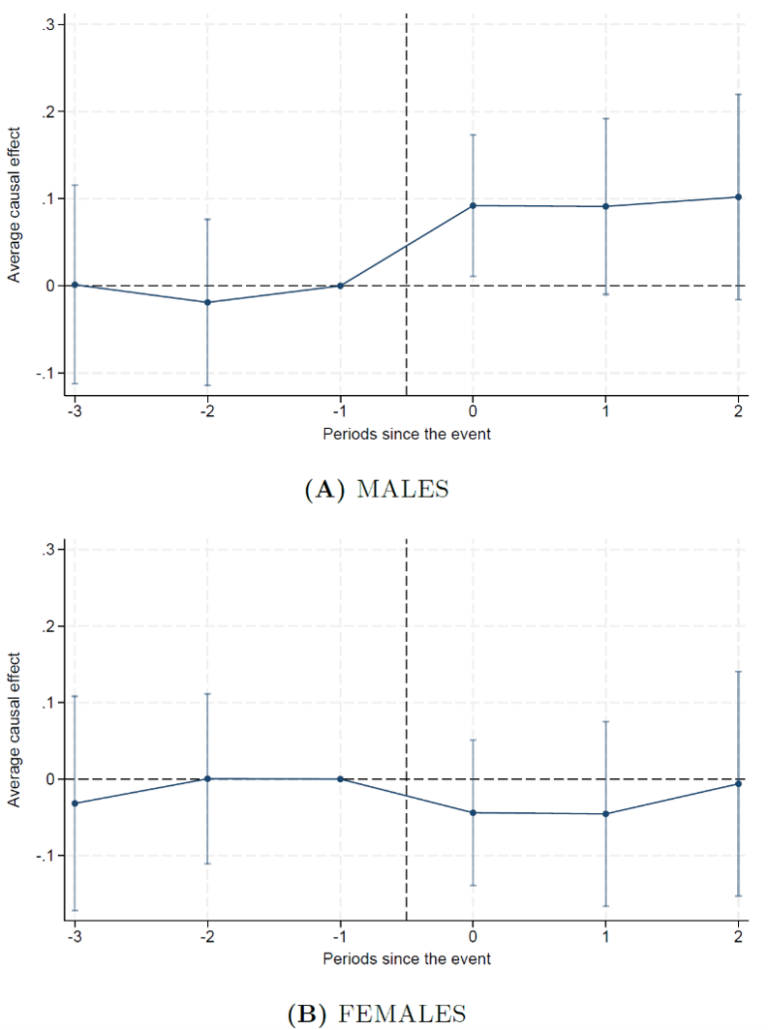
Notes: The figure displays male and female wage responses before and after exposure to outside job opportunities. We present event study estimates along with the 95% confidence intervals.
Why This Happens: Interpreting the Evidence
In the paper we develop a simple model to interpret the patterns we observe in the data. Two mechanisms could explain why women’s wages respond less to outside options:
- Preferences and constraints. Women may value shorter commutes or other non-wage attributes more, making fewer offers suitable for renegotiation.
- Renegotiation behavior. Women may face larger negotiation frictions, either due to renegotiation aversion or due to lower returns to bargaining, even when a credible outside job opportunity exists.
Our findings support the second mechanism. Women move jobs just as often as men when offers arise, showing that the offers are relevant. But women do not use these offers to renegotiate pay while staying. This suggests that the gap is driven by differences in renegotiation rather than differences in opportunity.
Further evidence strengthens this interpretation. Among blue-collar workers – where wages are set more rigidly – outside opportunities do not raise wages for either gender but still increase job mobility (to an even greater extent than for white-collar workers). Where bargaining is limited, the gender gap in wage responses to outside job opportunities disappears.
Evidence from Job Characteristics
We also look at what kinds of job opportunities matter. Men’s wage gains appear across a wide range of job opportunities: high-paying firms, and firms both near and far. Women’s wages do not respond to any of these dimensions.
Job mobility, however, responds to job quality for both genders. Both men and women are more likely to move to higher-paying firms and less likely to accept long commutes. Weighing these two margins against each other, women require a wage premium about one and a half times as large as men to accept a longer commute, suggesting stronger location constraints.
Policy Implications
These findings carry a clear message: information about outside job opportunities is not enough to close the gender pay gap. Women know about outside opportunities and act on them by switching jobs, but they do not use them to negotiate better terms with their current employer. This points to the renegotiation step that policies could target directly.
Policies that may matter include:
- Structured wage-setting that reduces the role of individual bargaining in determining pay.
- Pay transparency and regular wage reviews, which limit the need to ask for raises.
- Information and support around bargaining, especially in flexible-pay environments.
Conclusion
Outside job opportunities play a central role in shaping wage growth. Men use them to raise pay; women usually do not. This difference explains a large share of the gender pay gap that emerges within jobs over time.
The study shows that even in a highly equal labor market like Sweden, gender gaps can grow through wage-setting processes. Closing these gaps requires attention not only to hiring and job choice, but also to how wages are renegotiated once people are already employed.
References
Biasi, B. and H. Sarsons (2022). “Flexible Wages, Bargaining, and the Gender Gap.” The Quarterly Journal of Economics, 137(1), 215–266.
Caldwell, S. and O. Danieli (2024). “Outside Options in the Labor Market.” Review of Economic Studies.
Caldwell, S., I. Haegele, and J. Heining (2026). “Bargaining and Inequality in the Labor Market.” The Quarterly Journal of Economics, 141(1), 315–371.
Card, D., A. Cardoso, and P. Kline (2016). “Bargaining, Sorting and the Gender Wage Gap.” Quarterly Journal of Economics, 131(2), 633–686.
Fredriksson, P., D. Gülümser, and L. Hensvik (2025): “Outside Job Opportunities and the Gender Gap in Pay,” Tech. rep., Rockwool Foundation Berlin (RF Berlin).
Roussille, N. (2024). “The Role of the Ask Gap in Gender Pay Inequality.” The Quarterly Journal of Economics, 1557–1610.
