




Short summary
The quality of management practices is crucial for both productivity of firms and the wellbeing of workers. Many firms use checklists as a management practice. Top managers often believe in the benefits of checklists as a mechanism to assure product and service quality. But what about workers? Might it be that they dislike the intensive use of checklists? How will they react if a firm decides to reduce the number of checklists? And to what extent may these reactions differ depending on employees’ training level?
A large German bakery chain, known for the high quality of its products, conducted a study to find out. The firm partnered with a team of researchers to investigate, motivated by two concerns. First, the chief people officer was concerned about an increase in turnover of qualified workers. They were hardly replaceable, having two to three years of vocational training. Traditionally, these workers would rarely quit the firm, but the figure had increased to around 12 percent per year – still low for the industry, but a matter of concern for management. Furthermore, in the employee survey, workers praised the firm for many things. But they were critical of the level of control imposed by checklists. Could it be that too much control could be counter-productive, leading to higher worker turnover and productivity losses?
The researchers asked workers and store managers: How useful and how time-consuming are these checklists? The firm then removed two of the most time-consuming and least valued checklists — one that checked on operational procedures and one on information transmitted between shifts within a store. In half of the stores the checklists were removed, randomized in a way similar to a clinical study. Following the introduction of these changes in half of the bakery shops over the study, the firm decided to permanently eliminate the operational checklist that workers regarded as demeaning but re-introduced one that helped information transmission between shifts.
Key Findings
- Sales rose by 2.7% in stores where checklists were removed — comparable to the effect of introducing team bonuses.
- Attrition among trained workers and store managers fell by 35%, reducing costly hiring and retraining.
- Untrained workers’ attrition increased by 20%, suggesting checklists provide valuable structure for less experienced staff.
- There was no rise in measurable workplace problems.
- Beneficial effects were concentrated in stores where regional managers predicted the treatment would be effective.
- Removing checklists did not appear to increase workers’ time allocated to production.
- Employee’s perceived trust by management improved, from 5.2 to 5.5, and workplace commitment, from 4.8 to 5.1 on average (on a scale from 1 to 7).
Author Quote
“Checklists have many benefits, but there are costs of using them. Skilled workers dislike being monitored by checklists. Hence, too many checklists can harm firm performance and be a disamenity for skilled workers.”
Reference: Based on RFBerlin discussion paper No. 65/26 – March 2026 Is This Really Kneaded? Identifying and Eliminating Potentially Harmful Forms of Workplace Control, Guido Friebel, Matthias Heinz, Mitchell Hoffman, Tobias Kretschmer, Nikolay Zubanov
Research summary
Modern management science was invented more than a century ago. These ideas were brought to practice by Ford and others, leading to enormous productivity gains. Recent research shows that good management practices — clear targets, monitoring, and rewards — have substantial positive effects on productivity. But what if workplace control could be overdone and would have negative effects on people’s behaviour?
Workers are likely to care about what other people – say, their bosses – believe about them. This is reasonable; we all care about our reputation as good co-workers, as being professional or diligent. Consider now that a boss can decide on how intensively they monitor a worker. In this context, a more controlling boss sends the signal that their belief in the worker being a ‘good’ worker is weak. A less controlling boss signals a stronger belief in the worker being good. If the worker’s effort depends on receiving the signal that the boss believes them to be a good worker, then too much control might negatively affect the worker’s behaviour.
We designed a randomised controlled trial on checklists. Out of the more than 20 checklists that the firm used to steer its sales operations we removed two. Stores were assigned to treatment and control groups, in a way very similar to clinical studies in medicine and, increasingly, in economics. The treatment group received a message from the chief operations officer that the two checklists would be removed. The message also expressed that the firm’s management trusted its workforce.
The graph below illustrates the effects of this removal of checklists. Sales in the treated shops increased by 2.7 percentage points, an effect similar to the introduction of team bonuses that we worked on before with a different chain. In retail increasing sales by single-digit numbers is quite profitable, because of the substantial fixed costs. Google reviews reveal that, in treated stores, consumers are more likely to perceive fast line speed and a positive shop appearance (e.g., cleanliness). This sheds light on how positive sales effects may manifest.
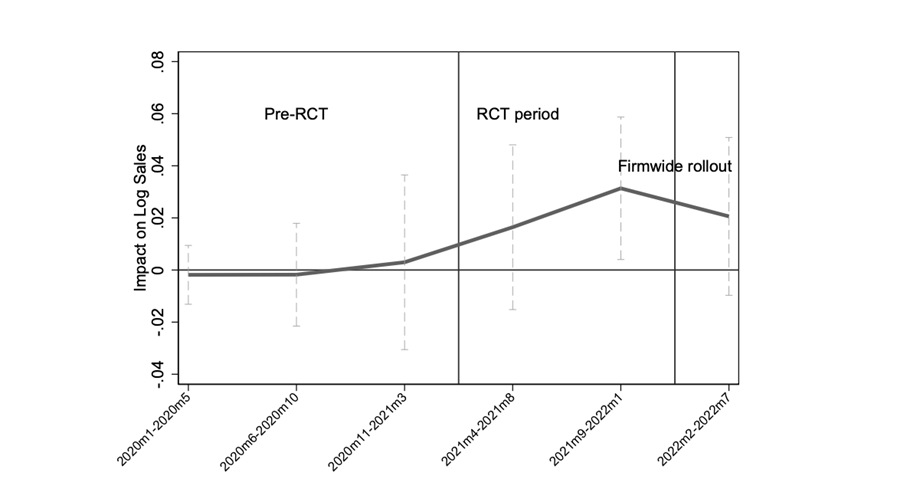
Note: The figure shows how sales evolved in stores where checklists were removed compared to stores where nothing changed. Before the study began (pre-RCT), sales trends in the two groups were similar — as expected if the random assignment worked well. During the study period (April 2021 – January 2022), sales in stores where checklists were removed rose by around 2.7%. After the firm rolled out the change to all stores (from February 2022), some but not all of the positive effect persisted, arguably because one checklist was re-introduced. The line shows the coefficient estimates, and the dotted line shows the 95% confidence intervals.
We also find that store managers’ fluctuation strongly decreases. In previous work in retail, we estimated the turnover costs of an employee as several thousand Euros. But the cost of losing trained workers and managers would be much higher in terms of training, hiring and foregone sales costs. These workers and managers do a lot of checklist completion and may need checklists less given their knowledge. They are also the ones who may find it most annoying that the firm asks them to use checklists. In contrast, the treatment has a positive effect on fluctuation for unskilled workers without vocational training who may benefit from structure and checklists. Finally, regional managers, who each supervise around 10 to 15 stores, are quite able to predict where treatments may work. They can do so even before stores were assigned to the treatment or control group.
Implications
The use of workplace monitoring is likely to grow as AI makes it easier to develop detailed operational guidelines and track workers in real time. This trend is especially pronounced in routine-task industries like food and retail.
Our study points to the risk of excessive control. However, it also shows that it is crucial to understand where control may have more benefits than costs. Trained workers who have internalized best practices tend to find heavy checklist use demeaning — and respond by leaving. Less experienced workers, by contrast, benefit from the structure checklists provide.
Importantly, middle managers, the ones managing regions, have much useful information. They can predict which stores can do with fewer checklists and which of them need them. Firms should engage in deep conversations with their middle ranks to make use of this knowledge.
Disclaimer
The opinions and views expressed in this publication are those of the author(s) and do not necessarily reflect those of the ROCKWOOL Foundation Berlin (RFBerlin). While research disseminated through this series may address policy-relevant topics, RFBerlin, as an independent research institute, does not take institutional policy positions.
Publications in the RFBerlin Research Insights series may represent preliminary or ongoing work that has not been peer-reviewed. Readers are advised to consider the provisional nature of such research when citing or applying its findings.
These publications aim to make scientific work accessible to a broader audience and to encourage informed, research-based discussion. All materials are provided by the respective authors, who bear responsibility for appropriate attribution and rights clearance. While every effort has been made to ensure accuracy and proper acknowledgment, RFBerlin welcomes notifications of any concerns regarding authorship, citation, or intellectual property rights. Please contact RFBerlin to request corrections if needed.
Use of these materials for the development or training of artificial intelligence systems is strictly prohibited.
