


Does Economic Espionage Pay Off?
Governments have long used espionage to acquire valuable technological knowledge from abroad. From semiconductors to artificial intelligence, concerns about economic espionage have become a central feature of geopolitical competition. But one fundamental question has remained surprisingly difficult to answer: does stealing technological knowledge actually improve economic performance?
Our research provides a rare opportunity to answer this question. During the Cold War, East Germany operated one of the world’s largest economic espionage programs, collecting scientific and technical information from companies and research institutions in the West. Using previously inaccessible intelligence archives together with newly digitized firm records, we trace espionage information from its source in the West to the final recipient in the East German economy.
We find that the returns to economic espionage were substantial. Our results suggest that the East German espionage program in the 1970s and 1980s raised East German GDP at the end of the 1980s by 7.4 percent. Firms receiving more valuable intelligence experienced faster productivity growth, invested more heavily in their capital stock, relied more on intermediate inputs, and became more specialized in their core products. These gains also spread to other firms through production networks. The evidence further suggests that covertly acquired knowledge substantially strengthened East German industry within the socialist bloc but did not enable firms to compete more successfully in Western markets. Firms benefiting most from espionage were also more likely to survive the transition to a market economy after German reunification.
Our study offers new evidence that technological knowledge can generate large economic gains even when it is transferred outside normal market channels. Although it examines events from the Cold War, the underlying questions are highly relevant to today’s debates on export controls, industrial policy, intellectual property protection, and technological competition.
Key Findings
- A one percentage-point increase in firms’ access to espionage information raised annual value added and labor productivity growth by almost one percentage point.
- Benefits spread through supplier and customer networks, amplifying the overall economic gains.
- East Germany’s economic espionage during the 1970s and 1980s increased total value added in its industrial sector in 1988 by around 22.3 percent. Given the size of this sector, this corresponds to a 7.4 percent increase in East German GDP.
- Each additional piece of valuable intelligence generated an estimated annual economic return of around 330,000 euros (in 2020 prices).
- Espionage strengthened East Germany’s competitive position within the socialist bloc but did not substantially improve success in Western markets.
- Firms receiving more intelligence were significantly more likely to survive the transition to a market economy after German reunification.
Relevance Today
Many governments are currently tightening export controls, screening foreign investment, and strengthening the protection of strategic technologies. The findings of this study demonstrate why access to frontier knowledge matters economically and why debates over technology transfer have become a central element of international economic policy. They also underscore the importance of safeguarding technological know-how.
Author Quote
Albrecht Glitz: “Economic espionage is often discussed, but rarely measured. By tracing individual pieces of intelligence from their source in the West to their recipient in the East, we can finally quantify its economic consequences.”
Adrian Lerche: “The Cold War setting may seem distant, but the underlying question is remarkably current: what happens when countries gain access to technologies they could not otherwise obtain?”
Reference: Based on Glitz, Albrecht, Adrian Lerche and Lukas Mergele (2026), “Economic Espionage, Knowledge Flows, and Firm Performance”, RFBerlin Discussion Paper No 255/26.
Research Summary
A Cold War story with modern relevance
Advanced technologies, export controls, and economic espionage have become central issues in international economic policy. In response to Russia’s invasion of Ukraine, for example, the West tightened export controls on dual-use goods with potential military applications, which Russia has sought to circumvent with the help of its network of operatives abroad.¹ There are also concerns about Chinese efforts to acquire the technological know-how underlying EUV lithography machines, which are essential for manufacturing the world’s most advanced semiconductors and are currently produced exclusively by the Dutch company ASML.²
These examples seem distinctly modern, but governments have attempted to acquire foreign technologies for centuries. East Germany’s extensive economic espionage program during the Cold War offers an exceptional historical laboratory for understanding whether covert access to frontier knowledge translated into real economic gains. Because economic espionage is inherently conducted in secret and leaves little systematic evidence behind, such an assessment has long been extremely difficult.
Figure 1:
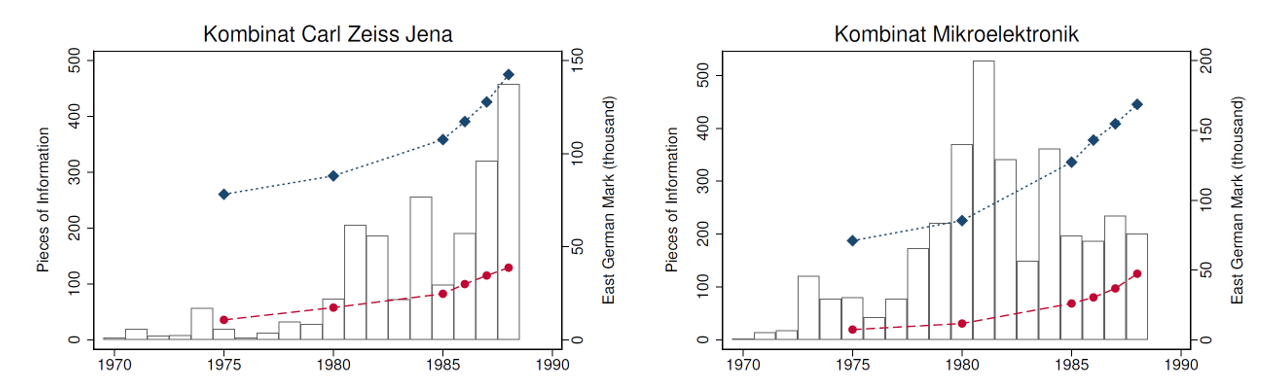
Figure 1: Bars show the annual number of intelligence reports received by each combine (left axis). The red and blue lines show gross value added and capital stock per worker, respectively, in thousands of East German marks (right axis).
Tracing knowledge across the iron curtain
The study combines two unique historical sources: detailed intelligence archives of the infamous Stasi documenting the flow of information from Western informants to East German firms during the 1970s and 1980s, and newly digitized production records for 145 large industrial combines, which together accounted for about one third of East Germany’s GDP in the 1980s. Unlike most research on knowledge spillovers, which has to infer knowledge flows indirectly, the intelligence archives identify which firms received individual pieces of scientific and technical information. This makes it possible to observe the diffusion of knowledge directly.
Figure 1 illustrates the structure of the linked data, reporting for the flagship combines Carl Zeiss Jena and Mikroelektronik annual gross value added and capital stocks per worker (lines, right axis) together with the number of high-quality intelligence reports received (bars, left axis).
What the evidence shows
The results consistently indicate that firms receiving more valuable intelligence items became more productive. They expanded output, invested in machinery, increased their use of intermediate inputs and concentrated production on their strongest products. Employment changed little, implying that the new knowledge primarily made existing workers more productive instead of simply increasing firm size. Export gains were concentrated in socialist markets, particularly the Soviet Union, suggesting that espionage strengthened East Germany’s technological position within the Eastern Bloc without enabling firms to catch up fully with Western competitors.
Why the results are credible
The empirical analysis compares similar firms operating in the same industries that differed in the amount of espionage information they received. It explicitly accounts for firms’ own R&D activities and exploits historical features of the intelligence network that generated differences in knowledge flows unrelated to firms’ current performance. In a robustness check, the analysis also controls directly for firms’ demand for information. Together, these approaches ensure that the estimated impacts on firms’ performance and production structure are indeed driven by the arrival of valuable espionage information.
Beyond the recipient firms
An important contribution of our study is to show that the economic gains extended well beyond the firms directly receiving intelligence. The analysis accounts for linkages in the East German production network, reconstructed from historical input-output tables. It suggests that more productive firms demanded additional inputs from suppliers while supplying their downstream customers more efficiently, allowing productivity gains to spread throughout the economy. These indirect effects accounted for a substantial share of the overall gains.
Quantifying the aggregate gains
A back-of-the-envelope calculation shows that total value added in the East German industrial sector in 1988 was 22.3 percent – or 20,216 million East German marks – higher than it would have been in the absence of the Stasi’s espionage program. Since the industrial sector covered by the firm data accounts for about one third of the East German economy, this corresponds to a 7.4 percent increase in East German GDP. These numbers imply an annual monetary return per piece of valuable information acquired in the West of around 1.64 million East German marks – or roughly 330,000 euros in 2020 prices.
Assessing the long-term impacts
The analysis shows that the benefits of economic espionage extended well beyond the socialist period. Firms that received larger inflows of valuable intelligence were more likely to survive the transition to a market economy after German reunification through successful privatization, suggesting that the productivity gains generated by espionage had lasting effects on firms’ competitiveness.
Policy implications and conclusion
The findings of this study contribute to the current policy debate by showing that access to foreign technology, even when obtained through illicit channels, can generate sizable productivity gains. It helps to explain why economic espionage remains a persistent and strategically relevant activity for many countries. They also highlight the importance of protecting strategically valuable technologies and rationalize why governments devote increasing attention to export controls, investment screening and international technology policy. More broadly, the analysis demonstrates that restrictions on international knowledge flows can have substantial consequences for productivity, industrial development and long-run competitiveness.
References
- https://www.nytimes.com/2026/07/12/world/asia/russia-spies-japan-war-drones-electronics.html?unlocked_article_code=1.xFA.U-6B.vsMsdy1pYHUY&smid=nytcore-ios-share
- https://www.economist.com/china/2026/07/05/has-china-obtained-the-worlds-most-important-machine
