

Short summary
Industrial robots and other automation technologies have transformed labour markets in recent decades. Much of the debate has focused on the immediate consequences for workers: who loses jobs, who keeps them, and who benefits from new opportunities. Far less is known about the long-run consequences of these technological changes, especially whether their effects extend beyond the workers directly exposed to automation and spill over to the next generation.
In our recent study (Heyman and Olsson, 2026), we examine these long-run effects, analysing how parental exposure to automation affects children’s education and careers later in life. By combining Swedish detailed data on family incomes, education, occupations, and industries with measures of robot adoption, we compare children whose parents were strongly exposed to automation in the 1990s with otherwise similar children whose parents were less exposed.
We find that children whose parents were exposed to automation earn less and experience lower income mobility later in life. These effects are concentrated among low-income families, where losses in parents’ earnings and job stability translate into weaker educational and labour market outcomes for children. Children from higher-income families are largely shielded from these risks. Our results suggest that technological change can shape intergenerational mobility and long-run inequality by amplifying disadvantages among already vulnerable families.
Key Findings
- Parental exposure to automation reduces children’s long-run prospects: When parents work in occupations and industries that adopt robots heavily, their children earn less and face lower upward mobility than otherwise comparable children whose parents are less exposed.
- The negative effects are concentrated among low-income families: The overall mobility loss is driven mainly by children whose parents were in the lower part of the income distribution. For them, automation makes it significantly harder to move up the earnings ladder later in life.
- Children in low-income families with automation-exposed parents face worse labour market outcomes as adults. These children earn less as adults, are more likely to experience unemployment or weak labour market attachment and are less likely to reach the top of the earnings distribution.
- Educational outcomes also worsen at the bottom: In low-income families, parental exposure to automation is associated with lower upper-secondary grades and a reduced likelihood of attending university, thereby reinforcing longer-term disadvantages.
- High-income families are largely insulated from these risks: For children from high-income families, we do not find clear evidence that parental exposure to robots harms their earnings or education, suggesting that richer households can buffer automation shocks.
Author Quote
“Our analysis covers a multitude of outcomes and reveals that the impact of automation on intergenerational mobility is not uniform across occupations but varies with the specific tasks associated with parents’ jobs.”
Based on: “Long–Run Effects of Technological Change: The Impact of Automation on Intergenerational Mobility”, RFBerlin Discussion Paper No. 047/26, by Fredrik Heyman and Martin Olsson.
Research summary
When a parent’s job is displaced by robots, what happens to their children’s future? Policy debates about automation usually focus on today’s workers and who gains and who loses. But if technological change harms families’ incomes and stability, it may also shape the next generation’s opportunities.
In our recent study (Heyman and Olsson, 2026), we ask whether parental exposure to automation in the 1990s reduced children’s long-run income mobility, earnings, and educational attainment. Using Swedish data that follow parents and children over three decades, we find that this is the case: on average, children whose parents worked in robot-intensive industries and in occupations with more automatable tasks have lower income mobility and worse labour market and educational outcomes in adulthood. These effects are concentrated among low-income families, while children from better-off households are largely shielded. Existing work on robots and labour markets (e.g., Acemoglu and Restrepo, 2020; Dauth et al., 2021) has focused on direct effects on employment and wages. We show that the consequences reach across generations and can widen inequality in ways that persist long after the initial shock.
For parents, we observe who was working in 1990, in which industry and occupation, and how much they earned. We then track their children into adulthood and measure their earnings, employment, and education up to 30 years later. To see which parents were exposed to automation, we combine two measures: the industry spread of robots (using international data on robot installations) and how easily the tasks in each occupation can be performed by robots (using a measure that scores occupations by their similarity to tasks described in robot-related patents created by Webb (2020)). This approach captures both where robots expanded (industries) and which jobs were most exposed (occupations). Parents can therefore face different levels of exposure, even if they hold similar jobs, depending on how quickly their industry adopts robots.
A key challenge is separating the effect of automation from other differences between families. Parents in robot-heavy industries may differ in ways that also influence their children’s outcomes. To address this, we compare parents in similar robot-exposed occupations with similar earnings, education, age, and firm-related characteristics, but working in industries with different levels of robot adoption. We also use robot adoption in other countries to isolate the role of technology from industry-specific shocks, and we confirm the pattern using firm-level data on automation. Taken together, these approaches make it more likely that our results capture the impact of automation itself, rather than other underlying differences.
We find that when parents work in highly robot-intensive industries and automated occupations, their children do worse in the long run. In particular, income mobility falls, meaning children’s outcomes are more closely linked to their parents’ income. In contrast, for parents in less-exposed occupations, industry-level robot adoption has no clear effect on their children.
In addition, we find that children from low-income families are more adversely affected by automation. Figure 1 illustrates this pattern, showing how children’s outcomes vary across the parental income distribution, comparing children whose parents in highly robot-exposed occupations worked in high- versus low-robot-adopting industries. Children whose parents were at the bottom of the earnings distribution face a range of adverse outcomes: they earn less, are more likely to experience unemployment, obtain lower school grades, and are less likely to attend university. For children from high-income families in the same industries and occupations, we find no such effects.
Figure 1: How parental automation exposure affects children’s outcomes across the income distribution
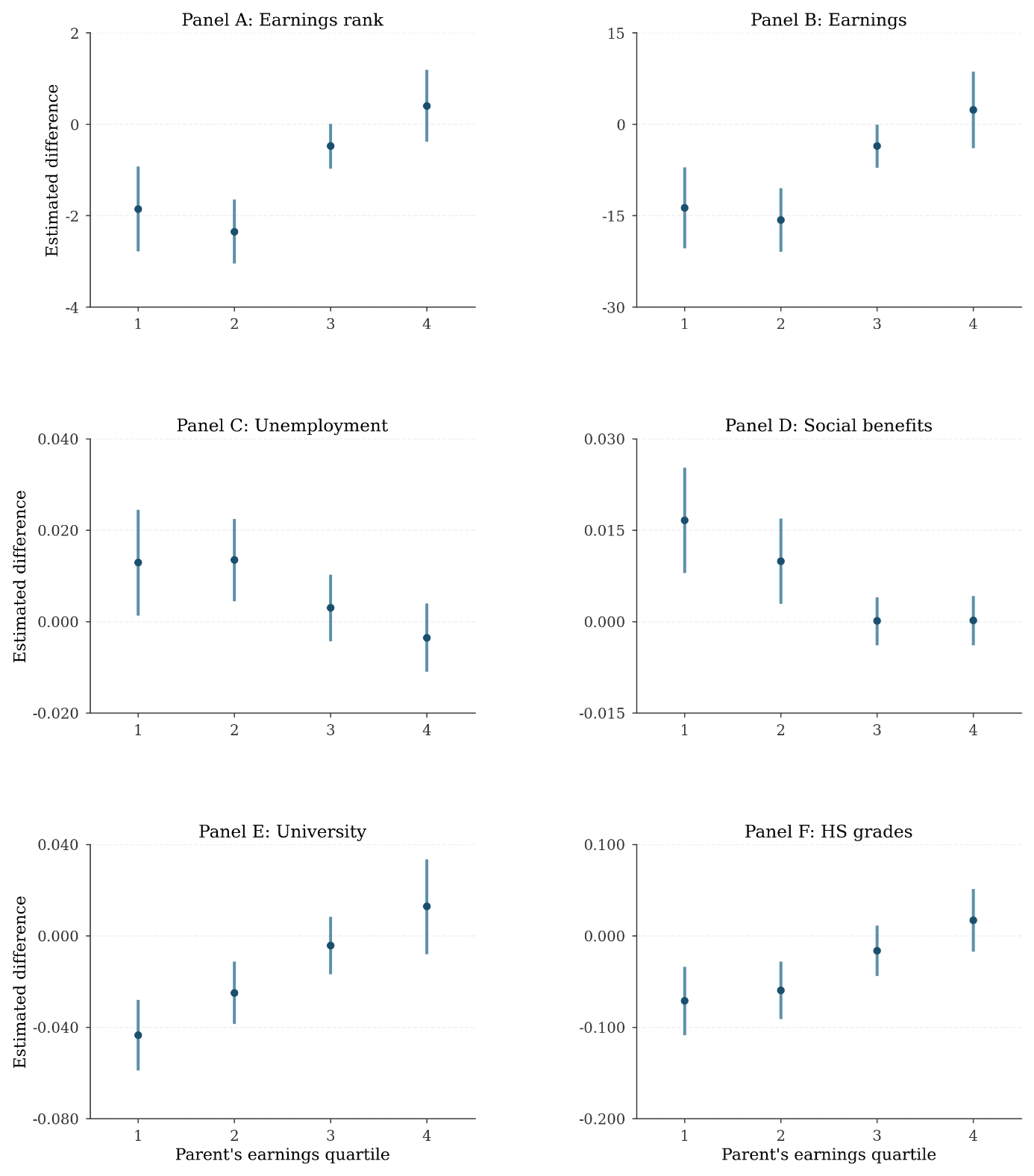
Our results are consistent with a mechanism whereby parents in low-income families working in highly exposed jobs and industries experience earnings losses, are more likely to leave the labour force, and rely more on social benefits and sick leave. We do not see these patterns among higher-earning parents. This suggests that the story is not that children follow their parents into declining sectors. Rather, automation shocks hit household resources, harming children’s development and opportunities. Families with more resources can cushion the blow while those with fewer cannot. The implication is that automation can weaken intergenerational mobility primarily by widening resource gaps between families after labour-market shocks.
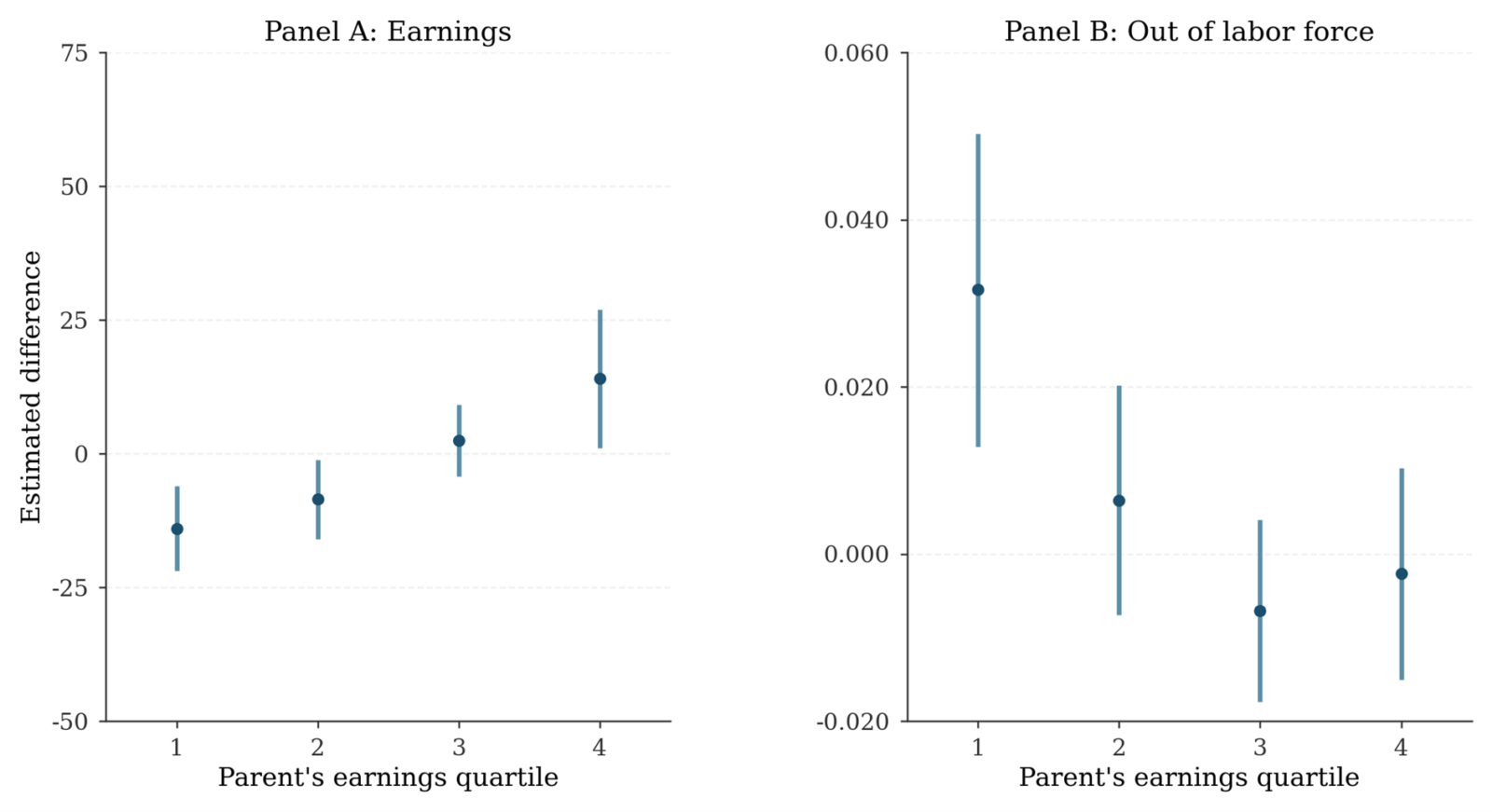
Figure 2 supports this mechanism. It shows how automation affected the parents themselves across the income distribution. Panel A shows that earnings losses are concentrated among low-income parents in robot-intensive industries, while Panel B shows they are also more likely to leave the labour force altogether. These parental shocks closely mirror the adverse outcomes for their children shown in Figure 1.
Figure 2: Parental earnings losses and labour force exits concentrated at the bottom of the income distribution
Policy Implications
Our findings suggest that if societies want to preserve equality of opportunity as automation and AI spread, policy should not just focus on today’s workers. Income support, retraining, and active labour market policies for workers in at-risk occupations and industries can help. But targeted support for children in affected families is also needed, for example, tutoring, mentoring, or other educational interventions, so that automation shocks that negatively affect household resources do not spill over to the next generation. Our results highlight that technological change can have long-run impacts across generations unless policies are designed to support the families most adversely affected.
Conclusion
We find that parental exposure to automation reduces children’s long-run mobility and labour market outcomes on average, and these effects are concentrated among low-income families. Technological change can therefore widen inequality across generations, not only among workers today. Whether that happens depends in part on how well policy supports the families and children most exposed to automation shocks. Open questions remain, notably, whether newer technologies such as AI will amplify or dampen these intergenerational dynamics, and which policy measures are most effective in practice. The evidence from three decades of Swedish data indicates that automation already shapes the opportunities of the next generation in ways that favour those whose parents had more to begin with.
References
Acemoglu, D. and P. Restrepo (2020). Robots and jobs: Evidence from US labor markets. Journal of Political Economy 128 (6), 2188–2244.
Dauth, W., S. Findeisen, J. Suedekum, and N. Woessner (2021). The adjustment of labor markets to robots. Journal of the European Economic Association 19 (6), 3104–3153.
Heyman, F., M. Olsson (2026). Long–Run Effects of Technological Change: The Impact of Automation on Intergenerational Mobility”, RFBerlin Discussion Paper No. 047/26.
Webb, M. (2020). The impact of artificial intelligence on the labor market. Working Paper, Stanford University.
Disclaimer
The opinions and views expressed in this publication are those of the author(s) and do not necessarily reflect those of the ROCKWOOL Foundation Berlin (RFBerlin). While research disseminated through this series may address policy-relevant topics, RFBerlin, as an independent research institute, does not take institutional policy positions.
Publications in the RFBerlin Research Insights series may represent preliminary or ongoing work that has not been peer-reviewed. Readers are advised to consider the provisional nature of such research when citing or applying its findings.
These publications aim to make scientific work accessible to a broader audience and to encourage informed, research-based discussion. All materials are provided by the respective authors, who bear responsibility for appropriate attribution and rights clearance. While every effort has been made to ensure accuracy and proper acknowledgment, RFBerlin welcomes notifications of any concerns regarding authorship, citation, or intellectual property rights. Please contact RFBerlin to request corrections if needed.
Use of these materials for the development or training of artificial intelligence systems is strictly prohibited.
