
Short Summary
When a restaurant adopts a delivery platform, it gains access to new markets and a workforce outside its own payroll. This changes the boundary of the firm: tasks that once had to be done inside the restaurant, or were too costly to provide at all, can now be supplied through a platform. This study asks who wins and who loses when this happens.
Using Brazilian data linking restaurants and platform workers to administrative records, our paper shows that adoption reorganizes restaurant work. Adopting restaurants reduce in-house service hours and replace them almost one-for-one with platform delivery hours. The replaced workers rarely become couriers. The new delivery workforce instead comes mainly from workers with weak attachment to formal employment.
Key Findings
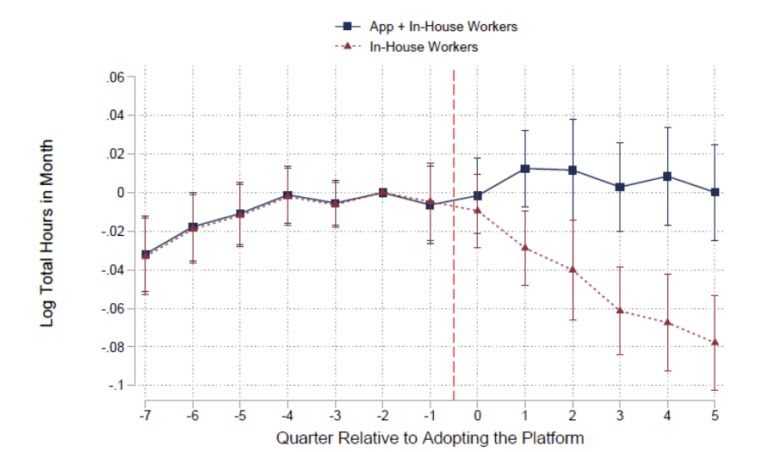
- At the average adopter, in-house hours fall by 7.6 percent five quarters after adoption, while total hours including platform delivery workers remain roughly unchanged.
- Displacement concentrates on waiters, while cooks remain mostly unaffected. Displaced waiters rarely become couriers and instead are more likely to reallocate to another formal job.
- Workers at exposed competitors lose more than workers at adopting restaurants due to their employer being more likely to close.
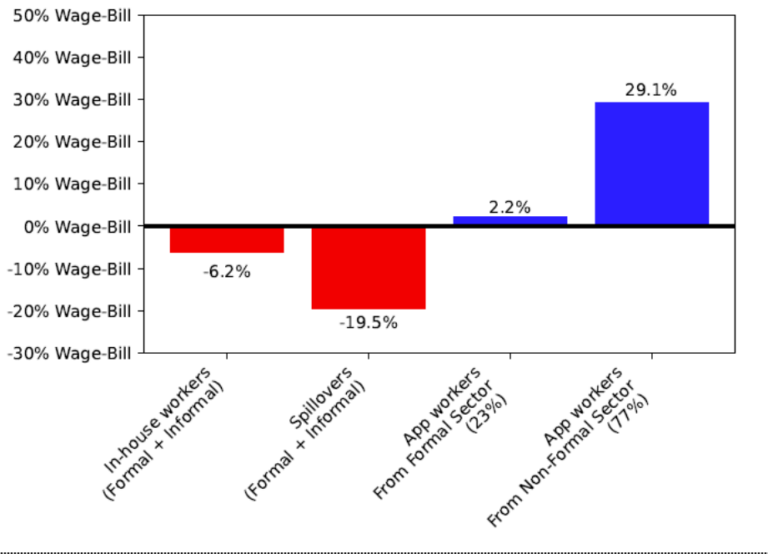
- Platform gains mostly accrue to workers with weak formal attachment. Platform workers are concentrated around non-formal or recently laid-off entrants who represent 77% of platform workers.
- The same reallocation of work has gendered consequences: women are more exposed to losses in restaurant employment, while men receive most of the new platform income.
Relevance Today
Much of the debate over digital platforms focuses on how to regulate them without a clear picture of who benefits and who is negatively affected. This paper contributes to the debate by measuring the incidence of platform adoption across workers. That evidence matters for platform regulation, worker protection, and adjustment support, including current debates around the EU Platform Work Directive (Directive (EU) 2024/2831).
Author Quote
“A delivery platform does not simply add delivery to a restaurant. It changes who performs the work and who receives the income. The key question is not only whether the platform creates earnings, but who gains and who loses.”
Reference:Based on RFBerlin Discussion Paper: Pascuel Plotkin, “Digital Adoption, Labor Demand, and Worker Earnings: Evidence from Online Delivery.”
Research Summary
Digital platforms are reshaping work. Like earlier waves of technological change, they can shift tasks across workers rather than simply add or eliminate jobs (Autor et al., 2003; Acemoglu and Autor, 2011). But policymakers often regulate platforms without a clear picture of who benefits and who is harmed. Delivery platforms are a useful example. They can help restaurants expand delivery and create income opportunities for workers outside formal employment, but they can also move tasks outside the firm and reduce work for existing employees. My research studies this incidence directly by asking who gains and who loses when restaurants adopt delivery platforms.
Restaurant adoption combines two forces. First, by reducing search and delivery frictions, the platform can increase demand for meals, especially where restaurants have fewer walk-in customers. Second, it gives restaurants access to delivery labor without hiring drivers formally. Adoption can therefore expand delivery-related activity while shifting some service tasks outside the boundaries of the firm. In this sense, platform adoption is also a modern form of domestic outsourcing: the work still serves the firm, but the worker performing it is no longer on the firm’s payroll (Goldschmidt and Schmieder, 2017).
To study these changes, my paper links data from a major online-delivery platform in Brazil to administrative records covering formal workers and employers. This makes it possible to observe when restaurants adopt the platform, how many platform-worker hours they use, and what happens to formal employees and nearby competitors. The analysis compares adopting restaurants and their workers to similar restaurants and workers in areas where the platform was not yet available.
The first result is that adoption reorganizes work inside adopting restaurants. Five quarters after adoption, in-house labor hours fall by 7.6 percent. But once platform delivery hours are added, total labor hours used by the restaurant remain roughly unchanged. The average adopter is not simply shrinking. It is changing who performs which tasks. The decline is concentrated among non-cooking service workers, such as waiters and related in-house occupations. Cooks’ hours are unaffected on average, consistent with the number of meals prepared inside the restaurant being unaffected even when delivery is outsourced.
Figure 1. Job reorganization inside adopting restaurants
The effects vary significantly across locations. In low-density areas, where restaurants usually have less walk-in traffic, the platform appears to bring a stronger market expansion effect. Restaurants in these areas expand their total workforce by about 6 percentage points more than restaurants in high-density areas. This increase is driven mainly by cooks, while non-cooking workers remain broadly unchanged. This pattern helps separate two forces: delivery can create new demand for meals, but it also moves service tasks toward platform delivery workers.
For workers employed at adopting restaurants, the losses are modest but real. One year after adoption, their earnings fall by about 1.5 percent and their probability of formal employment falls by 1.5 percentage points. These losses are smaller than the decline in in-house labor demand because many workers who leave find other formal-sector jobs. Among workers who separate from their original employer, 75 percent have found a new formal job by the fifth quarter after adoption.
A key point is that these workers are not simply moving to the platform. Five quarters after their employer adopts, their transition rate into platform work reaches only 0.4 percent. The evidence therefore points to replacement rather than direct outsourcing of the same workers. Restaurants reduce some in-house service work, but the delivery tasks are mainly performed by a different workforce.
Losses also occur outside adopting restaurants. When many nearby restaurants start using the platform, non-adopting competitors are more likely to contract or close. Workers at these exposed non-adopting restaurants experience larger losses than workers at adopting restaurants: earnings fall by 6.6 percent after one year, and formal employment falls by 3.8 percentage points. Part of the cost of adoption is therefore borne by workers at competitors that lose demand or exit.
The main earnings gains accrue to platform workers, but not equally across all of them. The largest gains go to workers entering from non-formal employment or recent job loss, who represent 77 percent of platform workers. For this group, net gains equal 29.1 percent of the pre-platform wage bill of adopting restaurants. Workers who already had a formal job before joining the platform gain much less, once outside options and work-related costs are taken into account: their net gains equal 2.2 percent of the pre-platform wage bill. This difference reflects the limited outside options of workers with weaker attachment to formal employment, especially in a labor market where informal work is common (Ulyssea, 2018).
Figure 2. Who wins and who loses from platform adoption
Gender is another important dimension of incidence. Because restaurant workers in Brazil are more likely to be women, while platform delivery workers are overwhelmingly men, the same reallocation of work shifts income across gender groups. The accounting shows that women experience net losses of 13.7 percent of the pre-platform restaurant wage bill, while men experience net gains of 14.7 percent.
Conclusion
This study shows that the effects of platform adoption extend well beyond the workers hired through the app. By allowing restaurants to outsource delivery, platforms change the allocation of work inside firms, affect nearby competitors, and create income for workers who were weakly attached to formal employment. The broader lesson is that digital technologies can generate gains and losses at the same time, often for different groups of workers. For policymakers, the challenge is to regulate platform work without losing sight of this broader incidence: who benefits, who bears the cost, and how regulation shifts that balance.
References
- Plotkin, Pascuel. 2026. Digital Adoption, Labor Demand, and Worker Earnings: Evidence from Online Delivery.
- Autor, David H., Frank Levy, and Richard J. Murnane. 2003. The Skill Content of Recent Technological Change.
- Acemoglu, Daron, and David Autor. 2011. Skills, Tasks and Technologies: Implications for Employment and Earnings.
- Goldschmidt, Deborah, and Johannes F. Schmieder. 2017. The Rise of Domestic Outsourcing and the Evolution of the German Wage Structure.
- Ulyssea, Gabriel. 2018. Firms, Informality, and Development: Theory and Evidence from Brazil.
- Directive (EU) 2024/2831 of the European Parliament and of the Council of 23 October 2024 on improving working conditions in platform work.
