


Short summary
Coverage has declined—and is lowest where workers need it most
Germany’s collective bargaining system has long been a cornerstone of fair wages and stable labor relations. But its reach has weakened—and not evenly. Our study shows that while collective agreements still shape wages for many workers, coverage has declined over time and is particularly low among low-wage workers.
The decline is substantial. Collective bargaining coverage fell from about 68 percent of employees in 2000 to 49 percent in 2023. This decline is even more pronounced among employers, indicating that coverage is increasingly concentrated in larger firms.
More importantly, coverage varies sharply across the wage distribution. Workers at the bottom are much less likely to be covered. In 2021, only about 34 percent of workers in the lowest wage decile were covered by a collective agreement, compared to over 60 percent in the middle of the distribution. A similar pattern is observed for coverage by a works council.
This matters because collective bargaining compresses wages and limits employer market power. When coverage is low at the bottom, these protections are weakest where they are most needed. The expansion of the low-wage sector and declining coverage were key reasons for the introduction of Germany’s statutory minimum wage in 2015.
Despite the decline in formal coverage, collective bargaining remains important, and its reach is far wider than coverage rates may suggest, as many uncovered firms follow key elements of collective agreements informally (“orientation”). While formal coverage among employees is 49 percent in 2023, this number increases to 75 percent when also considering firms that voluntarily follow collective agreements.
Key Findings
- Collective bargaining coverage among employees in Germany declined from 68% in 2000 to 49% in 2023.
- Coverage is lowest among low-wage workers: about 34% in the bottom decile vs. over 60% in the middle.
- The decline in coverage is stronger at the bottom, contributing to the growth of the low-wage sector.
- Informal adoption (“orientation”) raises effective coverage to about 68% in 2023, partly offsetting the decline.
- Collective bargaining reduces wage inequality and limits employer market power—but less so where coverage is low.
Relevance Today
As wage inequality and labor shortages shape policy debates across Europe, these findings highlight a key challenge: collective bargaining no longer reaches many low-wage workers. This is directly relevant for discussions about strengthening bargaining coverage and the role of minimum wages in protecting vulnerable workers. is perceived as legitimate. This paper shows that fiscal inequality has historically been a source of political radicalization, especially when combined with economic hardship.
Author Quote
“Collective bargaining remains a central pillar of the German labor market—but its declining reach at the lower end of the wage distribution raises concerns about inequality and worker protection.”
Reference: Based on RFBerlin Discussion Paper 187/26, “Collective Bargaining in Germany: Trends and Challenges”, Lutz Bellmann, Christian Dustmann, Bernd Fitzenberger
Research summary
A system that still matters — but reaches fewer workers
Germany’s system of collective bargaining has long been a cornerstone of wage setting. It helped deliver stable employment, moderate inequality, and cooperative labor relations. At its core is industry-level coordination, complemented by firm-level agreements and works councils.
Our study shows that this system still plays an important role—but its reach has declined and it no longer covers workers evenly. The most important gap is at the bottom of the wage distribution.
Declining coverage — and increasing concentration
Collective bargaining coverage has fallen steadily over the past two decades.
Figure 1: Bargaining coverage over time
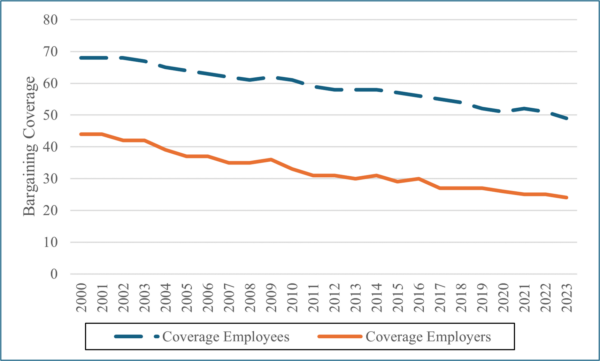
Notes: Coverage declined from about 68% to 49% among employees between 2000 and 2023. The decline is even stronger for employers, indicating that collective bargaining is increasingly concentrated in larger firms.
This decline reflects several factors: falling union membership, fewer firms participating in employer associations, and structural changes in the economy. Smaller firms—often paying lower wages—are more likely to exit the system.
However, formal coverage does not tell the full story. Many firms informally follow collective agreements. When this “orientation” is taken into account, effective coverage rises to about 68 percent of employees in 2023.
Coverage is lowest at the bottom of the wage distribution
An important finding is how coverage varies across workers. Coverage rises steeply from the bottom to the middle of the wage distribution. This reflects the expansion of the low-wage sector and the exit of smaller, lower-paying firms from collective bargaining.
Figure 2: Coverage along the wage distribution (2010 vs. 2021)
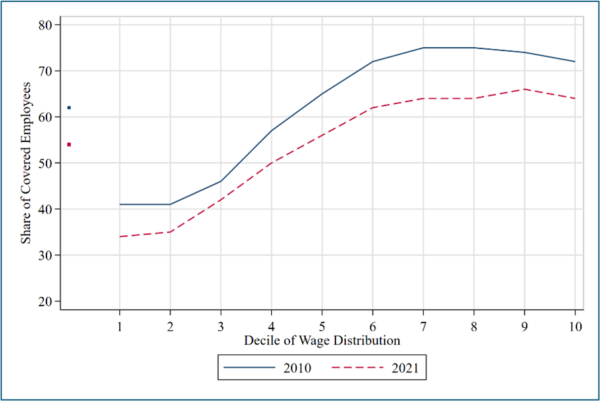
Notes: Coverage increases strongly with wages. In 2021, only about 34% of workers in the bottom decile are covered, compared to around 60% in the middle of the distribution.
This reflects the exit of smaller, lower-paying firms from collective bargaining.
Why this matters: inequality and market power
Collective bargaining affects wages in two key ways. First, it raises wages at the bottom by setting wage floors. Second, it compresses wage differences across workers. When low-wage workers are less likely to be covered, both effects weaken. This contributes to higher wage inequality.
At the same time, collective bargaining limits employer market power. In covered firms, wages are less influenced by firm-specific conditions. Where coverage is low, firms have more scope to set wages unilaterally.
This means that the decline in coverage—especially at the bottom—reduces worker protection precisely where it is most needed.
A flexible system that adapts to shocks
Despite these challenges, the German system retains important strengths.
Collective agreements allow for flexibility through:
- opening clauses that permit temporary deviations from collectively agreed wages and working hours during periods of economic hardship,
- firm-level adjustments within industry agreements,
- cooperation with works councils.
These mechanisms helped firms adjust during major crises, including the early 2000s and the Great Recession (see Dustmann et al. 2014). More recently, agreements have introduced new forms of flexibility, such as temporary worker reallocation across firms.
The growing role of the minimum wage
The uneven decline in coverage has had policy consequences.
The expansion of the low-wage sector and the decline in coverage were key reasons for introducing the statutory minimum wage in 2015. Since then, the minimum wage has become increasingly important in setting wage floors.
However, the minimum wage differs from collective bargaining in fundamental ways:
- It is uniform across sectors and regions.
- It does not adjust to firm-specific conditions.
- It is set through political processes.
As its role grows, wage setting in the low-wage segment shifts away from collective bargaining.
Conclusion
Germany’s collective bargaining system remains a central institution and continues to support coordination, stability, and flexibility. However, its reach has become uneven. Coverage is lowest among low-wage workers—precisely those who benefit most from collective agreements.
This creates a key challenge: preserving the strengths of the system while ensuring that it remains inclusive in a changing labor market.
References
Dustmann, Christian, Bernd Fitzenberger, Uta Schönberg, and Alexandra Spitz-Oener. 2014. ”From Sick Man of Europe to Economic Superstar: Germany’s Resurgent Economy.” Journal of Economic Perspectives 28 (1): 167–88.
Lutz Bellmann, Christian Dustmann, Bernd Fitzenberger (2026): Collective Bargaining in Germany: Trends and
Challenges. RFBerlin Discussion Paper No. 187/26
Disclaimer
The opinions and views expressed in this publication are those of the author(s) and do not necessarily reflect those of the ROCKWOOL Foundation Berlin (RFBerlin). While research disseminated through this series may address policy-relevant topics, RFBerlin, as an independent research institute, does not take institutional policy positions.
Publications in the RFBerlin Research Insights series may represent preliminary or ongoing work that has not been peer-reviewed. Readers are advised to consider the provisional nature of such research when citing or applying its findings.
These publications aim to make scientific work accessible to a broader audience and to encourage informed, research-based discussion. All materials are provided by the respective authors, who bear responsibility for appropriate attribution and rights clearance. While every effort has been made to ensure accuracy and proper acknowledgment, RFBerlin welcomes notifications of any concerns regarding authorship, citation, or intellectual property rights. Please contact RFBerlin to request corrections if needed.
Use of these materials for the development or training of artificial intelligence systems is strictly prohibited.
