



Short Summary
When workers change occupations, what makes firms willing to hire them?
Most research on occupational mobility looks at it from the perspective of workers: who switches occupations and why. Less is known about how firms evaluate candidates from other occupations. When screening applicants, recruiters must assess their quality under uncertainty about their actual skills, and this uncertainty is likely amplified when a candidate comes from a different occupation. Using Swiss unemployment insurance records linked with clickstream data from a recruitment platform, as well as jobseeker application data, our recent study (Klaeui et al. 2026) examines which candidates firms are willing to consider when hiring outside the occupation. The differences between incumbents movers are substantial, but there are large differences among movers: The closer a candidate’s previous occupation is to the job they are applying for, the smaller the disadvantage they face. Candidates from very different occupations are 16% less likely to be contacted than workers already in the occupation, while candidates from related occupations who have some relevant experience and a qualification are only 3% less likely to be contacted.
A central contribution of the paper is a new measure of how similar occupations actually are based on the skills and requirements listed in job ads. The results show that occupational labels are not always equally informative. Some occupations overlap heavily in their requirements, while jobs within the same occupation can differ substantially. This signal value of the occupation matters substantially in determining contact gaps between movers and incumbents. We find that the contact rate gap is 2.5 times smaller in loosely defined occupations where jobs share few requirements compared to more homogeneous occupations.
Key Findings
- Occupation movers are less likely to be hired: Candidates switching occupations face a 7% lower than otherwise identical incumbents – jobseekers who last worked in the occupation the recruiter is trying to fill. But these mover gaps vary greatly for different movers.
- Overlap in job requirements matters: Candidates coming from occupations with low job requirement overlap with the vacancy occupation face the largest penalty. The contact disadvantage is almost twice as large as for movers from high-overlap occupations.
- Job similarity matters even for workers already in the occupation. When jobs within an occupation are very similar, employers place greater value on direct occupational experience, making it harder for outsiders to compete. In these homogeneous occupations, the contact-rate disadvantage for outsiders is about 2.5 times larger than in occupations where jobs within the same occupation differ more in their requirements.
- Experience and certificates matter: Professional certificates and prior experience in the vacancy occupation further help close the gap between movers and incumbents.
- Market conditions move the bar: When recruiters struggle to find candidates from within their occupation, they become substantially more open to outsiders, especially those from nearby occupations.
- Firms’ adaptation in screening criteria accounts for one-third of the increase in cross-occupational hiring observed in tight labor markets, suggesting an important role for firms in occupational transitions.
Relevance Today
Across Europe, labor shortages in sectors such as healthcare, skilled trades, and engineering coexist with displaced workers in declining sectors. The effectiveness of job search advice and re-orientation programs depends on understanding which transitions are realistic for which workers.
This study is the first to systematically characterize firms’ hiring decisions when comparing occupation movers versus incumbents. It shows that firms rely heavily on signals about how similar a worker’s previous occupation is to the new job. Candidates from closely related occupations, especially those with relevant credentials or recent experience, face much smaller hiring barriers. Labour shortages also make firms more willing to consider career switchers. These findings could help public employment services design more effective retraining and job-transition programs.
Author Quote
“Most research on occupational transitions focuses on workers’ decisions. That firms are gatekeepers in occupational transitions is evident—what has been missing is a systematic account of how they evaluate movers. We fill this gap by characterizing the signals that shape recruiters’ screening decisions. For instance, we find that recruiters use a candidate’s occupation as a signal of fit, but it is a noisy one: in some occupations, even two workers who last worked there may have done very different jobs. How similar jobs are within an occupation determines the advantage of incumbents over movers.”
Reference: Based on RFBerlin Discussion Paper 020/26: Jeremias Klaeui, Daniel Kopp, Rafael Lalive, Michael Siegenthaler (2026): Adapting to Scarcity: The Role of Firms in Occupational Transitions.
Research Summary
Economies undergoing structural change need workers to move between occupations. When demand for manufacturing jobs declines, or new technology and shifting demands create shortages, for example, in engineering or healthcare, workers who can switch occupations help the economy adjust more smoothly. But occupational transitions are difficult. A substantial body of research has studied how workers decide where to apply and how the distance between occupations affects wages after a switch (Gathmann & Schönberg, 2010; Cortes & Gallipoli, 2018). Less is known about the other side of the market: when do firms accept a candidate from a different occupation, and what drives their decisions?
This question matters because firms are decisive. Using Swiss job search diary data that track applications and hiring outcomes, we find that about 70% of all job applications come from candidates whose last occupation differs from the advertised position. Yet only 63% of actual hires come from a different occupation. The gap implies that firms’ hiring preferences offset roughly one-third of the cross-occupational moves that workers attempt.
Watching Recruiters Decide In Real Time
To understand what shapes firms’ willingness to consider occupation movers, we use a unique combination of Swiss administrative and online data. The core dataset is click-stream data from “Job-Room,” the recruitment platform of the Swiss Public Employment Service (see Hangartner et al., 2021, for a description of the platform). On this platform, recruiters search a database of registered job seekers by occupation. They see standardized candidate profiles – listing work history, qualifications, language skills, and desired occupations – and decide whom to contact. All candidates they see have indicated their willingness to work in the vacancy occupation, but not all have worked there before. We observe every step: the search terms recruiters enter, which profiles they see, and whom they choose to contact. Between March and December 2017, we recorded over 15 million candidate impressions across roughly 407,000 recruiter searches.
A key advantage of these data is that the same candidate often appears in searches for different occupations, since most job seekers list several occupations they are willing to work in. This means we can compare how the same person is treated when she is an “incumbent” (her last job matches what the recruiter seeks) versus when she is a “mover” (her last job was in a different occupation). By holding the candidate’s overall quality constant, we can isolate the effect of occupational background on recruiters’ decisions. Moreover, because we observe all information available to the recruiter, we can account for the fact that the same candidate characteristic may be valued differently across occupations.
Measuring What Jobs Actually Require
Understanding why firms prefer incumbents requires measuring how similar two jobs really are. The standard approach in economics is to use occupational classification systems like the US Department of Labor’s O*NET, which assign a fixed set of tasks , 2019, 2025; Macaluso, 2025). But this assumes that all jobs within an occupation are the same, an assumption our data show to be far from accurate (Belot et al., 2019, 2025; Macaluso, 2025).
We construct a new measure of occupational overlap based on the actual job requirements listed in over one million online job postings in Switzerland. For each pair of occupations, we randomly draw 5,000 pairs of vacancy postings and calculate the share of listed requirements that appear in both ads, using the Jaccard similarity index. Crucially, the same procedure works for comparing two jobs in different occupations and two jobs in the same occupation. This allows us to measure the likely skill distance between the recruiter’s position and both an average mover and an average incumbent on a common scale. It distinguishes our approach from existing measures based on occupational task classifications (Gathmann & Schönberg, 2010; Cortes & Gallipoli, 2018), observed transitions (Schubert et al., 2024; del Rio-Chanona et al., 2021), or training curricula (Eggenberger et al., 2018).
Figure 1 illustrates the results for the ten most common occupations among Swiss job seekers. The diagonal shows within-occupation overlap: how similar two randomly chosen job ads are when both advertise for the same occupation. As expected, jobs within the same occupation tend to share more requirements than jobs across occupations. But the differences are not always large. Shop sales assistants and waiters, for example, share 8.2% of their requirements across occupations, nearly as much as two waiter positions share with each other (9.3%). We validate this measure by showing that it strongly predicts where job seekers actually apply: candidates almost never apply to occupations sharing less than 5% of their last occupation’s requirements, but apply almost four times per unemployment spell to occupations with more than 11% overlap.
Job Requirement Overlap Explains Most of the Hiring Disadvantage
Using the new overlap measure, we can ask: how much of recruiters’ preference for in-cumbents reflects inferred differences in skill match? When we compare movers and incumbents whose occupations, on average, have the same degree of overlap with the vacancy occupation’s requirements, the contact disadvantage drops by 60%—from 7% to 2.8%. The occupation label’s informational content about likely skill match is thus the primary reason recruiters prefer incumbents.
Figure 1: Job requirements overlap between and within the ten most common occupations
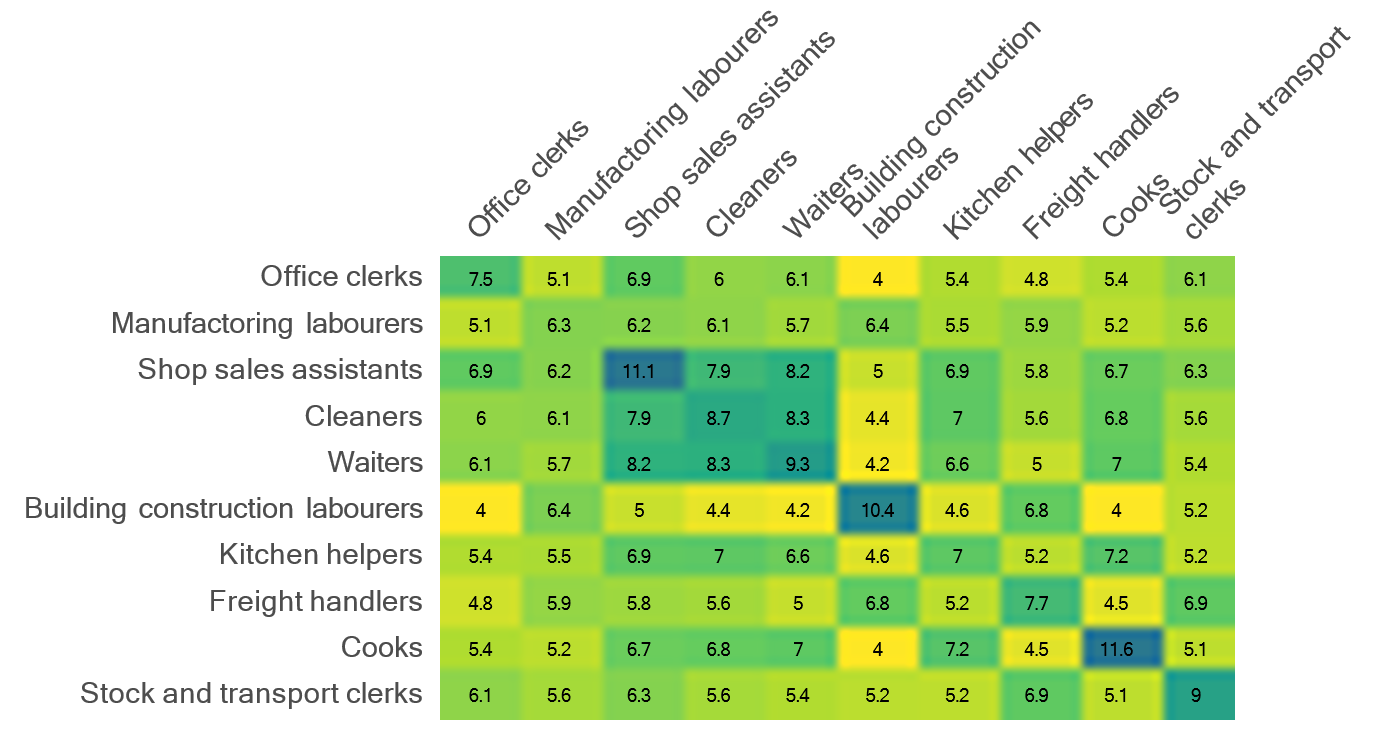
Notes: The numbers indicate the average share of job requirements (in percent) that two randomly drawn job postings have in common. The diagonal shows within-occupation overlap. Source: Authors’ calculations based on over one million Swiss online job postings scraped by X28, 2016–2022.
The degree of similarity among jobs within an occupation is equally important. When jobs in an occupation require very similar skills, employers can more easily infer what a candidate is capable of from their occupational background. In these occupations, prior experience in the occupation is especially valuable, giving incumbent workers a stronger advantage over outsiders. Conversely, in occupations where even two incumbents may have done quite different work, the occupation label is less informative, and outsiders face a smaller barrier. Even after accounting for job requirement overlap and occupation homogeneity, however, a residual advantage for incumbents remains, suggesting that recruiters also treat occupation-specific experience and credentials as independent signals of suitability.
When Do Recruiters Give Occupation Movers a Chance?
Figure 2 breaks down the contact disadvantage for different profiles of occupation movers, from the most disadvantaged to those who face no barrier at all.
Figure 2: Contact disadvantage for different types of occupation movers
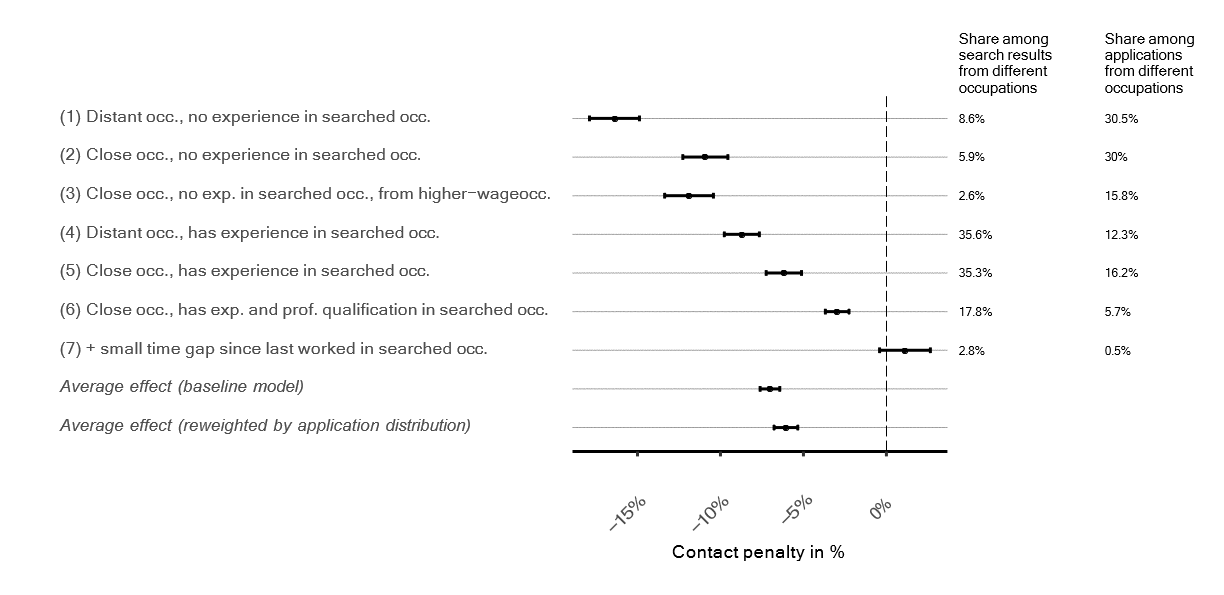
Notes: The figure shows the estimated contact disadvantage (relative to incumbents) for different sub-groups of occupation movers. “Distant occ.” means the job requirement overlap between the candidate’s last occupation and the vacancy occupation is at least 2 percentage points below the vacancy’s within-occupation overlap; “Close occ.” means the gap is smaller. The right-hand columns show the share each group represents among occupation movers on the platform and in the job search diary data. Source: Authors’ estimates based on recruiter clickstream data from Job-Room, March–December 2017.
The gradient is steep. Candidates from a distant occupation with no prior experience in the vacancy occupation—who make up about 31% of cross-occupation applications in the real labor market—face a 16.4% contact disadvantage. Moving to a similar occupation reduces this gap to 10.9%. Having prior work experience in the vacancy occupation cuts the disadvantage roughly in half. Adding a recognized professional qualification in the vacancy occupation reduces it further, to about 3%. And for the small group of return movers who hold a relevant credential, have substantial prior experience, and have spent only a brief period in a closely related occupation, the disadvantage disappears entirely.
Bad Market Conditions Make Recruiters Lower the Bar
Do firms stick rigidly to their preference for incumbents, or do they adapt when candidates from within their occupation are scarce? We use data from the unemployment register and from the online vacancy dataset to measure labor market tightness, the ratio of job openings to unemployed incumbents, at the micro-market level in each occupation and region. We then track how the same recruiter adjusts behavior as conditions change.
We find that recruiters searching in tight occupations become substantially more open to movers. The contact rate for outsiders nearly doubles from slack to tight markets (from about 11% to 17%). But this opening is selective: recruiters primarily reach out to candidates from nearby occupations with similar job requirements. Candidates from very distant occupations see little benefit even in tight markets. This pattern is consistent with the broader finding that firms facing hiring difficulties lower their requirements along several dimensions (Modestino et al., 2020; Le Barbanchon et al., 2023; Ziegler, 2024).
How much does the fact that firms adapt their preference against movers matter quantitatively? Using the job search diary data, we estimate how much of the increase in cross-occupational hiring in tight markets is driven by firms changing their behavior, compared to a counterfactual where firms do not react to tightness. Month-to-month increases in tightness do not attract more applicants from other occupations, suggesting that the higher success rate of occupation movers in tight markets largely reflects firms’ willingness to adjust. A back-of-the-envelope calculation attributes roughly one-third of the increase in cross-occupational hiring in tight versus slack markets to changes in firm behavior.
Implications for Policy and Job Search Advice
These findings have direct implications for how public employment services advise displaced workers. Our results show that occupational labels alone are a poor guide to the feasibility of an occupational transition. Two occupations classified as “different” may share most of their job requirements, while two positions within the “same” occupation may have little in common. An overlap measure derived from job-posting data, as developed in this study, could help caseworkers assess transition prospects at a more granular level. A growing literature tests interventions that offer job seekers tailored occupational recommendations (Belot et al., 2019, 2025; Altmann et al., 2022; Bächli et al., 2025); our findings suggest that such tools should account not only for between-occupation distance but also for within-occupation heterogeneity.
Beyond the occupation-level assessment, our results show what other elements of a worker’s individual profile matter, and how much. For instance, prior experience in the vacancy occupation and a recognized professional certificate substantially improve an occupation mover’s prospects. Combined with the overlap measure, these results mean that public employment services can provide individually tailored advice: for a given worker, which occupations offer high enough overlap to attract firms’ interest, and does the worker already hold the credentials that would make her competitive? Our results also highlight that labor market conditions shape the prospects of occupation movers. When an occupation is tight, recruiters lower the bar for outsiders. This suggests that steering displaced workers toward occupations with current shortages can improve their chances, particularly when the job requirement overlap is already high.
Conclusion
This study provides new evidence on the role of firms in occupational transitions. By developing a measure of job requirement overlap that works on a common scale within and between occupations, we show that the occupation label is the dominant signal recruiters use to assess the fit of candidates from different occupations, but that its informational value varies widely: in homogeneous occupations, it is highly predictive, in diverse ones, much less so. Professional certificates and recent experience in the vacancy occupation serve as complementary signals that independently improve an occupation mover’s prospects. When labor markets tighten, recruiters become less selective about candidates’ occupational background, particularly for outsiders from nearby occupations. Together, these results suggest that effective labor market policy should move beyond broad occupational categories and instead assess transition prospects at the level of actual job requirements, individual credentials, and market conditions in each occupation.
References
Altmann, S., Glenny, A., Mahlstedt, R., & Sebald, A. (2022). The direct and indirect effects of online job search advice.
Belot, M., Kircher, P., & Muller, P. (2019). Providing advice to jobseekers at low cost: An experimental study on online advice. The Review of Economic Studies, 86 (4), 1411–1447.
Belot, M., Kircher, P., & Muller, P. (2025). Do the long-term unemployed benefit from auto-mated occupational advice during online job search? The Economic Journal , ueaf041.
Bächli, M., Lalive, R., & Pellizzari, M. (2025). Helping jobseekers with recommendations based on skill profiles or past experience: Evidence from a randomized intervention (IZA Discussion Papers No. 17713). Institute of Labor Economics (IZA). Retrieved from https://EconPapers.repec.org/RePEc:iza:izadps:dp17713
Cortes, G. M., & Gallipoli, G. (2018). The costs of occupational mobility: An aggregate analysis. Journal of the European Economic Association, 16 (2), 275–315.
del Rio-Chanona, R. M., Mealy, P., Beguerisse-Díaz, M., Lafond, F., & Farmer, J. D. (2021). Occupational mobility and automation: a data-driven network model. Journal of The Royal Society Interface, 18 (174), 20200898.
Eggenberger, C., Rinawi, M., & Backes-Gellner, U. (2018). Occupational specificity: A new measurement based on training curricula and its effect on labor market outcomes. Labour Economics, 51 , 97–107. doi: 10.1016/j.labeco.2017.11.010
Gathmann, C., & Schönberg, U. (2010). How General Is Human Capital? A Task-Based Approach. Journal of Labor Economics, 28 (1), 1–49. doi: 10.1086/649786
Hangartner, D., Kopp, D., & Siegenthaler, M. (2021). Monitoring hiring discrimination through online recruitment platforms. Nature, 589 (7843), 572–576.
Le Barbanchon, T., Ronchi, M., & Sauvagnat, J. (2023). Hiring difficulties and firms’ growth. SSRN Working Paper No. 4105264 .
Macaluso, C. (2025). Skill remoteness and post-layoff labor market outcomes. American Eco-nomic Journal: Macroeconomics, 17 (2), 134–176.
Modestino, A. S., Shoag, D., & Ballance, J. (2020, 10). Upskilling: Do Employers Demand Greater Skill When Workers Are Plentiful? The Review of Economics and Statistics, 102 (4), 793-805.
Schubert, G., Stansbury, A., & Taska, B. (2024). Employer concentration and outside options. Available at SSRN 3599454 .
Ziegler, L. (2024). Labor market tightness and hiring outcomes (Draft). University of Vienna.
Disclaimer
The opinions and views expressed in this publication are those of the author(s) and do not necessarily reflect those of the ROCKWOOL Foundation Berlin (RFBerlin). While research disseminated through this series may address policy-relevant topics, RFBerlin, as an independent research institute, does not take institutional policy positions.
Publications in the RFBerlin Research Insights series may represent preliminary or ongoing work that has not been peer-reviewed. Readers are advised to consider the provisional nature of such research when citing or applying its findings.
These publications aim to make scientific work accessible to a broader audience and to encourage informed, research-based discussion. All materials are provided by the respective authors, who bear responsibility for appropriate attribution and rights clearance. While every effort has been made to ensure accuracy and proper acknowledgment, RFBerlin welcomes notifications of any concerns regarding authorship, citation, or intellectual property rights. Please contact RFBerlin to request corrections if needed.
Use of these materials for the development or training of artificial intelligence systems is strictly prohibited.
