

Short summary
Will generative AI mainly replace workers, or will it increase living standards? This study responds “yes” to both. Based on our economic model, large language models (LLMs) could raise real income by about 8.7%. However, these gains are unequally distributed across occupations and demographic groups. Scientific technicians and workers in administrative services benefit the least, while more manual occupations tend to gain more. High school dropouts experience some of the largest gains.
These predictions do not just depend on whether a job is exposed to AI. What also matters is whether AI is a substitute for labor or not, whether lower costs increase demand, and how easily workers can reallocate to other jobs. These wider labor-market adjustments are key, and the study finds sizable shifts in employment. The share of scientific technicians falls by about 2.5%, while mechanics and transport rise by almost 1.5%. This labor reallocation creates spillover effects across occupations and narrows the gaps in wage gains between occupations with different direct exposure to AI. If actual reallocation would be more frictional, the unequal impact would be amplified.
Key Model Predictions
- LLMs raise aggregate real income by about 8.7%.
- Real wages rise in all occupations, but least in administrative services and for scientific technicians.
- Lower-income groups gain slightly more on average; high-school dropouts see the largest gains, around 9.3%.
- Employment shifts matter: scientific technicians shrink by about 2.5%, while mechanics and transport grow by almost 1.5%. Whether LLMs widen or narrow inequality across occupations depends on how smoothly workers can move between jobs.
- Whether LLMs widen or narrow inequality across occupations depends on how smoothly workers can move between jobs.
Relevance Today
Public debate often treats AI as either a universal boost or a universal threat. Reality is more nuanced. AI can raise income overall, while still creating pressure in specific occupations and forcing workers to adjust. That means the key policy challenge is not only how exposed a job is, but how smoothly workers can move when demand shifts across occupations. This is why reallocation, retraining, job-search, and income support belong at the center of the AI policy debate.
Author Quote
“In contrast to previous episodes of technical change, which have been pro-rich, we find that on average, initially poorer groups gain more from generative AI than initially richer groups.”
Based on RF Berlin Discussion paper 039/26: Fenella Carpena and Simon Galle, The Labor Market Impact of Occupation-Specific Technical Change: Inspecting the Mechanisms (January 2026).
Research summary
With the rise of generative AI, as with earlier waves of automation, a familiar question returns: will it make society richer or primarily displace workers? In this debate, techno-optimists stress productivity gains, while techno-pessimists fear job displacement and falling incomes. Both can be true: technological progress raises income overall, but often it simultaneously hits occupations unevenly and potentially lowers wages for more exposed workers. We therefore propose a framework that concisely integrates both forces: the overall economy grows but wage gains or losses are unequal across occupations. When applying our framework to the arrival of large language models (LLMs): we find broad real-wage gains and an increase in aggregate real income of 8.7%. At the same time, employment in many “cognitive” occupations (for instance scientific and administrative) shrinks and the benefits of LLMs are tilted toward lower-income groups.
Our starting point: Differences across occupations
Computer programmers are far more exposed to LLMs than mechanics or many low-education service jobs. These differences across occupations matter because they shape where AI adoption occurs and where gains arise. Early studies on the impact of LLMs successfully pinpointed in which occupations AI will be more exposed to LLMs (Eisfeldt et al. 2023; Eloundou et al. 2024). Our study takes this heterogeneity in occupational exposure to AI as a starting point.
To assess how differences in occupational exposure affect wages, we need to understand how the arrival of new technology changes labor demand and supply across occupations. Here, our model aims to obtain clarity by stripping down the forces governing supply and demand to their essentials. Less is more. In other words, our framework is deliberately stylized and transparent to facilitate communication between researchers and practitioners but also detailed enough to generate granular predictions for wage changes across many occupations and detailed demographic groups.
Determining whether wages rise or fall, and by how much
Different occupations are exposed to AI in different ways, but exposure alone does not determine who gains and who loses. Three forces shape the wage effects: whether AI replaces workers or helps them, whether cheaper output boosts demand for that occupation, and how easily workers can move to other jobs. Our study develops a framework that traces how these forces interact to determine wage changes across the economy.
Whether a new technology – or improved machinery – is a substitute or a complement for workers is a classic question in economics. Still, its answer may vary substantially across occupations, especially in the context of AI. In some occupations, AI may be a substitute (e.g., for programmers), while for others, such as workers in sales, it may be more complementary. Naturally, the more substitutable workers are with technology, the more wages tend to be pushed down. This is the mechanism techno-pessimists emphasize: input substitution.
When machines can replace workers, that does not automatically mean fewer jobs. If technology makes production cheaper, prices can fall and demand can grow. If demand grows enough, firms may actually hire more workers—even if each unit of output uses less labor than before. This way, final-demand expansion pushes wages up. Which channel then dominates, and whether wages in an occupation go up or down, therefore depends on the balance between input substitution and final-demand expansion. The difference between them, referred to as gross substitutability, determines the net impact on labor demand.
How easily workers can switch occupations is crucial. When mobility is high, displaced workers quickly flow into other jobs, spreading the shock across the labour market — a ripple effect that narrows wage gaps between occupations. When mobility is low, the adjustment falls heavily on exposed workers, and wage changes become more unequal. When mobility is limited enough, a large drop in labor demand can push wages down in some occupations — even when the economy as a whole gains.
Quantifying the aggregate and distributional impact of LLMs
Our paper’s second main contribution is quantitative: it applies the framework to generative AI and asks what an LLM-driven productivity shock implies for wages, employment reallocation, and inequality.
To translate “AI exposure” into economic outcomes, we discipline the key parameters governing supply and demand using external evidence. We also estimate how productivity changes across occupations by drawing on experimental evidence showing productivity gains for management consultants using AI tools. We then extend these estimates to other occupations, scaling the expected gains based on how exposed each job is to large language models. These two steps are, for now, based on strong assumptions, but they allow us to simulate an economy-wide equilibrium where wage changes reflect not only direct exposure but also reallocation-driven spillovers. Under our assumptions, we find real wage gains for all occupations, because the AI shock substantially raises aggregate productivity. But the gains are uneven: scientific technicians and administrative services gain the least, reflecting a combination of high exposure and relatively high substitutability with LLMs.
Employment shifts are sizable, reinforcing the idea that reallocation is a key margin of adjustment. For example, the employment share of scientific technicians falls by about 2.5%, while mechanics and transportation rises by almost 1.5%—a pattern consistent with workers moving away from the most exposed (and more substitutable) occupations. These movements dampen wage inequality: spillovers from reallocation compress differences in wage growth across occupations, even though exposure varies sharply.
Figure 1: Predicted occupation-level employment reallocation after LLM adoption.
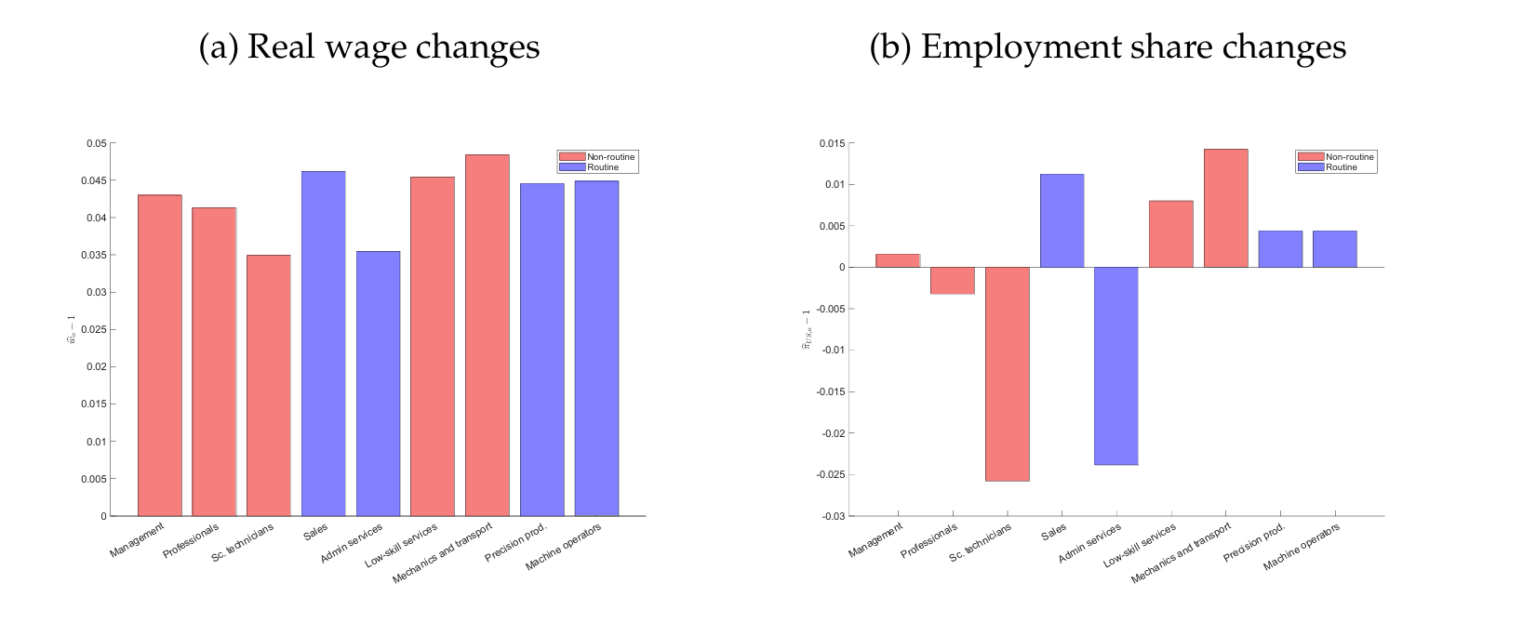
Note: LLM-driven productivity gains raise real wages in every occupation, but wage growth is lowest in highly exposed, more substitutable occupations (e.g., administrative services, scientific technicians). Employment reallocates away from the most exposed occupations, generating wage spillovers that compress wage differences.
Interestingly, the effects of AI appear slightly “pro-poor” rather than favouring highly educated workers. Income gains are negatively related to initial income, meaning lower-income workers benefit more. For example, high-school dropouts see the largest average gains (around 9.3%), while the most highly educated groups gain the least. This contrasts with earlier waves often described as favoring high-educated workers, and it follows directly from the combination of broad productivity gains plus AI exposure concentrating in relatively well-paid, cognitive routine work, while many manual-intensive occupations benefit from the productivity gains.
Figure 2: Income gains across the initial income distribution
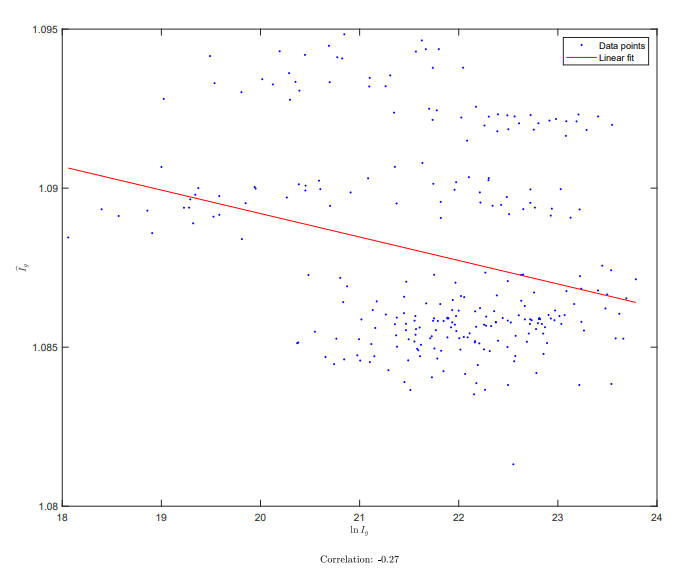
Note: Under the calibrated LLM shock, income gains are widespread and slightly larger for initially lower-income groups, though most of the variation in gains remains within income levels—highlighting the importance of occupation-level exposure and reallocation.
Policy Implications
Three implications follow from this framework and the calibration. First, “AI exposure” by itself is not enough for understanding labor market impacts: policy needs to track substitution vs. complementarity and demand expansion as separate channels, because they can point in opposite directions for wages and employment.
Second, even when aggregate gains are large, adjustment can be painful in specific occupations; policies that reduce reallocation costs—job search support, rapid retraining tied to local demand, and portable benefits—matter for whether workers experience AI as opportunity or threat.
Third, the importance of ripple effects implies that interventions targeted only at “exposed” occupations may miss substantial spillovers; monitoring and policy design should account for displacement pressures and wage impacts in destination occupations as well.
Conclusion
Our recent paper (Carpena and Galle, 2026) offers a useful way to bridge the gap between the techno-optimist and techno-pessimist narratives. While AI can boost productivity and raise wages overall, it may still displace workers and reduce wages in the most exposed occupations—especially when substitution outweighs increased demand and workers cannot easily move to new jobs. Our model predictions suggest sizable aggregate gains from LLMs and relatively compressed wage inequality, with meaningful occupational reallocation and mildly pro-poor income effects. The open question is not whether AI helps or hurts “the labor market” in general, but which occupations face substitution pressure, how demand responds, and how easily workers can transition when the shock arrives.
References
Carpena, F. & Galle, S. The Labor Market Impact of Occupation-Specific Technical Change: Inspecting the Mechanisms (January 2026). RF Berlin Discussion paper 039/26
Eisfeldt, A. L., Schubert, G., & Zhang, M. B. (2023). Generative AI and firm values (No. w31222). National Bureau of Economic Research.
Eloundou, T., Manning, S., Mishkin, P., & Rock, D. (2024). GPTs are GPTs: Labor market impact potential of LLMs. Science, 384(6702), 1306-1308.
Disclaimer
The opinions and views expressed in this publication are those of the author(s) and do not necessarily reflect those of the ROCKWOOL Foundation Berlin (RFBerlin). While research disseminated through this series may address policy-relevant topics, RFBerlin, as an independent research institute, does not take institutional policy positions.
Publications in the RFBerlin Research Insights series may represent preliminary or ongoing work that has not been peer-reviewed. Readers are advised to consider the provisional nature of such research when citing or applying its findings.
These publications aim to make scientific work accessible to a broader audience and to encourage informed, research-based discussion. All materials are provided by the respective authors, who bear responsibility for appropriate attribution and rights clearance. While every effort has been made to ensure accuracy and proper acknowledgment, RFBerlin welcomes notifications of any concerns regarding authorship, citation, or intellectual property rights. Please contact RFBerlin to request corrections if needed.
Use of these materials for the development or training of artificial intelligence systems is strictly prohibited.
