
A working paper is where research lives before the world reads it. Big questions deserve answers straight from the experts. So, this season, we open up. Across five episodes, host Tim Phillips sits down with the researchers behind the projects at RFBerlin.
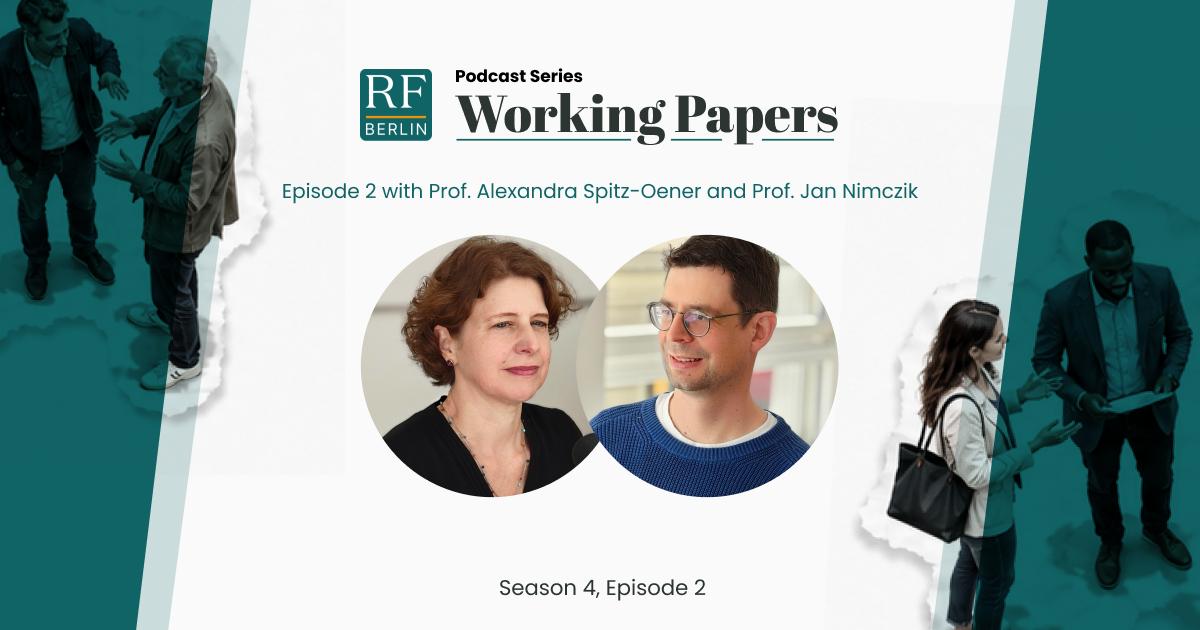
In this episode of Working Papers, Prof. Alexandra Spitz-Oener (Deputy Director of RFBerlin) and Prof. Jan Nimczik (RFBerlin Project Leader) explain why so many people stay put, even when a better job might be waiting somewhere else. Drawing on German reunification as a natural experiment, they show that finding work depends less on qualifications alone than on a very specific kind of connection.
Also available on these podcast platforms:
Only 3 to 4% of displaced East German workers moved west within five years of losing their jobs, despite higher wages, recognised qualifications, a shared language and relocation subsidies all pointing that way. The reason wasn’t laziness or lack of opportunity: it was information. What moved people was a former coworker who did the same job and had already made it in the West. Jan Nimczik explains why that specific tie mattered so much:
“It only works if your East German colleague, who is now in the West, is similar to you: if the information that person can provide is relevant to you, because you see yourself in that person. If he or she made it, then I can make it as well.”
The finding reaches well beyond 1989. As AI and automation reshape the labour market and remote work weakens the very ties the research identifies, Alexandra Spitz-Oener draws out what it means for policy today:
“The standard response to regional job losses has been relocation subsidies and better job listings. Those are useful, but they don’t address the deeper problem: people don’t know whether they’ll actually succeed in a new place. Connecting displaced workers with people who have made similar transitions could be much more effective than generic incentives.”
Resources mentioned in the episode:
📄 If They Made It, I Can Make It: Workplace Connections and Labour Migration, by Michelle Hansch, Jan Nimczik and Alexandra Spitz-Oener (RFBerlin Discussion Paper No. 7725, 2025)