
We are continuing the RFBerlin Masterclass Series, grounded in the Handbook of Labor Economics and the research that extends it. In this series, we invite contributing authors of its chapters to Berlin for intensive, in-depth teaching sessions.
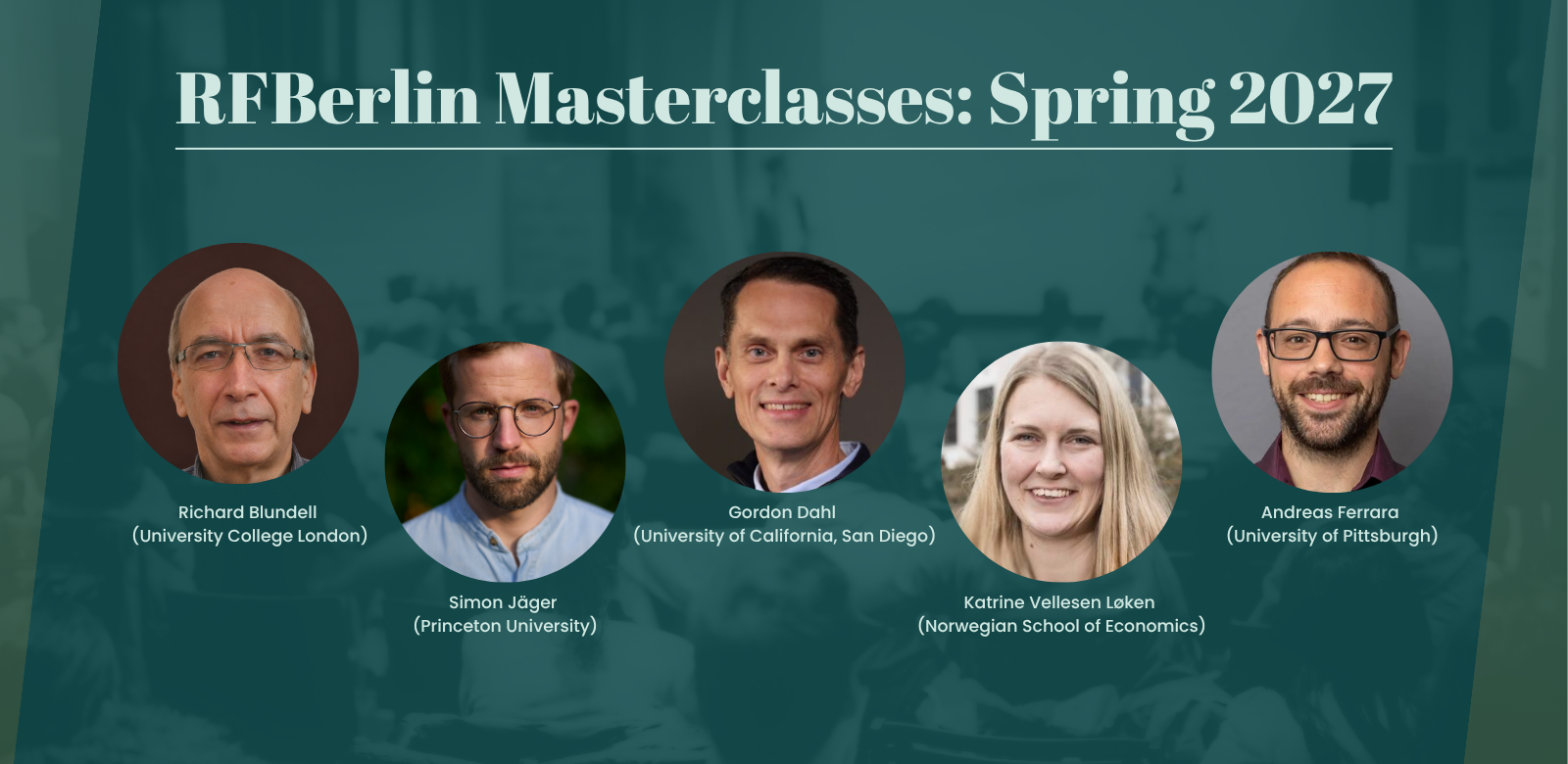
In the first half of 2027, we welcome five leading economists for four masterclasses at the frontier of economic research: inequality, wages, families, and AI. Learn from the researchers shaping your field, and apply now.
11-12 March 2027
Consumption, Income, and Earnings Dynamics: the Distributional Dynamics of Inequality
Sir Richard Blundell holds the David Ricardo Chair of Political Economy at UCL and co-directs the ESRC Centre for the Microeconomic Analysis of Public Policy at the Institute for Fiscal Studies. Knighted in 2014, he is a past president of the Econometric Society, the European Economic Association, the Royal Economic Society, and the Society of Labor Economists.
His masterclass turns to how inequality takes shape and shifts across consumption, income, and earnings.
15-16 April 2027
Collective bargaining, unions, and the wage structure: an international perspective
Simon Jäger is Associate Professor of Economics and Public Affairs at Princeton University and a Research Associate at the NBER. A member of the RFBerlin Network, his research focuses on the origins and consequences of labour market inequality.
His masterclass looks at how collective bargaining and unions shape wages across countries. Using data from 18 advanced economies, it asks why bargaining coverage is linked to lower wage inequality, and how that link works.
Application deadline: 18 February 2027
20-21 May 2027
Families, Public Policies and the Labor Market
Gordon Dahl is Professor of Economics at the University of California, San Diego, a Research Associate at the NBER, and a Fellow of the Society of Labor Economists; his work covers families, public policy, and the labour market.
Katrine Vellesen Løken is Professor of Economics and Vice Rector for Research at the Norwegian School of Economics and an editor of The Review of Economic Studies; her research covers early investments in children and the long-term effects of social policies.
Their masterclass will examine how government policy shapes family life and the labour market, from fertility and marriage to family labour supply and gender inequality. Drawing on evidence from across OECD countries, it reviews what recent research has established and where it points next.
Application deadline: 25 March 2027
14 June 2027
Large Language Models and Generative AI in Applied Economics
Andreas Ferrara is Associate Professor of Economics at the University of Pittsburgh and a Research Associate at the NBER. A Fellow of the RFBerlin Network, his research spans economic history, labour economics, and political economy.
His masterclass is a hands-on guide to using large language models and generative AI in applied economics research. Across four sessions, it moves from tools and workflow to building a reliable pipeline, validating results, and real applications, from digitizing historical records to measuring sentiment at scale.