



Why lower-paid workers began catching up after 2010
Short Summary
Wage inequality rose considerably across the 2000s in Germany (see Dustmann, Ludsteck and Schönberg, 2009). Then, around 2010, the trend reversed. Wages at the bottom began to grow faster than wages in the middle and at the top of the distribution, and by 2017, inequality in the lower half of the distribution had returned to its early-2000s level. Documenting this reversal is an important finding: the decline in German wage inequality after 2010 has received far less attention than the earlier rise. Importantly, the turnaround began five years before Germany introduced its statutory minimum wage.
A new study by Christian Dustmann, Martin Friedrich, Carl Gergs and Uta Schönberg traces this development to a marked rise in the number of vacancies relative to the number of jobseekers after the Great Recession. Economists refer to this ratio as labour market tightness. Vacancies relative to jobseekers more than tripled between 2010 and 2019. The authors attribute this to a marked increase in labour demand, driven above all by higher domestic consumption of services and more construction activity. Labour supply, by contrast, remained almost constant in the 2010s despite population ageing, because immigration of foreign workers was strong.
Because vacancies were plentiful, lower-paid workers changed jobs more often than before and, on average, achieved substantial wage gains when they moved. A considerable part of these gains came from the fact that, in particularly tight local labour markets, moves from low-paying to better-paying firms became significantly more likely. In the 2010s, less productive workers had considerably better chances of finding jobs at “good firms” than in the 2000s.
At the aggregate level, workers with comparable skills were also paid more uniformly across firms in the 2010s than before. This suggests that firms’ wage-setting power declined. A further indication is that wages moved closer to workers’ individual productivity.
Because lower-skilled workers benefited disproportionately from the abundance of vacancies, wages of workers with and without higher education also converged: the wage gap fell by about five percentage points between 2010 and 2019 and continued to decline thereafter.
The introduction of the statutory minimum wage in 2015 also helped to reduce wage inequality, but only at the very bottom of the wage distribution. Stronger wage growth had already begun five years earlier and also reached lower-middle wage groups that were already earning above the minimum wage at the start of the 2010s. These findings point to the tight labour market as the main driver of the reversal in inequality.
Key Findings
- Wage inequality in Germany declined from 2010 onwards after rising strongly in the 2000s, a reversal that has received relatively little attention.
- Labour market tightness, the ratio of vacancies to jobseekers, more than tripled between 2010 and 2019. German regions with larger increases in tightness also saw larger declines in inequality.
- Lower-paid workers changed jobs more often and increasingly found jobs at better-paying firms.
- Wages moved closer to workers’ productivity, and pay differences between similarly skilled workers at different employers narrowed. This points to weaker employer wage-setting power and a more competitive labour market.
Relevance Today
Germany is again debating wage growth and labour shortages in the context of an ageing population. Our study shows that the relative scarcity of workers compared with the number of vacancies can directly affect the distribution of wages. It would be too simple to attribute the decline in wage inequality after 2010 solely or mainly to the introduction of the minimum wage: the reversal began earlier, and wages also rose disproportionately for workers in lower-middle wage groups who were not directly affected by the minimum wage.
Author Quote
“Our central contribution is to demonstrate that rising labour market tightness can lead to substantial wage compression even in the absence of changes to wage-setting institutions.”
– Christian Dustmann, Director of RFBerlin and Professor of Economics at University College London
Reference: Labor Market Tightness and the Reversal of Inequality Trends in Germany, by Christian Dustmann, Martin Friedrich, Carl Gergs and Uta Schönberg. RFBerlin Discussion Paper No. 307/26; forthcoming in the Quarterly Journal of Economics.
Research Summary
A striking reversal after 2010
For much of the 1990s and 2000s, wages in Germany became more unequal. This trend was especially pronounced in the lower half of the distribution: between 2000 and 2008, real wages at the 10th percentile fell by roughly 11%, median wages fell by about 3%, while wages at the 90th percentile rose by about 4%. By 2008, the gap between the median and the 10th percentile was 8 percentage points wider than in 2000. A worker at the 10th percentile earns more than 10% of full-time employees.
This paper documents a striking reversal from around 2010. Wages at the bottom began to rise faster than wages further up the distribution. Between 2010 and 2019, the gap between the 10th percentile and the median narrowed by roughly eight percentage points, while the gap between the median and the 90th percentile was broadly stable. The reversal did not stop in 2019. Up to 2023, real wage growth remained positive at the very bottom but turned negative further up the distribution, so lower-half wage inequality continued to compress. By 2023, overall wage dispersion had fallen below its 2000 level.
This timing of the reversal is central to the study. Germany introduced a statutory minimum wage only in 2015. The minimum wage clearly raised wages at the very bottom, but the broader compression had begun several years earlier and extended beyond the part of the distribution directly affected by the wage floor.
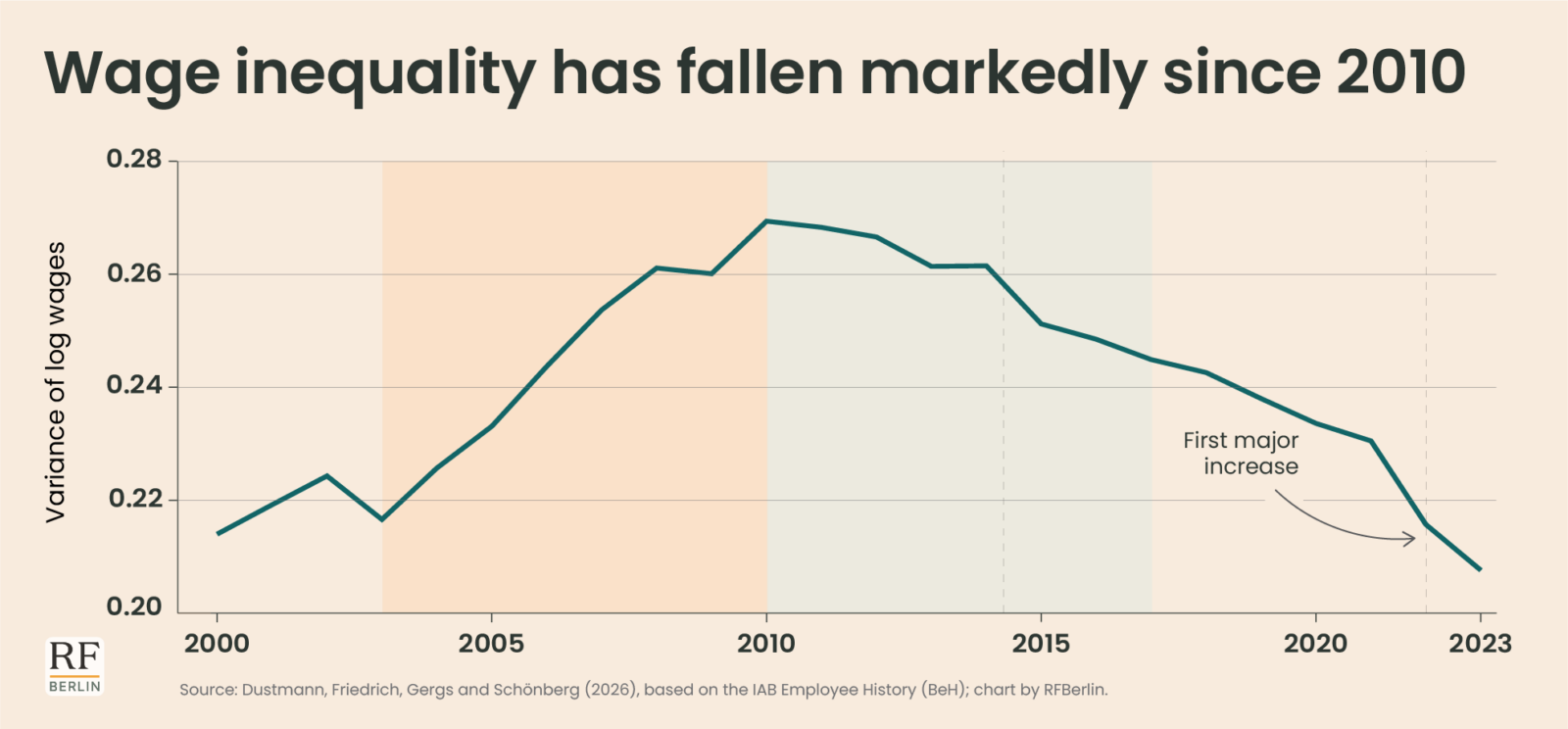
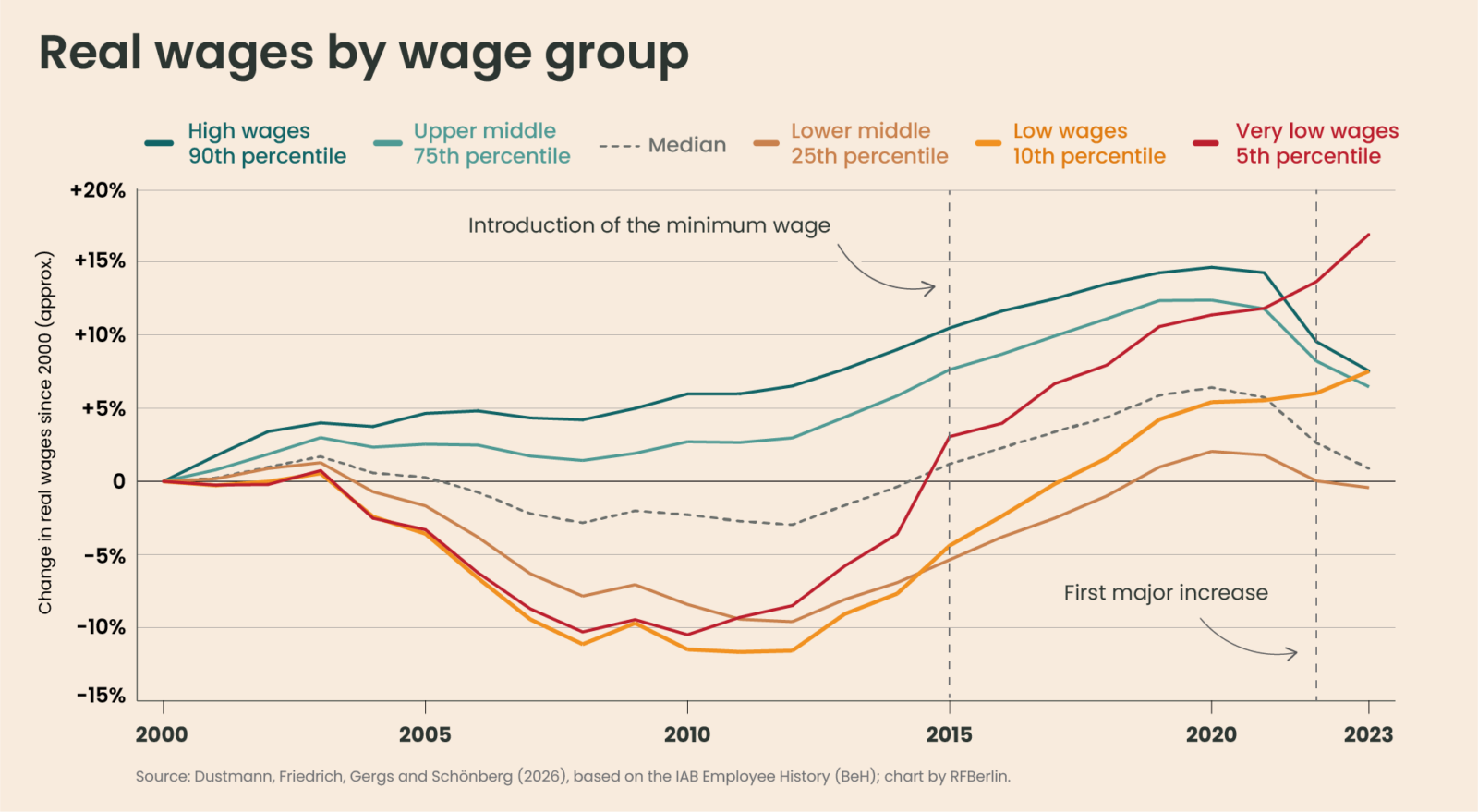
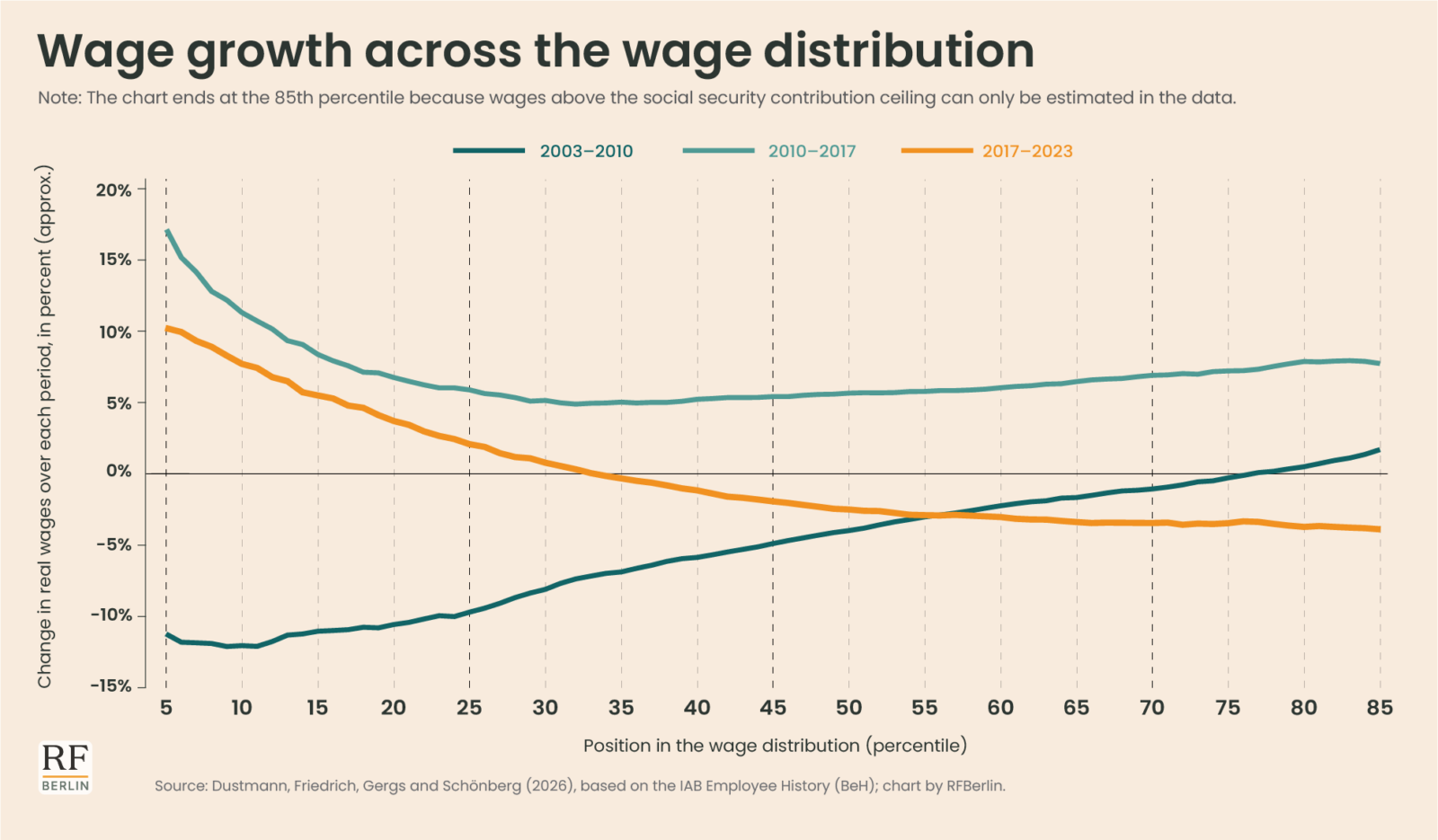
Figure 1. Wage inequality in Germany. Overall wage dispersion rose through the 2000s and began to fall around 2010. Wage growth after 2010 was strongest toward the bottom of the distribution. The vertical lines mark the introduction of the statutory minimum wage in 2015 and its first major increase in 2022. Source: IAB Employee History (BeH), version 10_08_00. RFBerlin’s own illustration based on Dustmann, Friedrich, Gergs and Schönberg (2026).
What changed in the labour market?
The key change was a sharp rise in labour market tightness: the number of vacancies relative to the number of jobseekers. Unemployment had already been falling since the mid-2000s, but the ratio of vacancies to jobseekers changed much more dramatically after the Great Recession. It more than tripled between 2010 and 2019.
Our paper links this tightening mainly to stronger labour demand. Growth became less export-led and more driven by domestic consumption. Private consumption accounted for nearly 40% of real GDP growth between 2010 and 2017, compared with around 25% between 2003 and 2010. Construction also expanded. Both developments raised demand in sectors that employ relatively many people without a university degree. While demographic change contributed to tighter labour markets, immigration more than offset the decline in the domestic working-age population.
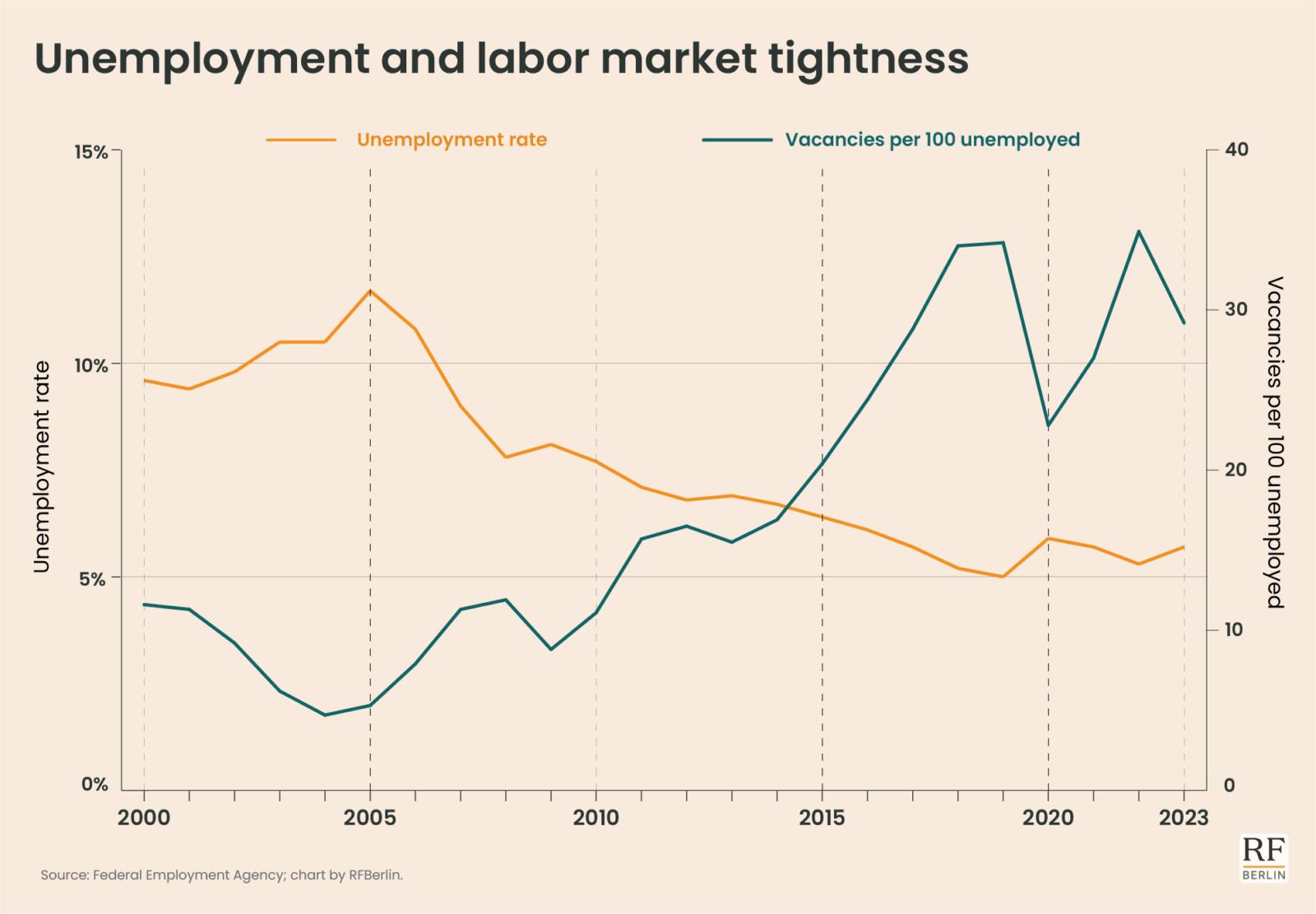
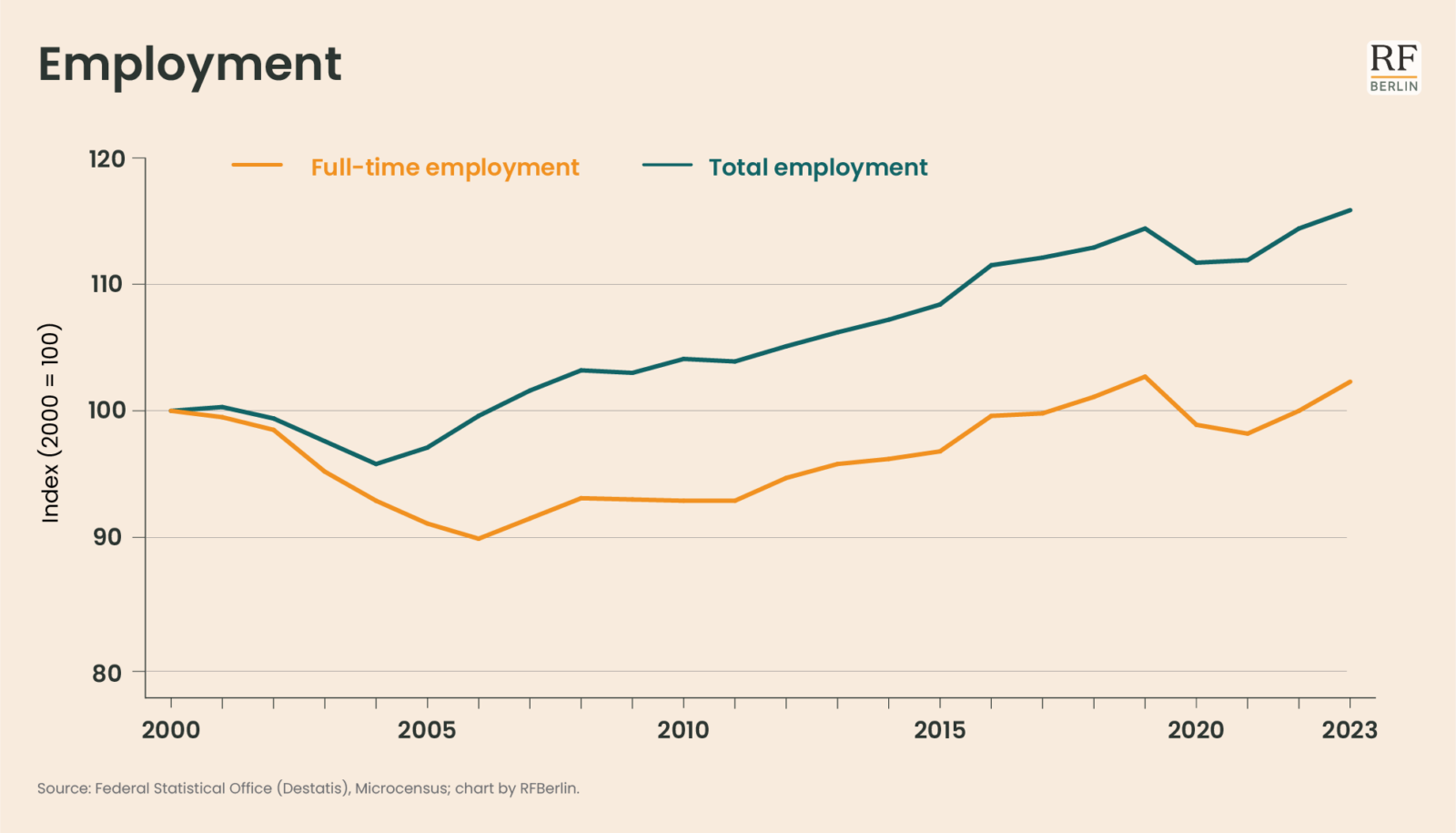
Figure 2. Germany’s labour market became much tighter after the Great Recession. The unemployment rate fell while vacancies relative to unemployment rose sharply after 2010. Employment also expanded strongly. Sources: Own analysis of data from the Federal Employment Agency and the Federal Statistical Office (Destatis). RFBerlin’s own illustration.
Why did tighter labour markets compress wages?
The first mechanism is the job ladder. When vacancies are plentiful, workers receive more outside offers. Those opportunities matter most for people near the bottom of the wage distribution because they have more room to move up to a better job. At the regional level, increased tightness is associated with a higher probability that a worker in the bottom quartile of the wage distribution changes jobs. For workers at the top of the wage distribution, the relationship is much weaker.
After 2010, job-to-job transitions increased particularly among workers below the 40th percentile. Wage growth also rose more for people who changed employers than for those who stayed. Job switchers from the lower part of the distribution increasingly moved to firms paying higher wage premia.
This reallocation changed the firm component of wages. Differences in firm wage premia narrowed: their variance fell from 0.051 in 2003–2010 to 0.043 in 2010–2017. The share of residual wage variance attributable to firm effects fell from 22% to 17%. Before the recession, workers had tended to move towards lower-paying firms; from 2010 onwards, workers increasingly moved up the job ladder. At the same time, low-wage workers now had better chances than before of finding a job at better-paying firms.
Tighter labour markets also affected the return to education, the wage gap between workers with higher and lower education. It rose from roughly 40% to 43% between 2003 and 2010, then fell by about five percentage points by 2019. Two factors contributed: after 2010, lower-skilled workers no longer drifted towards lower-paying firms, and demand for highly skilled workers grew more slowly than before, partly because construction and domestic consumption gained in importance.
Finally, tighter labour markets strengthened workers’ bargaining position. When outside offers become easier to obtain, firms find it harder to retain workers while paying them substantially below their productivity. We estimate that job-to-job separations became more responsive to wages after the Great Recession. As a result, wage markdowns relative to productivity fell from 36% to 27%.
What about the minimum wage?
Our study does not conclude that the minimum wage was negligible. Its introduction in 2015 produced a clear additional compression at the very bottom of the distribution: the gap between the median and the 5th percentile fell sharply. But there was no comparable break at the 15th or 20th percentiles, where compression continued smoothly. And the wider reversal had already started around 2010. We therefore argue that rising labour market tightness was the dominant force behind the broad post-recession decline in lower-half wage inequality, while the minimum wage reinforced this ongoing trend at the very bottom.
Conclusion
The German experience highlights a mechanism through which macroeconomic conditions can shape inequality. When labour demand is strong and vacancies are plentiful, lower-paid workers can gain not only because firms raise wages, but above all because they can more easily find better alternatives and move to better-paying employers. This can compress the wage distribution even without major changes in wage-setting institutions such as the minimum wage. The data after 2019 show that the decline in inequality continued, but they should be interpreted more cautiously: the Covid-19 pandemic, Russia’s war of aggression against Ukraine, high inflation and large real minimum-wage increases all had a major impact on the German labour market, making it much harder to isolate the role of labour market tightness in those later years.
This distinction matters for current debates about labour shortages and demographic change. The tightening of the 2010s was primarily demand-driven. In the coming years, by contrast, population ageing could reduce the number of available workers. Our paper does not examine whether a supply-driven tightening will have the same effects. This is an important open question for future research.
References
Christian Dustmann, Martin Friedrich, Carl Gergs and Uta Schönberg (2026), Labor Market Tightness and the Reversal of Inequality Trends in Germany, RFBerlin Discussion Paper No. 307/26; forthcoming in the Quarterly Journal of Economics.
Dustmann, C., J. Ludsteck and U. Schönberg (2009), Revisiting the German Wage Structure, Quarterly Journal of Economics 124(2), 843–881.
