


Short summary
How do coworkers shape the careers of young workers? The answer is less straightforward than it may seem. High-performing colleagues can be a source of valuable on-the-job learning, but they may also be direct competitors for promotions, pay increases, or permanent positions. In our recent study (Cornelissen et al., 2025), using German data, we show that these opposing forces largely offset one another on average, making the overall effect of peer quality difficult to detect.
To disentangle these channels, we distinguish between two types of coworkers in a young untrained worker’s first job: those with whom they are likely to compete—other untrained entrants—and those on a different career path—workers who have completed apprenticeship training. The latter can generate knowledge spillovers while being less likely to compete for the same career opportunities. This distinction reveals a clearer pattern: high-quality trained coworkers improve long-term career outcomes, whereas high-quality untrained peers tend to hinder them through increased competition.
Key Findings
- A 20% increase in the quality of trained coworkers in a young, untrained worker’s first job leads to a 3.7% rise in earnings after five years.
- These gains persist for at least a decade, even after switching employers, and are especially pronounced in complex occupations, pointing to learning from coworkers as a key mechanism.
- High-performing untrained peers tend to reduce young workers’ earnings and increase their job-switching—particularly when they are at a similar career stage—suggesting competitive pressure as the driver.
- Relative rank within the peer group, as a proxy for competitiveness, strongly predicts long-term earnings.
- Men experience stronger spillover and competition effects than women.
Relevance Today
This research underscores that learning from coworkers can be a powerful driver of career growth—but these benefits may in some circumstances be offset by internal competition. To foster learning, employers should create environments where young employees engage closely with well-trained, experienced colleagues. This may require thoughtful adjustments to hybrid and remote work policies to ensure meaningful peer interaction.
Author Quote
“Coworkers play a dual role: they can pass on knowledge or compete for opportunity. By separating the effects of learning from those of competition, we uncover how early workplace dynamics leave lasting marks on career trajectories. This has important implication in how workplace design can shape equitable and effective career development.”
Reference: Based on Knowledge Spillovers, Competition, and Individual Careers, RFBerlin Discussion Paper No. 80/25; forthcoming at the American Economic Review
Research summary
Economists widely recognize that learning on the job is a key driver of skill development, boosting productivity and long-term career prospects. Yet we know surprisingly little about how these skills are formed within firms—and in particular whether coworkers play a meaningful role. If peer learning is important, investments in training and education may generate broader benefits, extending beyond the individual to their colleagues. While the idea of knowledge spillovers between employees is well established, evidence on their magnitude remains mixed.
Research Context and Challenges in Identifying Coworker Peer Effects
To study this question, we use detailed German social security data to identify young labor market entrants with low formal qualifications—specifically, workers without an apprenticeship or university degree. These “untrained” workers, at the start of their careers, are likely to benefit from working alongside more knowledgeable colleagues. The data allow us to track career paths over time and measure the quality of coworkers in workers’ first jobs—those in the same occupation and workplace. This enables us to examine whether early exposure to higher-quality peers improves long-term outcomes.
Even with rich data, identifying causal peer effects is challenging. Workers with stronger colleagues may simply be employed in better firms, reflecting sorting rather than learning. In such cases, better outcomes may reflect individual ability rather than peer influence. Our empirical strategy addresses this sorting bias by approximating a setting in which labor market entrants are randomly assigned to peer groups of differing coworker quality.
A second challenge arises from workplace competition. High-performing peers may improve learning opportunities but also reduce advancement prospects through competition for promotions, wages, or retention. This aspect has been largely overlooked in the literature that seeks to identify knowledge spillovers at the workplace. However, ignoring this channel can obscure the effects of peer learning. A central contribution of our study is to account for both mechanisms.
We exploit a key feature of the German labor market: some young workers enter employment directly, while others first complete firm-based apprenticeship training. We refer to these groups as “untrained” and “trained” workers. Although they often work side by side, they follow different career paths. This allows untrained workers to learn from trained colleagues without directly competing with them, while interactions among untrained workers are more likely to involve competition.
How Peer Learning and Competition Shape Careers
When we consider overall coworker quality, we find no clear effect on long-term outcomes. However, distinguishing between trained and untrained peers reveals a stark contrast. Untrained workers benefit from exposure to high-quality trained coworkers but are negatively affected by high-quality untrained peers. This pattern is particularly pronounced in complex occupations, where learning opportunities are greater.
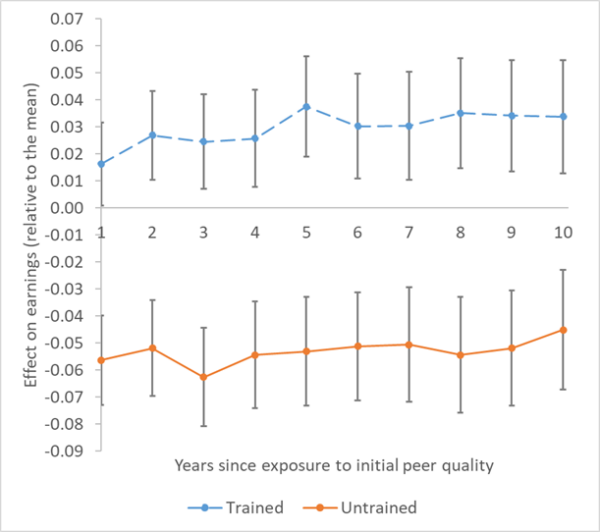
Figure 1 illustrates these effects. Exposure to higher-quality trained peers increases earnings by 3.7% after five years, while exposure to higher-quality untrained peers reduces earnings by about 5%. These effects persist over the ten-year follow-up period. The negative impact of untrained peers likely reflects competition for similar roles, whereas the positive effect of trained peers is consistent with learning.
Figure 1: The Effects of the Quality of Trained and Untrained Peers in the First Job on Earnings Over Time (Complex Occupations)
Dissecting the Competition Effect
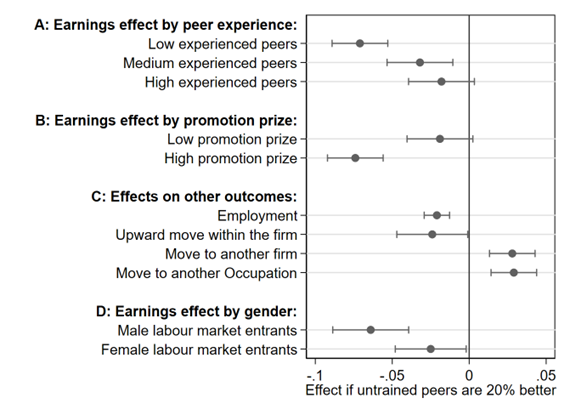
Focusing on outcomes five years after entry, Figure 2 shows how the negative impact of high-quality untrained peers varies across workplace conditions:
- Peer experience: The effect is strongest when peers have low experience, indicating direct competition among workers at similar career stages.
- Promotion incentives: The negative effect increases when the gains from promotion are larger.
- Career outcomes: High-quality untrained peers reduce retention and advancement and increase job mobility, consistent with competitive pressure.
- Gender differences: The negative effects are stronger for men than for women, consistent with differences in competitive behavior and career dynamics.
Together, these patterns support the interpretation that the negative effects reflect competition.
Figure 2: Variation in the spillover effects from untrained peer quality
Dissecting the Knowledge Spillover Effect
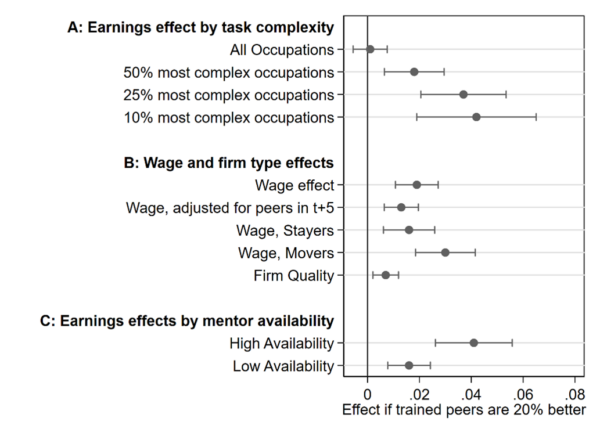
Figure 3 examines how the positive impact of trained peers varies across settings:
- Task complexity: Effects are strongest in complex occupations, where learning opportunities are greater.
- Wages and firm outcomes: Exposure to high-quality trained peers increases wages and improves access to better firms, even after accounting for current coworkers. These gains persist for both movers and stayers, consistent with lasting skill accumulation.
- Mentor availability: Effects are larger when more experienced trained coworkers are present, reinforcing the learning interpretation.
These findings point to knowledge spillovers as the mechanism behind the positive effects of trained peers.
When we examine gender differences, we find that men and women who remain with their initial employer benefit similarly from knowledge spillovers. Among workers who switch firms, however, only men see additional gains, as exposure to high-quality peers is more likely to help them move to better-paying firms.
Figure 3: Variation in the spillover effects from trained peer quality
Conclusions and Implications
Our findings show that knowledge spillovers can be offset by peer competition. Among untrained workers, exposure to high-performing coworkers has no average effect on earnings, but this masks opposing forces: competition among untrained peers reduces earnings, while learning from trained peers increases them. These effects are strongest among similarly positioned workers and in more complex occupations.
The results also suggest that apprenticeship training generates positive externalities through knowledge spillovers, implying that its social returns may exceed private returns. Ignoring these spillovers may lead to underestimation of the benefits of vocational training.
Finally, the findings shed light on gender differences in competition. Men are more affected by competitive pressures, consistent with evidence from experimental settings, suggesting that such differences play an important role in shaping labor market outcomes. Men also benefit more from knowledge spillovers, as these translate into upward mobility to higher-quality firms for men but much less so for women.
References
Cornelissen, Thomas, Christian Dustmann, and Uta Schönberg (2017): Peer effects in the workplace. American Economic Review 107 (2), 425-456.
Cornelissen, Thomas, Christian Dustmann, and Uta Schönberg (2025): Knowledge Spillovers, Competition, and Individual Careers. RFBerlin Discussion Paper No. 80/25, forthcoming at the American Economic Review.
Herbst, Daniel, and Alexandre Mas (2009): Peer effects on worker output in the laboratory generalize to the field. Science 350 (6260), 545-549.
Kandel, Eugene, and Edward P. Lazear (1992): Peer pressure and partnerships. Journal of Political Economy 100 (4), 801-817.
Mas, Alexandre, and Enrico Moretti (2009): Peers at work. American Economic Review 99 (1), 112-145.
Sandvik, Jason J., Richard E. Saouma, Nathan T. Seegert, and Christopher T. Stanton (2020): Workplace knowledge flows. The Quarterly Journal of Economics 135 (3), 1635-1680.
Waldinger, Fabian (2012): Peer effects in science: Evidence from the dismissal of scientists in Nazi Germany. The Review of Economic Studies 79 (2), 838-861.
Disclaimer
The opinions and views expressed in this publication are those of the author(s) and do not necessarily reflect those of the ROCKWOOL Foundation Berlin (RFBerlin). While research disseminated through this series may address policy-relevant topics, RFBerlin, as an independent research institute, does not take institutional policy positions.
Publications in the RFBerlin Research Insights series may represent preliminary or ongoing work that has not been peer-reviewed. Readers are advised to consider the provisional nature of such research when citing or applying its findings.
These publications aim to make scientific work accessible to a broader audience and to encourage informed, research-based discussion. All materials are provided by the respective authors, who bear responsibility for appropriate attribution and rights clearance. While every effort has been made to ensure accuracy and proper acknowledgment, RFBerlin welcomes notifications of any concerns regarding authorship, citation, or intellectual property rights. Please contact RFBerlin to request corrections if needed.
Use of these materials for the development or training of artificial intelligence systems is strictly prohibited.
