



New evidence from Chile shows that concerns about balancing career and family help explain the gender earnings gap among college graduates.
Short Summary
Men and women tend to choose different college majors. These choices have long-term consequences not only for earnings, but also for family formation and career trajectories. Women remain underrepresented in high-paying fields such as Engineering, while they are overrepresented in fields associated with greater career stability and higher fertility such as Teaching. Our research provides novel evidence that college majors affect fertility more than a decade after students apply to college, in addition to their well-known impacts on earnings. Combining information on students’ preferred majors with our estimates of how different majors affect earnings and fertility, we show that gender differences in the valuation of the earnings–fertility trade-off explain roughly 30 percent of the gender earnings gap among college graduates. Finally, we examine how alternative college admissions policies, including gender quotas and expanding capacity in high-demand programs, would affect these outcomes. Our results suggest that gender quotas can help to reduce gender earnings gaps while having little effect on aggregate earnings or fertility.
Key Findings
- College majors have large and widely varying effects not only on earnings, but also on fertility.
- Gender differences in priorities over earnings and fertility account for a sizable share of the gender earnings gap among college graduates.
- Gender-targeted admissions policies can reduce representation and earnings gaps.
Relevance Today
Many countries are trying to increase female representation in STEM careers and other high-paying professions. At the same time, policymakers are increasingly concerned about declining fertility and work-family balance. Our findings suggest that these issues are closely connected. Educational choices influence not only future wages, but also the types of careers and family trajectories students expect to have, with broader implications for a range of policy-relevant outcomes and gender gaps.
Author Quote
“Students are not only choosing future salaries when they select a major. They are also choosing different career paths, work environments, and ways of combining work and family life.”
Reference: Christopher Campos, Pablo Muñoz, Alonso Bucarey, and Dante Contreras. “College Major Choice, Payoffs, and Gender Gaps” (RFBerlin Discussion Paper Series 024/26. January 2026.)
Research Summary
Why are women underrepresented in some of the highest-paying occupations and industries? Part of the answer may emerge long before workers enter the labor market, when students decide what to study in college. In new research using data from Chile, we estimate how college majors affect both labor market earnings and fertility. We find that differences in major choice explain a large share of the gender earnings gap among college graduates, and that the weight men and women place on balancing career and family is an important determinant of these educational choices.
Figure 1 shows the basic pattern that motivates our research: men and women sort into very different fields of study, and some of the highest-paying fields such as Engineering and Science remain disproportionately male. The figure also shows that fields differ in family-related outcomes: graduates from some majors, such as Teaching and Health, are more likely to have children by their early thirties, while graduates from other fields, such as Law and Humanities, are less likely to do so.
Figure 1: Graduation, Earnings and Fertility
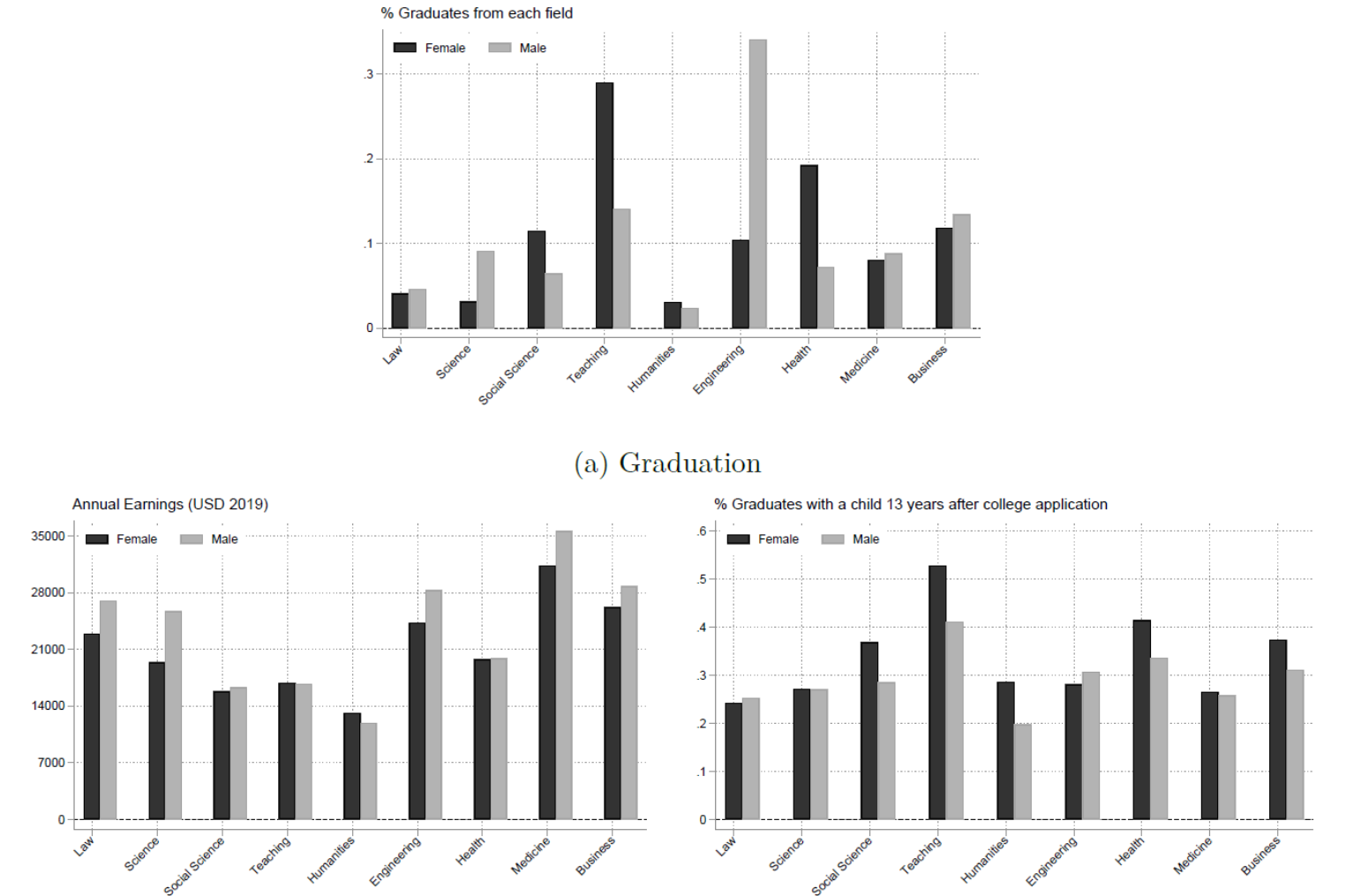
Notes: Panel (a) shows the share of male and female graduates in each field of study. Panel (b) shows the annual earnings of male and female graduates in each field of study. Panel (c) shows the share of students with at least one child thirteen years after their college application. All panels consider students who applied through the centralized admission system in Chile between 2004 and 2007.
These patterns raise an important question: Do college majors themselves shape later-life outcomes, or do they simply reflect differences among the students who choose them? Students who study Engineering, for example, may differ from Teaching students long before college begins. Chile’s centralized admission system helps us address this problem. Students submit rank-ordered lists of majors, and admission depends heavily on cutoff scores and seat availability. As a result, students with very similar backgrounds and preferences can end up in different fields of study for reasons that are partly outside of their control. Combining this feature of the admission system with detailed information on students’ preferences, degree completion, labor market earnings, and fertility allow us to estimate how different majors causally shape adulthood outcomes.
We find significant differences across majors. Graduates from Medicine, Engineering, and Business experience the highest earnings payoffs. The differences are large enough that they explain an important share of inequality among college graduates. But the differences across majors are not only monetary. Fields of study also differ sharply in their relationship with fertility. Some majors are associated with earlier and higher fertility, while others are associated with delayed childbearing and lower fertility rates in the early thirties. For example, graduates from Teaching and Health tend to have children earlier than graduates from Law. These patterns are consistent with additional evidence we document: fields associated with higher fertility tend to lead to careers with greater work-family compatibility, including more stable employment, smaller child penalties, and more progressive gender norms.
With gender-specific causal estimates of how majors affect earnings and fertility timing, we can examine whether men and women place different weight on these tradeoffs when choosing college majors. Using students’ reported preferences together with our estimates of the earnings and fertility returns to different majors, we show that both men and women respond to expected earnings. However, women place greater weight on how different careers may affect fertility, suggesting that career-family considerations play a more important role in major choice for women than for men. This distinction helps explain persistent gender differences in major choice. Some careers offer higher salaries but involve greater penalties for career interruptions or less predictable schedules. Others provide more stability and flexibility but lower earnings. Students appear to understand these differences and incorporate them into their educational decisions long before entering the labor market. As a consequence, women remain underrepresented in high-paying fields while they are overrepresented in fields associated with greater career stability and higher fertility. Our results suggest that these differences in preferences explain roughly 30 percent of the gender earnings gap among college graduates.
What can policy do? Using our estimates and the algorithmic structure of Chile’s centralized college admissions system, we evaluate how alternative admission policies could affect representation and inequality. One option is to simply increase the number of seats in Engineering and other high-return fields. Another is to reserve part of those seats for women. Our results suggest that broad expansions alone improve overall access but do little to reduce gender inequality because men and women apply to these programs at different rates. In some cases, these expansions may even widen earnings gaps. By contrast, targeted admissions policies for women can substantially reduce representation gaps and have the potential to reduce earnings inequality with small impacts on aggregate earnings or fertility
Conclusion
Educational choices are often viewed as investments in future earnings. Our findings suggest they are also linked to expectations about work-family balance. Understanding gender inequality therefore requires looking not only at labor market conditions after graduation, but also at how the educational system can shape career paths before working lives begin.
