



How Italy’s 2014 public-sector wage cap reshaped careers and talent allocation
Salary caps for public-sector workers are a popular policy in many countries. While these caps can contribute to fiscal savings, many argue that they also undermine the efficiency of public-sector organizations by driving talented workers away.
When Italy capped public salaries at €240,000 in 2014, the top executives of state-owned companies became more likely to leave for the private sector. Exits were concentrated among high-ability managers, reducing average managerial quality by about 2%.
Managers in more traditional public administration roles, who had fewer job opportunities outside of the public sector, largely stayed and faced substantial pay cuts.
Key Findings
- Public managers subject to the wage cap were 5 percentage points more likely to move to the private sector than comparable managers below the cap.
- This effect was especially large among managers of state-owned companies, who had outside options in the private sector.
- Managers in traditional public administration roles stayed, despite large pay cuts.
- In state-owned companies, exits were concentrated among high-ability managers.
- We estimate a 2% decline in average managerial quality following the cap. Fiscal savings were modest, at 0.1% of annual public employment costs.
Relevance Today
Governments around the world often consider public employment downsizing measures, including limits on public-sector pay. Federal wages in the United States have traditionally been subject to caps, and many European countries have also imposed similar measures. This analysis highlights a key policy trade-off: salary caps reduce labor costs but may also undermine organizational performance in the public sector. It also shows that these effects depend crucially on the availability of outside job opportunities for public employees.
Author Quote
“Salary caps may seem an effective policy tool to cut public expenditure, but our evidence shows that they can backfire. By pushing the best managers into the private sector, salary caps may weaken managerial quality, especially in state-owned companies, while leading to limited fiscal savings.”
Reference: Based on RFBerlin Discussion Paper No. 235/26: Edoardo Di Porto, Christian Dustmann, Chiara Giannetto, Lorenzo Incoronato(2026): Public Sector Salary Caps and the Careers of Public Managers
Research Summary
Should governments cap the pay of top public executives? While many countries today set limits on public-sector salaries, little is known about how these policies impact the careers of public managers and the efficiency of public organizations. Our recent study (Di Porto, Dustmann, Giannetto, and Incoronato, 2026) brings new evidence from Italy, where a 2014 reform lowered the ceiling on public managers’ pay. The policy led to modest fiscal savings, but it drove many high-ability managers away from state-owned companies and into private-sector firms, reducing the overall quality of public management. In more traditional public administration roles, with no obvious counterpart in the private sector, managers stayed and absorbed sizable pay cuts.
Public wage caps: very popular, still much to learn
In many advanced economies, governments limit the pay of senior public officials. While capping public wages can lead to budgetary savings, it may also induce the best managers – especially those who possess skills that are rewarded in the private sector – to leave public organizations, undermining performance and public service delivery. However, if public managers have limited alternative employment opportunities, salary caps may curb compensation with little effect on workforce composition or organizational performance. Yet there is little reliable evidence on the effects of these policies, largely due to a lack of detailed data on public employment.
A natural experiment in Italy in 2014
In May 2014, the Italian government imposed a €240,000 cap on the gross earnings of all public employees in Italy, claiming that “no public employee should earn more than the President of the Republic”. Only a small fraction of managers earned above the cap and were directly affected by it, with an average pay cut of almost €50,000. Using rich data from the Italian social security archives, we compare the careers of managers earning above the cap to the careers of similar managers earning below the cap, before and after the introduction of the cap in 2014. Crucially, we distinguish between managers employed in traditional public-sector organizations, such as public administration, health, or defense, and managers employed in state-owned companies operating in competitive industries, such as transport, finance, and communications. To study the consequences for the allocation of managerial talent, we use an established measure of individual ability from previous research.
Managers affected by the cap were more likely to leave, especially those with stronger private-sector opportunities
The reform had lasting effects on the career trajectories of public managers. Figure 1 shows the first key result. By 2020, public managers earning above the cap were about 5 percentage points more likely to have moved to the private sector than unaffected managers. In the paper, we show that the cap did not affect retirement probabilities for these managers.
Figure 1. Increased probability of moving to the private sector
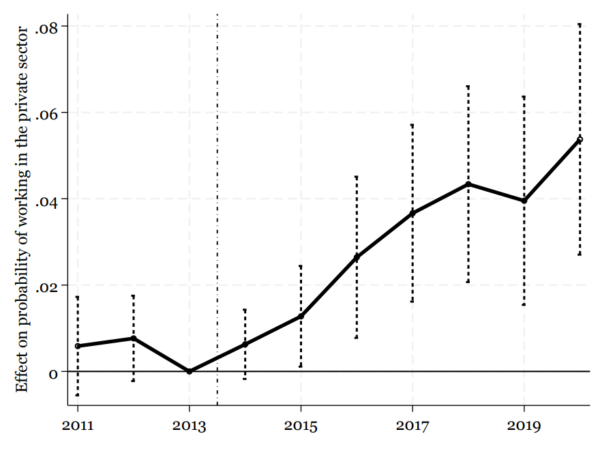
Notes: The figure displays coefficient estimates from event-study regressions comparing managers earning above the €240,000 wage cap in 2014 to managers earning below the €240,000 wage cap in 2014. Comparisons are made between managers of the same age, gender and prior private-sector experience. The regressions control for worker and year fixed effects, with standard errors clustered at the worker level. The vertical capped bars show 95% confidence intervals. The outcome is an indicator variable equal to one if the worker is employed in the private sector, conditional on being employed.
These effects were not uniform across public-sector executives. As shown in Figure 2, the propensity to leave public employment and move to private-sector firms was higher for managers in state-owned companies (dashed lines) than for managers in traditional public-sector roles (solid lines). More specifically, by 2020, managers of state-owned companies affected by the cap were about 11 percentage points more likely to work in the private sector, versus only 3 percentage points for managers in traditional public administration. This underscores the role of outside options. While managers in state-owned companies possess skills that are rewarded in the private sector, managers in traditional public administration – who often work in lawmaking, the judiciary, or administrative occupations with no obvious private-sector counterpart – face more limited alternative employment opportunities outside the public sector.
Figure 2. Heterogeneous impact across segments of the public sector
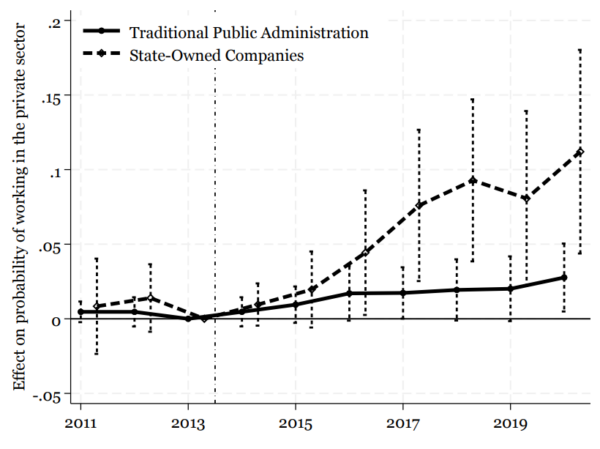
Notes: The figure displays coefficient estimates from event-study regressions comparing managers earning above the €240,000 wage cap in 2014 to managers earning below the €240,000 wage cap in 2014. Comparisons are made between managers of the same age, gender and prior private-sector experience. The regressions control for worker and year fixed effects, with standard errors clustered at the worker level. The vertical capped bars show 95% confidence intervals. The effects are estimated separately for the sample of managers in traditional public administration jobs (“Traditional Public Administration”, solid lines) and managers of state-owned companies (“State-Owned Companies”, dashed lines). The outcome is an indicator variable equal to one if the worker is employed in the private sector, conditional on being employed.
Impact on talent retention
Figure 3 focuses on managers of state-owned companies and shows that the most able among them were the ones more likely to leave. Using the individual-level ability proxies mentioned above, we separate the responses of managers with high ability (dashed lines) and low ability (solid lines). The increased propensity to move to private employers was especially pronounced among high-ability managers, who were about 15 percentage points more likely to work in the private sector by 2020 – more than twice the effect for low-ability managers. Moreover, state-owned companies did not succeed in hiring equally able replacements. These developments led to an estimated 2% decline in the average managerial quality of state-owned companies.
Figure 3. Exits concentrated among high-ability managers

Notes: The figure displays coefficient estimates from event-study regressions comparing managers earning above the €240,000 wage cap in 2014 to managers earning below the €240,000 wage cap in 2014. Comparisons are made between managers of the same age, gender and prior private-sector experience. The regressions control for worker and year fixed effects, with standard errors clustered at the worker level. The vertical capped bars show 95% confidence intervals. The effects are estimated separately for treated managers with above-median individual fixed effect (“High Ability”, dashed lines) and below-median individual fixed effect (“Low Ability”, solid lines). Individual fixed effects are estimated through AKM regressions. The matched control group remains the same as in the baseline analysis. The sample is restricted to managers of state-owned companies. The outcome is an indicator variable equal to one if the worker is employed in the private sector, conditional on being employed.
These losses in managerial quality were not compensated by large fiscal savings. The cut in public employment costs was modest at about €186 million cumulated between 2015 and 2020, or just 0.1% of the annual public wage bill.
Lessons for policy
In July 2025, the Italian Constitutional Court declared the 2014 cap unconstitutional, and a new threshold has been under debate since. Our analysis highlights a key trade-off for policymakers (in Italy and elsewhere) seeking to reduce public expenditure while preserving a highly performing public sector. While wage caps can contribute to cost savings, this study suggests that they may also undermine organizational performance by driving talented managers away. At the same time, the effects differ markedly across segments of the public sector. Managers in traditional public administration have relatively limited job opportunities outside the public sector and therefore respond little to reductions in pay. In such settings, salary caps may curb excess compensation with few adverse consequences for talent retention. By contrast, organizations operating in competitive markets face a much sharper trade-off between expenditure restraint and managerial quality.
Conclusion
Salary caps are a widely discussed policy tool to reduce the costs of public employment. Our study of Italy’s 2014 cap shows that they can indeed deliver some fiscal savings. However, these measures can also induce losses in the quality of public management, especially when private-sector alternatives are more readily available.
References
Di Porto, Edoardo, Dustmann, Christian, Giannetto, Chiara and Lorenzo Incoronato, (2026), Public Sector Salary Caps and the Careers of Public Managers, RFBerlin Discussion Paper 235/26.
