



Short summary
People who stay unemployed longer are much less likely to find a job—but why? Is it because long-term unemployed are fundamentally different people with poor employment prospects, or because employers and job seekers change their behavior with unemployment duration?
Using unique administrative data from Switzerland that tracks every job application, interview, and job offer of unemployed job seekers, this study shows that over 50% of the decline in job finding chances is caused by changing job seeker and employer behavior with unemployment duration, rather than by differences in who remains unemployed. The main driver is a sharp drop in job applications as unemployment lasts longer, reflecting growing worker discouragement. To a large extent, this discouragement stems from worsening the job opportunities, as employers increasingly discriminate against the long-term unemployed.
Key Findings
- Job finding rates fall sharply with unemployment duration: the probability of finding a job drops from about 7% per month early in unemployment to 4.5% after one year.
- Job applications decline with unemployment duration: after one year in unemployment, the average job seeker sends about 3 fewer applications per month (~25% fewer)—from 11 at the start of unemployment to 8.
- Interview chances fall with unemployment duration: the probability that an application leads to an interview declines from around 5% to 3.5%.
- Surprisingly, job offers per interview rise with duration: conditional on being interviewed, the chance of receiving an offer increase from about 20% to over 25% at longer durations.
- Our results show that more than half of the decline in job finding rates is due to changing job search and recruitment behavior with unemployment duration (duration dependence), with the remainder explained by the change in the composition of the unemployment pool (selection).
- Falling applications by job seekers are the main driver of “duration dependence”: as interview chances fall, many job seekers become discouraged and apply less partly because employers treat long unemployment as a negative signal (“statistical discrimination”).
Long-term unemployment remains a central policy concern across Europe and other industrialized countries. Our findings suggest that the standard policy approach based on retraining programs may miss a crucial mechanism: discouraged job seekers reduce applications due to employers’ reluctance to interview long-term unemployed workers. Job search assistance programs that better match applicant skills with vacancy requirements may be more effective than policies that target
Author Quote
“Most of the decline in job finding chances is not about who the unemployed are, but about how unemployment itself changes behavior of job seekers and recruiters. As recruiters become more reluctant to interview the long-term unemployed, workers respond by applying less — creating a self-reinforcing cycle of discouragement.”
Reference: Based on RFBerlin Discussion Paper 15/25, January 2026: Lalive, Osikominu, Pesaresi, Zuchuat and Zweimüller, Duration Dependence in Finding a Job: Applications, Interviews, and Job Offers.
Research summary
Why Unemployment Duration Matters
Across virtually all labor markets, one pattern is strikingly consistent: the longer people stay unemployed, the harder it becomes to find a job. Why does this happen?
One view emphasizes selection: those who remain unemployed longer are people with poor employment prospects to begin with–irrespective of unemployment duration. The opposing view stresses duration dependence: unemployment itself may worsen employment prospects, either through reduced applications by job seekers or fewer interviews and job offers by recruiters. Assessing the strength of these forces is crucial for designing effective policies to address long-term unemployment.
Our study opens the “black box” of the job finding process by tracking individual applications, interviews, and job offers month by month over an unemployment spell. Using uniquely detailed administrative data from Switzerland, it shows that most of the decline in job finding chances is driven by unemployment duration itself, not by selection on who remains unemployed.
The decline in job finding rates with unemployment duration is one of the most robust facts in labor economics. Yet interpreting this pattern is difficult because the unemployed population changes over time: some individuals exit quickly, while others remain unemployed for a long time.
Earlier studies draw on correspondence experiments, repeated surveys, and online job board data, but their conclusions are mixed (Kroft et al. (2013); Faberman and Kudlyak (2019), DellaVigna et al. (2022)). A key limitation of existing studies is their focus on only one side of the labor market or one stage of the job finding process. Our study addresses these gaps using monthly search diaries from Swiss public employment offices, covering 600,000 applications by around 15,000 job seekers.
What Happens as Unemployment Lasts Longer
Job seekers send out fewer applications. For an average job seeker, individual applications fall from around 11 per month at the start of unemployment to about 8 after one year—a decline of roughly 25%. This points to a genuine behavioral response: workers become discouraged.
Figure 1: Duration profile of applications
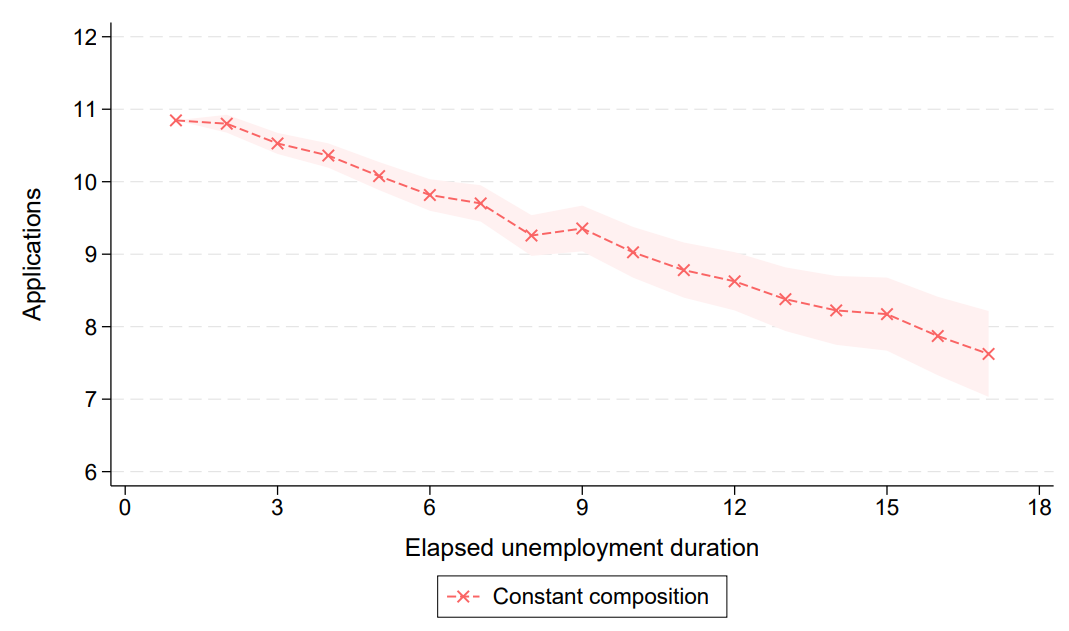
Note: The dashed line represents the average number of applications at each unemployment duration keeping the composition of the unemployment pool constant as in the first month of unemployment. The shaded area corresponds to the pointwise 90% confidence interval.
Employers send fewer interview invitations, but conditional on interviewing, they are more likely to make offers. Interviews per application decline sharply with duration, while job offers per interview rise. Most employers refrain from interviewing the long-term unemployed, but those who do are less demanding in terms of qualifications, so their interviews are more likely to result in a job offer.
Figure 2: Duration profile of employer responses
(a) Interviews per application (b) Job offers per interview
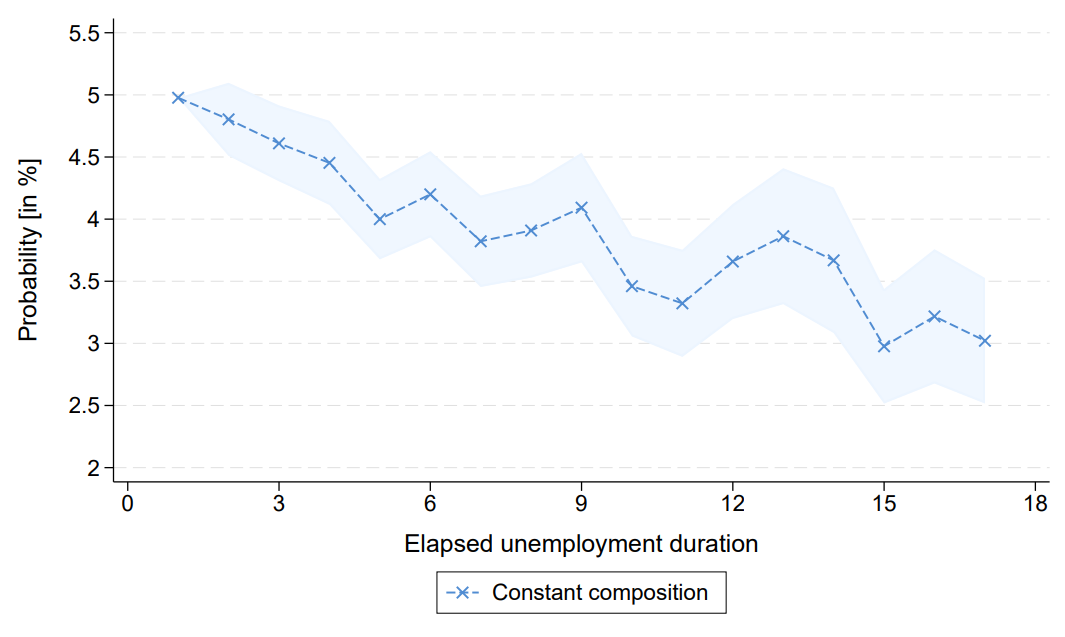
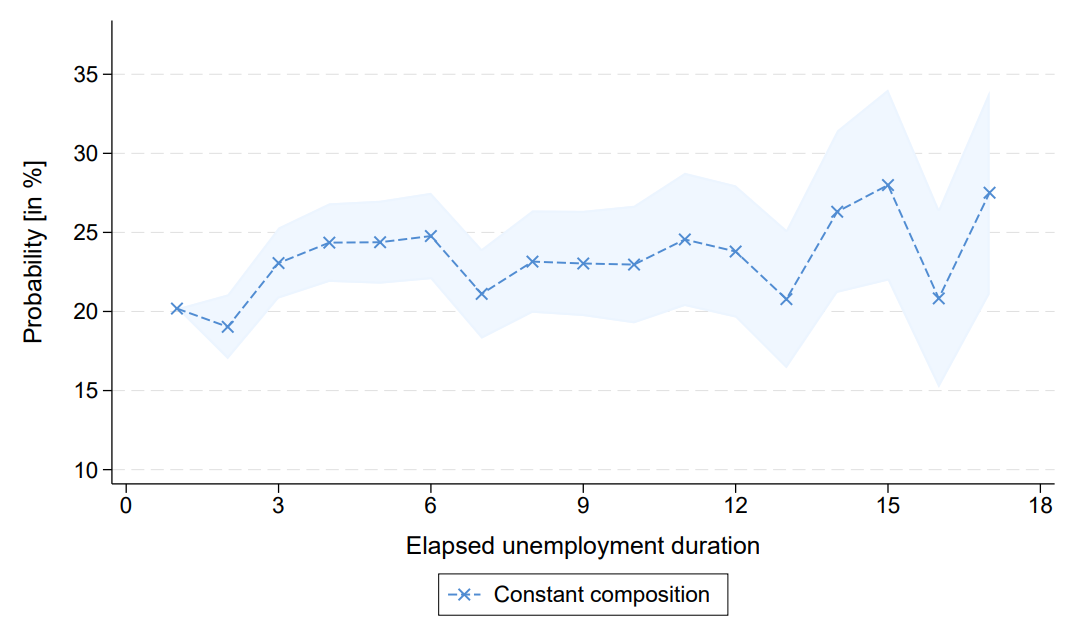
Note: In Panel a) the dashed line represents the average number of interviews per application for observationally equivalent job seekers at each unemployment duration.
In Panel b) the dashed line represents the average number of job offers per interview for observationally equivalent job seekers at each unemployment duration. The shaded areas correspond to the pointwise 90% confidence interval.
Decomposing the decline: duration dependence dominates. Our model shows that more than half of the decline in job finding rates is due to changing job search and recruitment behavior with unemployment duration (duration dependence). In turn, reduced applications by job seekers explains most of this effect (see Jarosch and Pilossoph (2019), Alvarez et al. (2023), and Mueller and Spinnewjin (2025) for similar decomposition exercises).
Figure 3: Duration profile of the job finding rate, decomposition
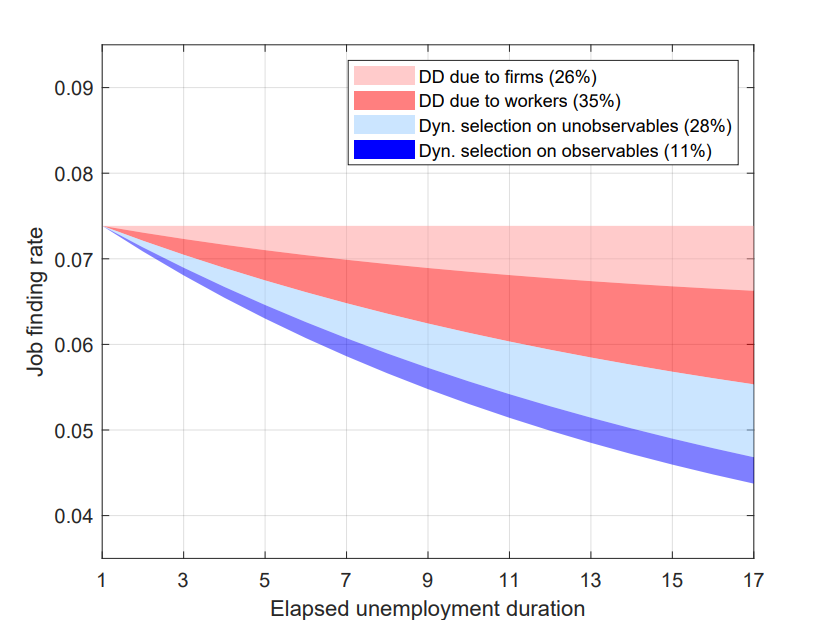
Note: This figure reports the decomposition of the duration profile of the job finding rate into the different sources of duration dependence (DD) and dynamic selection according to an estimated structural model with endogenous search effort and statistical discrimination.
Policy Implications
The problem isn’t just that workers get discouraged, it’s that employers lack information. Our results highlight the importance of job search assistance programs aimed at bridging the information gap between job seekers and potential employers. Lowering this “information asymmetry” is likely to increase job opportunities for the long-term unemployed and sustain their application effort. In this respect, a closer contact between public employment services and employers may be critical to prevent statistical discrimination against the long-term unemployed due to incomplete information.
Conclusion
Duration dependence plays a key role in shaping job finding prospects. The interaction between employers’ reluctance to interview the long-term unemployed and the resulting lower application effort by workers creates a self-reinforcing cycle of increasing discouragement. Job search assistance policies should aim to break this cycle.
An important avenue for future research is to examine more systematically why job applications decline with unemployment duration and whether job seekers adjust the types of vacancies they target over the course of an unemployment spell. Potential mechanisms include skill deterioration during unemployment–possibly linked to mental or physical health problems–as well as growing detachment from the labor market as professional or personal networks weaken.
References
Alvarez, F., Borovicková, K., and Shimer, R. (2023). Decomposing duration dependence in a stopping time model. The Review of Economic Studies, 91(6):3151–3189.
DellaVigna, S., Heining, J., Schmieder, J. F., and Trenkle, S. (2022). Evidence on job search models from a survey of unemployed workers in germany. The Quarterly Journal of Economics, 137(2):1181–1232.
Faberman, R. J. and Kudlyak, M. (2019). The intensity of job search and search dura-tion. American Economic Journal: Macroeconomics, 11(3):327–57.
Jarosch, G. and Pilossoph, L. (2019). Statistical discrimination and duration depen-dence in the job finding rate. The Review of Economic Studies, 86(4):1631–1665.
Kroft, K., Lange, F., and Notowidigdo, M. J. (2013). Duration dependence and labor market conditions: Evidence from a field experiment. The Quarterly Journal of Eco-nomics, 128(3):1123–1167.
Mueller, A. I. and Spinnewijn, J. (2025). The nature of long-term unemployment: Predictability, heterogeneity, and selection. Journal of Political Economy. Forthcoming.
Disclaimer
The opinions and views expressed in this publication are those of the author(s) and do not necessarily reflect those of the ROCKWOOL Foundation Berlin (RFBerlin). While research disseminated through this series may address policy-relevant topics, RFBerlin, as an independent research institute, does not take institutional policy positions.
Publications in the RFBerlin Research Insights series may represent preliminary or ongoing work that has not been peer-reviewed. Readers are advised to consider the provisional nature of such research when citing or applying its findings.
These publications aim to make scientific work accessible to a broader audience and to encourage informed, research-based discussion. All materials are provided by the respective authors, who bear responsibility for appropriate attribution and rights clearance. While every effort has been made to ensure accuracy and proper acknowledgment, RFBerlin welcomes notifications of any concerns regarding authorship, citation, or intellectual property rights. Please contact RFBerlin to request corrections if needed.
Use of these materials for the development or training of artificial intelligence systems is strictly prohibited.
